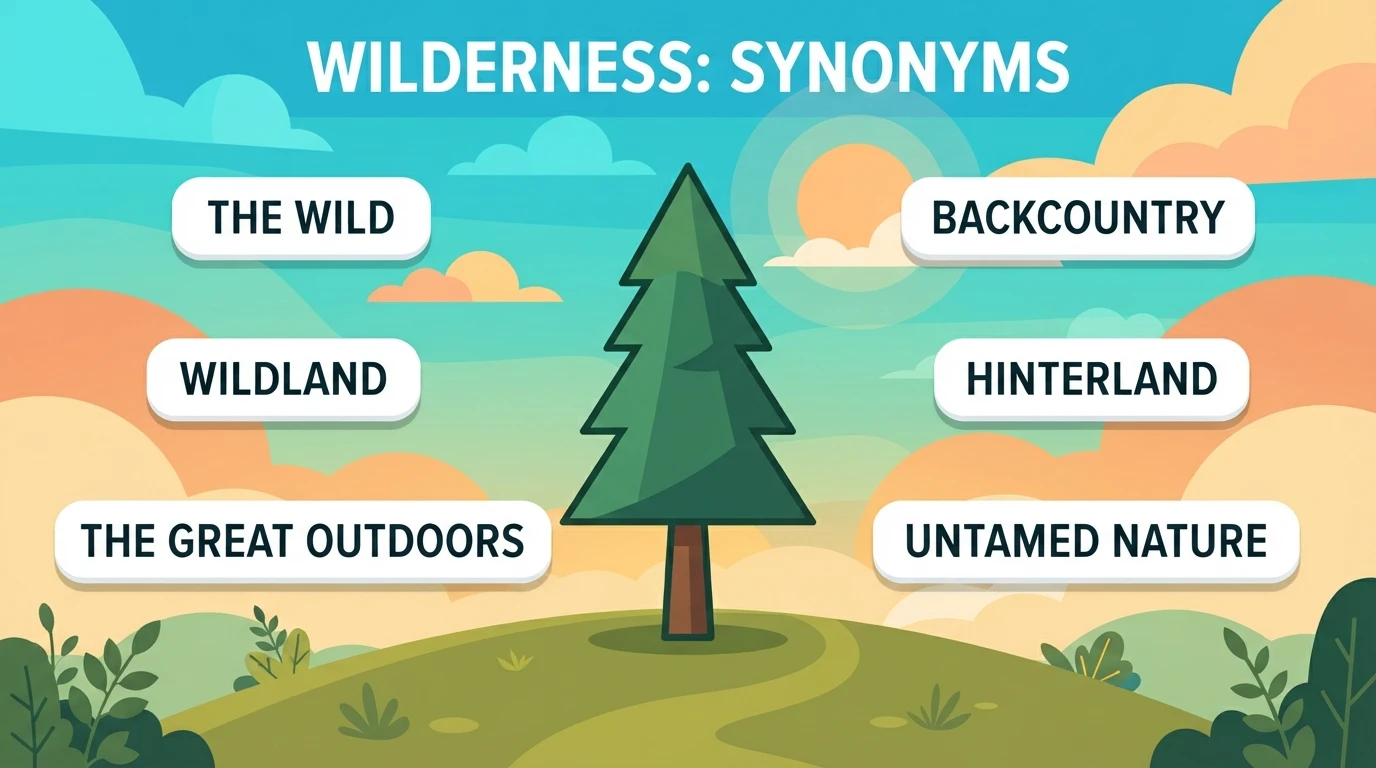
The best synonyms for wilderness include wild, wilds, backcountry, outback, and hinterland. Each word describes an uncultivated, largely uninhabited natural area, but they differ by region, formality, and the type of landscape they suggest, from dense forest to open desert.
Meaning of Wilderness
Wilderness is a noun referring to an area of land that remains in its natural state, largely untouched by human development, cultivation, or settlement.
It typically implies remoteness, ruggedness, and a lack of roads, buildings, or farmland. The word carries a sense of both danger and beauty, since wilderness areas are often praised for their untouched natural quality while also being associated with isolation and survival challenges.
Example: “The hikers spent three days deep in the wilderness without seeing another person.”
Wilderness can also be used more abstractly, referring to a period of obscurity or exile, as in “years spent in the political wilderness.” That figurative sense is worth knowing, since some synonyms below work only in the literal, geographic meaning.
Connotation and Nuance
Wilderness generally carries a positive or neutral tone in modern usage, often linked to conservation, adventure, and natural beauty.
Some near synonyms shift that tone. Words like wasteland or badlands suggest barrenness or hostility rather than untouched natural splendor. Others, like wilds, keep the same romantic, adventurous feeling as wilderness itself.
Understanding this emotional shading matters more than finding the longest possible list of alternatives.
Best Synonyms for Wilderness
These are the alternatives worth learning first, ranked by how naturally they replace wilderness in everyday writing.
Wild (used as a noun, often “the wild”)
The most direct and versatile alternative. Works in both casual and literary writing. Slightly more poetic than wilderness itself.
Wilds
Almost always plural. Sounds a bit more literary or dramatic than wilderness, often used to emphasize remoteness and danger.
Backcountry
Common in North American English, especially in outdoor recreation contexts like hiking, skiing, and camping. Implies remote terrain reached only on foot or by specialized vehicle.
Outback
Specific to Australia. Refers to the vast, sparsely populated interior of the country. Do not use this word for wilderness areas outside Australia.
Hinterland
A more formal, often geographic or journalistic term. Refers to remote land far from cities or coastlines, sometimes with a slightly technical tone.
25 Synonyms for Wilderness
Here are genuinely useful alternatives, grouped loosely by how closely they match the core meaning of wilderness.
- Wild
- Wilds
- Backcountry
- Outback (Australian context only)
- Hinterland
- Wildland
- Wild country
- Untamed land
- Uninhabited region
- Backwoods (informal)
- Boondocks (informal, American)
- Bush (used mainly in Australian and African English)
- Frontier (often historical or metaphorical)
- Open country
- Remote area
- Uncharted territory (mostly metaphorical)
- Virgin forest (specific to untouched woodland)
- Primeval forest (specific, ancient woodland)
- Badlands (specific, dry, eroded terrain)
- Wasteland (carries a barren, desolate tone)
- Scrubland (specific, low vegetation terrain)
- Moorland (specific, mainly British English)
- Tundra (specific, cold, treeless terrain)
- No man’s land (idiomatic, often implies conflict or contested space)
- Terra incognita (literary, means unexplored territory)
Not every word on this list means exactly the same thing as wilderness. Several describe a specific type of terrain rather than wilderness in general, which is why the next section matters just as much as the list itself.
Types of Synonyms for Wilderness
General alternatives: wild, wilds, wildland, untamed land. These work almost anywhere wilderness would work, with only minor tonal shifts.
Regional terms: outback (Australia), bush (Australia and parts of Africa), backcountry (North America). These are accurate only within their regional context and can sound odd or incorrect elsewhere.
Terrain specific terms: badlands, tundra, moorland, scrubland, virgin forest. These describe a particular kind of wild landscape, so they should replace wilderness only when that specific terrain applies.
Metaphorical or idiomatic terms: uncharted territory, no man’s land, terra incognita, frontier. These often describe unfamiliar or contested situations rather than literal wild land, so use them carefully depending on context.
Tonally shifted terms: wasteland. This implies desolation or barrenness, which is not always true of wilderness, so it should not be used as a neutral substitute.
Common Collocations and Natural Usage
Certain synonyms pair naturally with specific verbs and phrases, while others sound awkward in the same slots.
You “venture into the wilderness” and you “venture into the backcountry,” but you would rarely say “venture into the outback” unless specifically discussing Australia.
You “explore the wilds,” but “explore the hinterland” sounds more formal and fits better in journalism or academic writing than in casual conversation.
“Lost in the wilderness” works naturally, and so does “lost in the wild,” but “lost in the hinterland” sounds unusual, since hinterland typically describes a region rather than a place someone gets physically lost in.
Wilderness vs Similar Words
Wilderness vs wild: Wild often works better as part of a phrase, such as “the call of the wild,” while wilderness functions more naturally as a standalone noun describing a specific area.
Wilderness vs backcountry: Backcountry specifically implies terrain reached through hiking or off road travel, often for recreation. Wilderness is broader and does not require this recreational context.
Wilderness vs wasteland: Wasteland implies barrenness, ruin, or desolation, sometimes due to environmental damage or disaster. Wilderness implies natural, often thriving, untouched land, so these words are not interchangeable despite both suggesting remoteness.
Wilderness vs frontier: Frontier usually implies a boundary between settled and unsettled land, often with historical or expansionist connotations. Wilderness simply describes the untouched land itself, without necessarily implying a boundary.
How to Choose the Right Synonym
If you want a neutral, widely understood alternative, use wild or wilds.
If you are writing about outdoor recreation or hiking, backcountry fits naturally.
If your setting is specifically Australian, outback or bush will sound authentic, but avoid them elsewhere.
If you want a more formal or journalistic tone, hinterland works well.
If the terrain is specifically desert, forest, or tundra, choose the terrain specific word instead of a general synonym, since it will sound more precise and informed.
If you are writing metaphorically about unfamiliar territory rather than literal wild land, uncharted territory or frontier may fit better than wilderness itself.
Common Mistakes with Wilderness Synonyms
Mistake: Using “outback” for wilderness areas outside Australia.
Why it happens: Writers borrow the word because it sounds evocative, without realizing it refers to a specific place.
Mistake: Treating “wasteland” as a neutral synonym.
Why it happens: Both words suggest remoteness, but wasteland adds a negative, barren connotation that wilderness does not carry.
Mistake: Using “no man’s land” to describe peaceful, untouched nature.
Why it happens: The phrase sounds wild and remote, but it actually implies contested or dangerous territory, often with military origins.
Mistake: Applying “tundra” or “moorland” to any wild landscape.
Why it happens: These words sound descriptive and vivid, but they refer to very specific ecosystems and should not be used generally.
Antonyms of Wilderness
Genuine opposites of wilderness include civilization, city, urban area, settlement, and cultivated land. These describe developed, populated, or farmed areas, standing in direct contrast to untouched natural land.
Related Words
Habitat refers to the natural environment of a specific species, which is related to wilderness but not a true synonym, since habitat can exist even in developed or managed areas.
Ecosystem describes a biological community and its environment, a scientific term related to wilderness but broader and more technical in scope.
Frequently Asked Questions
What does wilderness mean?
Wilderness refers to a natural, largely uninhabited area untouched by human development, often associated with remoteness and rugged natural beauty.
What is another way to say wilderness?
Common alternatives include wild, wilds, backcountry, wildland, and untamed land, though the best choice depends on region and context.
What is the most formal synonym for wilderness?
Hinterland tends to sound the most formal, often appearing in journalism, geography, and academic writing.
Is outback the same as wilderness?
Not exactly. Outback specifically refers to the remote interior of Australia, while wilderness can describe any untouched natural area worldwide.
What is the difference between wilderness and wasteland?
Wilderness implies natural, often thriving land, while wasteland implies barren, desolate, or damaged land, giving the two words very different emotional tones.
What is the opposite of wilderness?
Civilization, urban area, and cultivated land all serve as accurate opposites, describing developed or populated spaces.
Can backcountry and wilderness be used interchangeably?
Often, yes, especially in outdoor recreation writing, though backcountry more specifically implies terrain reached through hiking, skiing, or off road travel.
Conclusion
Wilderness has plenty of strong alternatives, but few of them mean exactly the same thing in every context. Words like wild and wilds work almost anywhere, while outback, bush, and backcountry depend heavily on region. Others, like wasteland or no man’s land, shift the tone entirely.
Choosing the right synonym means thinking about geography, formality, and the specific type of terrain you are describing, not just picking the most dramatic sounding word available. Match the word to the landscape and the audience, and your writing will sound far more precise and natural.
Read More: Synonyms for Little Bit: 25 Useful Alternatives

Hi, I am Abid, a writer and editor at InstantSynonyms.com, where he creates clear and reader-friendly content about synonyms, vocabulary, and English word usage. His goal is to help readers choose the right words, expand their vocabulary, and write with greater confidence.