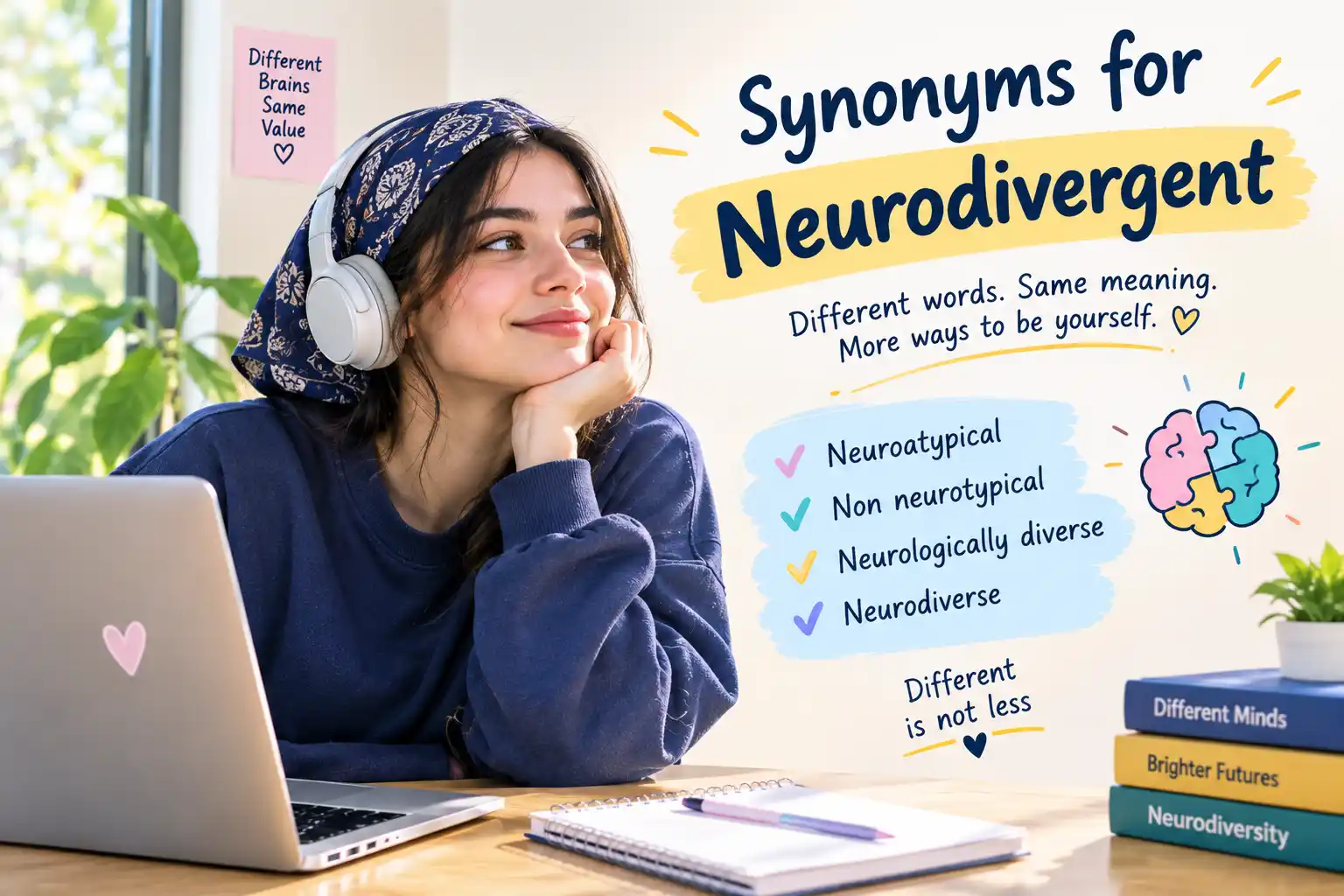
The closest alternatives to neurodivergent include neuroatypical, non neurotypical, and neurologically diverse. Neurodiverse is sometimes used the same way in casual speech, though it technically describes a group rather than a single person. There are very few true synonyms for this word, since it describes a specific identity rather than a general quality.
Meaning of Neurodivergent
Neurodivergent is an adjective describing a person whose brain processes information, learns, or experiences the world in ways that differ from what a given society currently treats as typical. It covers a wide range of neurological differences, including autism, ADHD, dyslexia, dyspraxia, dyscalculia, and Tourette syndrome, among others.
The word describes an individual. A person is neurodivergent. A group made up of people with different neurotypes, including both neurodivergent and neurotypical people, is neurodiverse. This distinction trips up many writers, and it is one of the most useful things to understand before choosing an alternative word at all.
Example: “She is neurodivergent and has found that noise cancelling headphones help her focus at work.”
Example: “The classroom included several neurodivergent students, each with different learning needs.”
The word is deliberately broad. It does not point to a single condition or a single experience. Instead, it groups together many different neurological profiles under one shared idea: that these brains function outside whatever a particular culture currently treats as the default.
Connotation and Nuance
Neurodivergent carries a neutral to positive connotation within the neurodiversity movement, which frames neurological differences as natural variation rather than as deficits or disorders to be fixed. This is a meaningful shift away from older medical language that described these differences primarily in terms of what a person supposedly lacks.
Because this is an identity term for many people, word choice here matters more than it does for most vocabulary questions. Swapping in an outdated, deficit focused word, even one that once appeared in clinical writing, can feel dismissive or inaccurate to the very people the word describes. This article avoids suggesting words that frame neurodivergence as a flaw, since those are not accurate synonyms. They reflect an entirely different, and largely outdated, way of thinking about the same underlying trait.
This is part of why a thesaurus style approach falls short here. A standard thesaurus entry might list clinical sounding words as if they were simple stand ins, without acknowledging that many people who use these words about themselves have deliberately chosen them over older alternatives for very specific reasons.
The Origin of Neurodivergent
The related term neurodiversity is widely credited to sociologist Judy Singer, who explored the concept in her academic writing in the late 1990s, alongside journalist Harvey Blume, who helped bring the idea into wider public discussion around the same time. The specific word neurodivergent is often credited to autistic activist Kassiane Asasumasu, who coined it to describe individuals within the broader neurodiversity framework.
The terminology grew out of the autism rights and disability rights movements, which pushed back against language that treated neurological differences purely as medical problems. Instead, the neurodiversity framework describes these differences as part of natural human variation, similar to how we already accept variation in height, personality, or handedness without treating every difference as a disorder.
This history explains why the word carries real weight for many of the people it describes. It was not handed down by outside experts. It grew directly out of self advocacy, which is part of why so many neurodivergent people feel a genuine sense of ownership over the term itself.
Best Alternatives to Neurodivergent
1. Neuroatypical
Part of Speech: Adjective
Meaning: Having a neurological profile that differs from what is considered typical.
Best Use: Works as a close, direct alternative in most sentences where neurodivergent would otherwise appear.
Tone or Register: Neutral, used in both everyday and academic contexts, though somewhat less common than neurodivergent itself.
Difference: Neuroatypical is nearly identical in meaning to neurodivergent, though neurodivergent has become the more widely recognized and commonly used term, especially within advocacy and community spaces.
Examples: “Being neuroatypical means his brain simply processes sensory input differently than most people’s.” “The support group welcomes neuroatypical adults looking to connect with others who share similar experiences.” Many writers use neuroatypical and neurodivergent as true interchangeable equals, more so than with most other alternatives on this list.
2. Non Neurotypical
Part of Speech: Adjective phrase
Meaning: Not fitting the neurological patterns considered standard or typical by current societal norms.
Best Use: Useful in academic or clinical writing that wants to define a term directly in relation to its opposite, neurotypical.
Tone or Register: Neutral to formal, more common in academic or research contexts than in everyday conversation.
Difference: This phrase defines the concept by contrast rather than through its own dedicated word, which makes it slightly more clinical sounding than neurodivergent or neuroatypical.
Examples: “The study compared communication styles between neurotypical and non neurotypical participants.” “Non neurotypical employees may benefit from flexible scheduling and sensory friendly workspaces.”
3. Neurologically Diverse
Part of Speech: Adjective phrase
Meaning: Having a neurological makeup that differs from typical patterns, used to describe either an individual or a group.
Best Use: Works well in more formal or explanatory writing, especially when spelling out the full phrase adds clarity for readers unfamiliar with the shorter terms.
Tone or Register: Neutral to formal.
Difference: This phrase can describe both individuals and groups, unlike neurodivergent, which more precisely applies to a single person.
Examples: “The company created a hiring initiative specifically for neurologically diverse candidates.” “Understanding neurologically diverse communication styles has improved how our team runs meetings.”
Why This Word Has So Few True Synonyms
Most words in English have a healthy list of interchangeable alternatives. Neurodivergent does not, and that is worth explaining rather than working around. It is a specific, community defined identity term tied closely to a particular history and framework, not a general descriptive word like happy or important.
Older clinical language exists that once covered some of the same territory, but those words carry a fundamentally different meaning. They describe difference as disorder, deficiency, or abnormality, while neurodivergent describes difference as simply that: difference. Presenting those older terms as synonyms would misrepresent both the word and the people it describes, so this guide leaves them out entirely.
Neurodivergent vs Similar Words
Neurodivergent vs Neurodiverse: Neurodivergent describes an individual person. Neurodiverse technically describes a group containing a mix of neurotypes, such as a classroom, workplace, or community. In casual conversation, people sometimes use neurodiverse to describe a single person, but the more precise and increasingly standard usage reserves neurodiverse for groups.
Neurodivergent vs Neurotypical: These two words are opposites rather than synonyms. Neurotypical describes someone whose neurological functioning aligns with what a given society currently treats as standard or typical.
Neurodivergent vs Autistic, ADHD, or Dyslexic: These are not alternatives to neurodivergent. They are specific examples of neurodivergence. Someone who is autistic is neurodivergent, but not every neurodivergent person is autistic. Treating these specific terms as interchangeable with the broader word neurodivergent would be inaccurate.
Common Collocations and Natural Usage
Certain phrases appear naturally alongside neurodivergent and its closest alternatives:
neurodivergent individual, neurodivergent employee, neurodivergent friendly, identify as neurodivergent, neurodiverse team, neurodiverse classroom, neurotypical peers
Notice the pattern in these examples. Neurodivergent pairs naturally with words describing a single person, such as individual or employee, while neurodiverse pairs naturally with words describing a group, such as team or classroom. Keeping this pattern in mind is the single most useful habit for using these words correctly.
How to Choose the Right Word
If you are describing one specific person, use neurodivergent rather than neurodiverse.
If you are describing a mixed group of people with different neurotypes, use neurodiverse.
If you want a slightly less common but equally accurate alternative for an individual, use neuroatypical.
If you are writing in a more academic or clinical context that benefits from defining the term by contrast, use non neurotypical.
If your audience may be unfamiliar with shorter terms, consider spelling out neurologically diverse for extra clarity.
Avoid reaching for older, deficit centered clinical language as a stylistic substitute. It does not mean the same thing, and it can read as disrespectful to many readers.
Common Mistakes with Neurodivergent
Mistake: Using neurodiverse to describe a single individual.
Correction: Use neurodivergent for one person, and reserve neurodiverse for a group made up of different neurotypes.
Mistake: Treating a specific diagnosis, such as autism or ADHD, as a general synonym for neurodivergent.
Correction: Specific conditions are examples of neurodivergence, not interchangeable substitutes for the broader term.
Mistake: Substituting outdated, deficit focused clinical language as though it means the same thing.
Correction: Modern identity language and older diagnostic language reflect different frameworks entirely. They are not accurate synonyms for one another.
Antonym of Neurodivergent
The clearest and most widely used antonym is neurotypical, describing someone whose neurological functioning matches what a given society currently considers standard.
Related Words
Autistic, ADHD, dyslexic, dyspraxic, and dyscalculic are specific examples of neurodivergence, each referring to a particular neurological profile rather than serving as a general synonym for the broader term. Neurodiversity, the related noun, refers to the overall concept of natural variation in human brains and minds, forming the wider framework that neurodivergent and neurotypical both belong to.
Frequently Asked Questions
Q: What does neurodivergent mean? A: Neurodivergent describes a person whose brain processes information, learns, or experiences the world differently from what is currently considered typical, including conditions like autism, ADHD, and dyslexia.
Q: What is another way to say neurodivergent? A: Close alternatives include neuroatypical, non neurotypical, and neurologically diverse, though genuinely interchangeable synonyms for this specific identity term are limited.
Q: Is neurodiverse the same as neurodivergent? A: Not exactly. Neurodivergent describes an individual, while neurodiverse technically describes a group containing a mix of different neurotypes.
Q: Is it respectful to use the word neurodivergent? A: Yes. Neurodivergent is widely used and generally considered respectful, especially compared to older, deficit focused clinical language. It remains good practice to listen for how an individual describes themselves and follow their lead.
Q: What is the opposite of neurodivergent? A: The standard antonym is neurotypical, describing someone whose neurological functioning matches typical societal patterns.
Q: Should I say a person is neurodivergent or a person with neurodivergence? A: Preferences vary by individual and community. Many people, especially within the autistic community, prefer identity first language such as neurodivergent person, though it is always best to follow a specific person’s own preference when known. Some people prefer person first phrasing instead, so asking directly is never a wrong move.
Q: How do I use neurodivergent in a sentence? A: Neurodivergent typically functions as an adjective before or after a noun, as in “a neurodivergent student” or “she identifies as neurodivergent.” It can also stand alone after a linking verb, as in “he is neurodivergent.”
Final Thoughts
Neurodivergent has very few true synonyms, and that is not a shortcoming of the English language. It reflects the fact that this word describes a specific, community rooted identity rather than a general quality with dozens of interchangeable options. Neuroatypical, non neurotypical, and neurologically diverse come closest, while neurodiverse remains useful specifically for describing groups rather than individuals.
The most important habit to build is precision rather than variety. Choosing the right word here means respecting both the meaning of the term and the people it describes, rather than reaching for older language simply for the sake of variation.
When you are unsure which word fits, the safest approach is often the simplest one. Use neurodivergent for a person, neurodiverse for a group, and let the person’s own preferred language guide you whenever you know it.
Read More: Synonyms for Incognito: 25 Alternatives for Every Context

Hi, I am Abid, a writer and editor at InstantSynonyms.com, where he creates clear and reader-friendly content about synonyms, vocabulary, and English word usage. His goal is to help readers choose the right words, expand their vocabulary, and write with greater confidence.