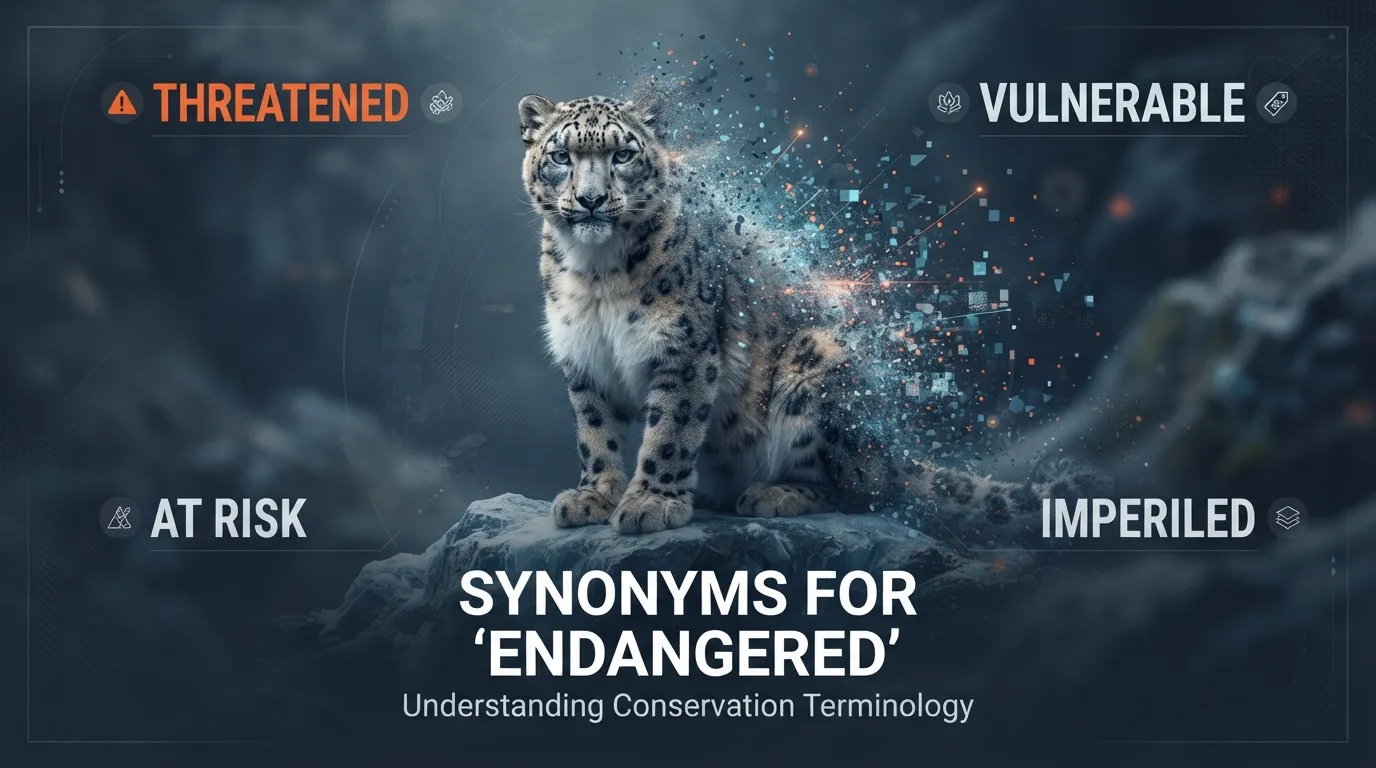
Endangered means at serious risk of harm, decline, or extinction. In conservation writing, threatened and vulnerable are the most precise alternatives, each marking a distinct, official risk level below endangered. In general writing about people, plans, or institutions, at risk, imperiled, and in jeopardy work naturally as substitutes, though none of them carry the same formal, scientific weight that endangered has when applied to a species.
Meaning of Endangered
Endangered is an adjective describing something or someone facing serious risk of harm, decline, or extinction. Its most specific and widely recognized use is in conservation science, where “endangered species” refers to a formal risk category assigned to animals or plants at high risk of extinction in the wild. Organizations such as the International Union for Conservation of Nature maintain official lists that classify species using this exact terminology, which means the word carries real technical weight in scientific and legal writing, not just descriptive color.
Beyond conservation, endangered describes any person, tradition, institution, or situation facing a serious threat to its continued existence. You might read about “an endangered language,” referring to one with few remaining speakers, or hear someone say their position at a company “felt endangered” after a round of layoffs. In this broader, more figurative use, the word still implies genuine risk rather than mild inconvenience or ordinary uncertainty. Something described as endangered is not simply unpopular or struggling a little; it is understood to be at real risk of disappearing altogether.
Grammatically, endangered functions almost exclusively as an adjective in modern English, most often placed directly before a noun, as in “an endangered species” or “an endangered tradition.” It can also follow a linking verb, as in “the species is endangered” or “her job felt endangered.” The word derives from the verb “to endanger,” meaning to put something in danger, and the adjective form describes the resulting state rather than the act itself.
Connotation and Nuance
Endangered carries a sober, urgent tone. It is rarely used lightly, and readers generally understand it as a signal that something valuable is genuinely at risk of being lost. This separates it from softer words like uncommon or unusual, which describe scarcity without necessarily implying any risk of disappearance.
At the same time, endangered is not the most extreme word available. It sits below critically endangered in formal classification and well above extinct, which describes something already gone. Writers sometimes reach for endangered when they actually mean something milder, such as declining or under pressure, which can overstate the situation. Precision matters here, particularly in scientific, journalistic, or policy writing, where readers may take the classification literally.
Best Synonyms for Endangered
Threatened is the closest formal synonym in conservation contexts. In official classification systems such as the IUCN Red List, threatened is actually a distinct, slightly lower risk category than endangered, sitting between vulnerable and endangered on the scale. In everyday, non technical writing, however, people often use threatened and endangered as rough equivalents, so context determines whether the distinction matters.
Vulnerable is another official conservation category, indicating a lower risk level than endangered on the same IUCN scale. It works well when a writer wants to acknowledge real concern about a species or population without claiming the more severe status that endangered implies.
At risk is the most flexible general purpose alternative on this list. It works naturally for species, individual people, cultural traditions, businesses, or institutions alike, and it does not carry any of the specific technical baggage that threatened, vulnerable, or endangered carry in conservation science.
Imperiled is a more formal, somewhat literary word for serious danger. It suits writing about species, cultures, or dramatic real world situations where a plainer phrase like at risk might feel too flat for the tone of the piece.
In jeopardy is a common idiomatic phrase meaning at serious risk, most often used for plans, careers, relationships, or positions rather than for living species. It pairs naturally with abstract nouns in a way that endangered generally does not.
20 Synonyms for Endangered
- Threatened (conservation, formal category)
- Vulnerable (conservation, formal category)
- At risk (general)
- Imperiled (formal, general)
- In jeopardy (idiomatic, general)
- In danger (general)
- At stake (contextual, for plans or outcomes)
- Precarious (describing situations rather than beings)
- Critically endangered (intensified, conservation)
- Dying out (informal, species sense)
- Disappearing (informal, species or tradition sense)
- Rare (related, not always a true synonym)
- Extinct (related, endpoint rather than synonym)
- Under threat
- Fragile (contextual, describing conditions)
- On the brink (idiomatic, intensified)
- Under pressure (contextual, milder)
- Beleaguered (formal, describing sustained hardship)
- Perilous (formal, usually describing a situation rather than a species)
- Waning (contextual, describing gradual decline)
Types of Synonyms for Endangered
Formal conservation terms: threatened, vulnerable, critically endangered. These belong to recognized classification systems and should be used carefully in any writing that touches on actual conservation status, since misapplying them can mislead readers about a species’ real situation.
General risk terms: at risk, in danger, in jeopardy, imperiled, under threat, perilous. These work across a wide range of subjects, from wildlife to careers to political movements, and carry no formal classification weight.
Descriptive or contextual terms: precarious, fragile, disappearing, dying out, waning, beleaguered, under pressure. These describe the feeling or trajectory of decline rather than assigning a formal status, and they often suit narrative or journalistic writing better than technical reports.
Rare and extinct are included as related words rather than direct synonyms. Rare simply means low in number, without necessarily implying any ongoing risk of decline, since a species can be naturally rare yet stable. Extinct describes the endpoint after a species has completely disappeared, which is a different state entirely from being at risk.
Intensity Scale
In formal conservation classification, risk increases in this order: vulnerable, endangered, critically endangered, extinct in the wild, extinct. Each of these terms has a specific, defined meaning within systems like the IUCN Red List, and moving a species from one category to the next reflects an actual change in its measured population and habitat data, not just a shift in tone.
In general, non technical usage, intensity roughly follows this rough order: at risk, threatened, under pressure, in danger, imperiled, on the brink, in jeopardy, with on the brink and in jeopardy typically carrying the most immediate urgency in everyday writing. Waning and disappearing suggest a slower, ongoing process rather than a single dramatic moment of risk, which makes them useful when describing gradual cultural or demographic decline rather than acute danger.
Common Collocations and Natural Usage
“Endangered species” is the standard fixed phrase in conservation writing, and it rarely gets substituted with a synonym in formal contexts, since it functions almost as a technical term rather than an ordinary descriptive phrase. “Endangered language” and “endangered tradition” extend the same underlying idea to culture, describing something with a shrinking base of speakers or practitioners.
“Critically endangered” is a specific, higher alarm classification and should not be used loosely for anything only mildly at risk. Using it casually, for instance to describe a struggling local restaurant, would sound exaggerated or even slightly comic given its precise scientific origin.
“In jeopardy” pairs naturally with abstract nouns like plans, careers, or relationships, as in “her job was in jeopardy” or “the merger was suddenly in jeopardy.” By contrast, “endangered” sounds unusual applied directly to a job or a deal without additional supporting language, since readers strongly associate the word with living things and cultural practices rather than business outcomes.
“On the brink of extinction” is a common intensified phrase that pairs naturally with endangered species discussions, while “on the brink of collapse” serves the same intensifying function for institutions, economies, or negotiations.
Endangered vs Similar Words
Endangered vs Threatened: in formal conservation classification, threatened indicates a lower risk level than endangered, meaning a threatened species faces real concern but not the same immediate risk of extinction. In everyday, non technical writing, the two words are often used loosely as equivalents, and most general readers will not notice or care about the technical distinction.
Endangered vs Extinct: endangered describes a species that is still alive but facing serious risk of disappearing; extinct means the species no longer exists anywhere on Earth. These two words describe entirely different states, and confusing them in scientific or journalistic writing is a genuine factual error rather than a stylistic choice.
Endangered vs Rare: rare simply describes low numbers, which may or may not indicate any actual risk of extinction. A species can be naturally rare, existing only in a small geographic range, while still maintaining a stable population and facing no meaningful threat. Endangered, by contrast, specifically implies a genuine and measurable risk of continued decline toward extinction.
Endangered vs Vulnerable: vulnerable sits one step below endangered on the standard conservation risk scale, meaning a vulnerable species faces real concern but a somewhat lower level of measured risk than an endangered one. Writers covering conservation topics should check the actual classification rather than assuming the two words are interchangeable.
How to Choose the Right Synonym
If you are writing formally about conservation status, use the precise official term that matches the actual classification: vulnerable, threatened, endangered, or critically endangered, depending on the specific data available for that species or population.
If you are writing generally about people, plans, or institutions facing risk, use at risk, in jeopardy, or imperiled, since these terms carry no scientific classification baggage and read naturally across many subjects.
If you want a more descriptive, less clinical tone for narrative or feature writing, use precarious or fragile, both of which suggest instability without invoking formal risk categories.
If the situation is especially urgent or dramatic, on the brink or in jeopardy convey the most immediate alarm, while critically endangered remains reserved specifically for the highest formal conservation category.
If you are describing a slow, ongoing decline rather than an acute crisis, waning or disappearing better capture that gradual trajectory than the more urgent sounding alternatives.
Common Mistakes with Endangered
Do not use endangered and extinct interchangeably. An extinct species no longer exists anywhere in the world, while an endangered one is still alive, just facing serious risk. This is one of the more common factual errors in casual writing about wildlife.
Avoid using critically endangered casually for anything only mildly at risk, since it is a specific, high alarm classification reserved for species facing an extremely high risk of extinction in the immediate future.
Be careful applying rare as a substitute for endangered, since something can be genuinely rare, existing in small numbers, without facing any particular ongoing risk of extinction. The two ideas often overlap but are not the same thing.
Watch for overusing imperiled or perilous in casual writing, since both words carry a formal, somewhat dramatic tone that can feel out of place in relaxed, conversational contexts.
Antonyms of Endangered
Safe, secure, thriving, and stable are the clearest opposites, describing something not currently at risk of harm or decline. In formal conservation terms, the closest opposite classification is “least concern,” the IUCN category assigned to species with no significant identified risk. Flourishing and abundant work well as more descriptive, less technical opposites in general writing about populations or traditions that are growing rather than shrinking.
Related Words
Extinction refers to the complete disappearance of a species, the endpoint that endangered status is meant to warn against. Conservation refers to the broader effort to protect species and habitats from reaching that endpoint. Habitat loss and poaching are common causes cited alongside endangered status rather than synonyms for the word itself, and understanding this distinction helps writers avoid blending cause and classification into a single confusing sentence.
FAQ
What does endangered mean? It describes something or someone at serious risk of harm, decline, or extinction, most formally applied to species facing a high risk of disappearing in the wild.
What is another way to say endangered? At risk and threatened are the most natural general alternatives, though threatened carries a specific, slightly lower meaning in formal conservation classification.
What is the strongest synonym for endangered? Critically endangered is the strongest formal classification, while on the brink and in jeopardy carry the most urgency in everyday, non technical writing.
What is the difference between endangered and threatened? In formal conservation classification, threatened is a lower risk level than endangered, though the two are often used loosely as synonyms in everyday writing where technical precision matters less.
What is the difference between endangered and extinct? Endangered means still alive but at serious risk; extinct means no longer existing anywhere at all. These describe different, non overlapping states.
Is vulnerable the same as endangered? No. Vulnerable is a distinct, lower risk category in formal conservation classification, indicating real concern but a somewhat lower measured risk than endangered status.
What is the opposite of endangered? Safe, secure, or thriving in general writing; in formal conservation terms, the closest opposite is the least concern classification.
Conclusion
Endangered describes real, serious risk, whether applied to a species, a language, a tradition, or a person’s situation, and its synonyms range from precise scientific terms to everyday phrases of concern. Vulnerable and threatened suit formal conservation writing where the exact classification matters, while at risk, imperiled, and in jeopardy work naturally in general contexts involving people, plans, and institutions. Words like precarious, fragile, and waning offer a more descriptive, narrative tone for writers covering gradual decline rather than acute crisis. Matching the word to both the subject and the actual level of risk involved keeps writing accurate rather than merely alarming, and it respects the difference between something that is genuinely disappearing and something that is simply uncommon, unpopular, or under ordinary pressure.
Read More: Synonyms for Satan: 30 Powerful Names to Know

Hi, I’m Ayesha, the creator of InstantSynonyms.com. I believe the right word can transform a sentence, strengthen an idea, and make communication more impactful. That’s why I created this site, to help writers, students, professionals, and English learners find accurate synonyms, antonyms, and better word choices quickly and effortlessly.
Every article is easy to understand, and designed to save you time while improving your vocabulary and writing. Whether you’re searching for a stronger alternative, a more precise expression, or simply expanding your word knowledge, my goal is to make finding the perfect word simple, fast, and reliable.