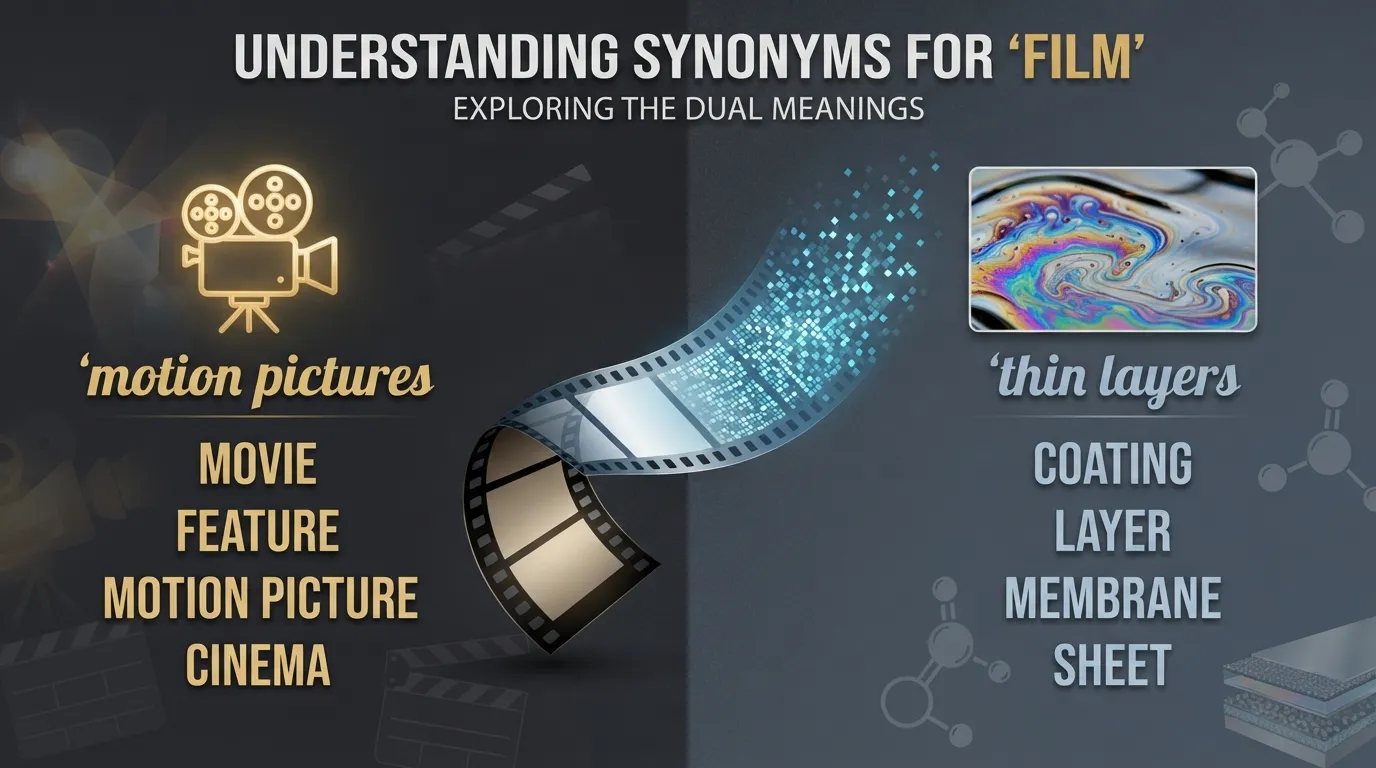
Film most commonly means a motion picture, but it can also refer to a thin layer or coating, or to photographic material. Movie is the closest everyday synonym for the motion picture sense, while picture and feature work in more specific contexts. For the thin layer sense, use coating or layer instead. Understanding these three distinct meanings, and choosing the right synonym for each, makes your writing sharper and prevents confusing overlaps that can trip up even careful writers.
Meaning of Film
In its most common modern sense, film is a noun referring to a motion picture, a story or content recorded and shown on screen, as in “we watched a great film last night.” It is used both casually and in more formal or critical writing about cinema. You’ll see this sense everywhere, from casual conversation to academic film studies programs, movie review columns, and international film festival coverage.
Film also refers to a thin layer or coating of a substance, as in “a film of dust covered the shelf.” This sense shows up often in scientific, culinary, and everyday descriptive writing, wherever something forms a delicate surface layer, whether that’s oil on water, condensation on glass, or a light coating of grease on a pan.
A third, now less common sense refers to the physical photographic material once used in cameras, as in “she loaded a roll of film.” Though digital photography has largely replaced this use in everyday life, the word survives strongly in photography communities, vintage camera hobbies, and historical or nostalgic writing about analog technology.
Because these three meanings are so different from one another, context almost always makes clear which sense a writer intends. Still, knowing the boundaries between them helps you choose precise synonyms instead of defaulting to “film” out of habit.
Best Synonyms for Film
Movie is the closest everyday equivalent in the motion picture sense, more common in casual American English, while “film” itself is often preferred in more formal, artistic, or British contexts. If you’re writing a casual blog post about weekend plans, movie feels natural. If you’re reviewing a festival entry or discussing directorial technique, film carries more weight.
Picture is a slightly older or more casual term for a motion picture, still common in phrases like “moving picture” or simply “picture.” It has a nostalgic, old Hollywood ring to it, and shows up often in industry trade language, like “motion picture” awards categories.
Feature specifically refers to a full length film, as opposed to a short film, and is common in industry and scheduling contexts, as in “the feature starts at eight.” This word draws a clear line between full length storytelling and shorter works, making it useful whenever length or format matters to your meaning.
Coating works well for the thin layer sense, particularly in technical, scientific, or descriptive writing, as in “a protective coating on the lens.” It suggests something applied deliberately, often for protection or function, rather than something that simply accumulates.
Layer is a more general replacement for the thin layer sense, useful when “film” would sound too technical or specific. It works across almost any context, from cooking to construction to everyday description, without sounding overly formal or scientific.
Beyond these five core alternatives, several more specialized synonyms exist for each sense, giving writers plenty of precise options depending on tone, formality, and subject matter.
18 Synonyms for Film
- Movie (motion picture sense)
- Picture (motion picture sense)
- Feature (motion picture sense, full length)
- Motion picture (formal, motion picture sense)
- Flick (informal, motion picture sense)
- Short (motion picture sense, short film)
- Documentary (motion picture sense, specific genre)
- Production (motion picture sense, broader)
- Cinema (British informal, motion picture sense)
- Coating (thin layer sense)
- Layer (thin layer sense)
- Membrane (thin layer sense, biological or technical)
- Skin (thin layer sense, informal, as on liquids)
- Sheet (thin layer sense, thicker material)
- Veneer (thin layer sense, surface material)
- Roll (photographic material sense)
- Negative (photographic material sense, developed film)
- Celluloid (photographic material sense, historical)
Each of these words carries its own shade of meaning. “Flick” feels breezy and casual, perfect for texting a friend about weekend plans. “Motion picture” sounds formal almost to the point of old fashioned, fitting for award ceremonies or legal contexts like copyright documents. “Documentary” narrows the meaning to a specific genre, so it only works when that genre actually applies. “Production” widens the scope, useful when you want to describe the entire filmmaking process or business rather than just the finished work.
On the thin layer side, “membrane” leans biological or technical, describing something with structure and function, like a cell membrane or a protective barrier. “Skin,” by contrast, feels informal and visual, often describing the surface that forms on liquids like pudding or paint. “Sheet” implies something thicker and more substantial than a film, useful when the layer in question has real physical presence. “Veneer” suggests a decorative or surface level covering, often used figuratively too, as in “a veneer of politeness.”
For the photographic sense, “roll” refers to unexposed or unprocessed film, still wound in its canister. “Negative” specifically means developed film with reversed tones, the intermediate step before printing a photograph. “Celluloid” evokes the historical material itself, often used nostalgically or academically when discussing early cinema history.
Types of Synonyms for Film
Motion picture sense: movie, picture, feature, motion picture, flick.
Thin layer sense: coating, layer, membrane, skin, veneer.
Photographic material sense: roll, negative, celluloid.
These three groups do not overlap. Using “coating” to mean a movie, or “movie” to mean a layer of dust, would be a genuine error rather than a stylistic choice. This separation matters because film is one of those words where sloppy synonym substitution can genuinely confuse a reader, not just sound slightly off. Always confirm which sense you’re working with before reaching for an alternative.
Common Collocations and Natural Usage
“Feature film” is a fixed, common phrase meaning a full length movie, distinct from a short film; “feature movie” is not standard. This kind of fixed pairing matters in professional and industry writing, where using the wrong combination can signal unfamiliarity with standard terminology.
“Film of oil” and “film of dust” are natural in the thin layer sense; “coating of dust” also works, but “layer of oil” sounds slightly more natural than “coating of oil” for a liquid film. These small preferences come down to convention more than strict rules, but native speakers notice when a collocation feels slightly off.
“Watch a film” and “watch a movie” are both natural, but “film” leans slightly more toward artistic or critical discussion, as in film festivals or film studies, while “movie” is the default casual word. If you’re writing marketing copy for a blockbuster action movie, “movie” fits the tone better. If you’re reviewing an arthouse film for a cinema studies publication, “film” signals the appropriate register.
Other useful phrases include “on film,” meaning something captured or recorded, as in “the entire event was caught on film,” and “film buff,” an informal but widely recognized term for someone deeply passionate about cinema. “Silent film” refers to an entire historical era and genre of early cinema, a phrase that has no natural substitute using “movie” instead.
Film vs Similar Words
1. Film vs Movie: both refer to the same thing in everyday use, but film is more common in formal, academic, or British English, while movie dominates in casual American English. Neither word is more “correct” than the other; the choice mostly reflects register, audience, and regional habit.
2. Film vs Cinema: cinema can refer to the art form of filmmaking in general, or in British English, to a movie theater itself; film more specifically means an individual work. So while you might study “cinema” as an academic discipline, you watch a “film” within that broader art form, and in the UK, you might go to “the cinema” to see it.
3. Film vs Documentary: a documentary is a specific type of film focused on real events or subjects; not all films are documentaries. Every documentary is a film, but plenty of films, from comedies to dramas to animated features, are not documentaries at all.
4. Film vs Production: a production refers more broadly to the entire process and business of making a film, including casting, financing, and filming, while film usually refers to the finished product itself. You might say “the production faced budget issues,” referring to the making process, while “the film received strong reviews” refers to the completed work.
How to Choose the Right Synonym
If you are writing casually about entertainment, use movie.
If you are discussing cinema as an art form or writing formally, use film.
Then if you specifically mean a full length work, use feature.
And if you mean a thin coating of a substance, use coating or layer depending on the material.
Also if you are writing about older photographic equipment, use roll or negative depending on the stage of development.
If your tone is playful or conversational, flick offers a lighthearted alternative to movie. If you’re writing for an audience that expects precision, like a scientific paper describing a chemical process, membrane or coating will sound far more appropriate than the more casual “film.” And if you’re covering film history specifically, celluloid adds authentic period flavor that “film” alone doesn’t quite capture.
Common Mistakes with Film
Do not use “film” and “cinema” interchangeably when cinema means a movie theater in British English; the two are not the same thing. Saying “I watched a film at the cinema” is correct, but treating “film” and “cinema” as pure synonyms ignores this important distinction.
Avoid using “movie” for the thin layer sense; that meaning only exists for “film.” You would never say “a movie of dust covered the shelf,” even though “movie” and “film” are close synonyms in the entertainment sense.
Be careful with “negative,” which specifically refers to developed photographic film with reversed colors or tones, not unexposed film in general. Calling an unused roll of film a “negative” is inaccurate; the negative only exists after development.
Another common mistake involves overusing “feature” for any film regardless of length. Reserve “feature” specifically for full length works, and use “short” when describing shorter pieces, to keep your meaning precise.
Writers sometimes also misuse “production” as a direct synonym for “film,” forgetting that production more accurately describes the process rather than the finished result. Saying “I watched a great production last night” sounds unusual compared to the more natural “I watched a great film last night.”
Antonyms of Film
There is no true antonym for the motion picture or photographic senses, since film is not a scalar concept; a film simply exists or it doesn’t, without an opposite state. For the thin layer sense, a reasonable contextual opposite is thickness or bulk, describing the absence of a thin covering. You might describe a surface as having “no film at all” or being “free of any coating,” which functions as a practical opposite without a single dedicated antonym word.
FAQ
What does film mean?
It most often refers to a motion picture, but can also mean a thin layer of a substance or photographic material.
What is another way to say film?
Movie is the most natural everyday alternative for the motion picture sense.
What is the difference between film and movie?
They mean the same thing, but film leans more formal or artistic while movie is more casual, especially in American English.
What is a feature film?
A full length movie, as opposed to a short film.
What does a film of dust mean?
A thin layer or coating of dust covering a surface.
Is cinema the same thing as film?
Not exactly. Cinema can mean the art form of filmmaking broadly, or in British English, a movie theater, while film refers to an individual work.
Can “flick” be used in formal writing?
No. Flick is informal slang and works well in casual speech or writing, but it doesn’t belong in academic, professional, or critical writing about cinema.
Conclusion
Film is a genuinely versatile word, carrying three distinct meanings that rarely cause confusion in practice, since context makes the intended sense clear almost every time. Whether you’re discussing a blockbuster movie, a thin film of oil on water, or a roll of vintage camera film, English offers plenty of precise synonyms to match your tone and meaning exactly. Choosing the right one, whether that’s movie for casual writing, coating for technical description, or celluloid for historical flavor, makes your writing sound more deliberate, more accurate, and more engaging to read.
Read More: Synonyms for Satan: 30 Powerful Names to Know

Hi, I’m Ayesha, the creator of InstantSynonyms.com. I believe the right word can transform a sentence, strengthen an idea, and make communication more impactful. That’s why I created this site, to help writers, students, professionals, and English learners find accurate synonyms, antonyms, and better word choices quickly and effortlessly.
Every article is easy to understand, and designed to save you time while improving your vocabulary and writing. Whether you’re searching for a stronger alternative, a more precise expression, or simply expanding your word knowledge, my goal is to make finding the perfect word simple, fast, and reliable.