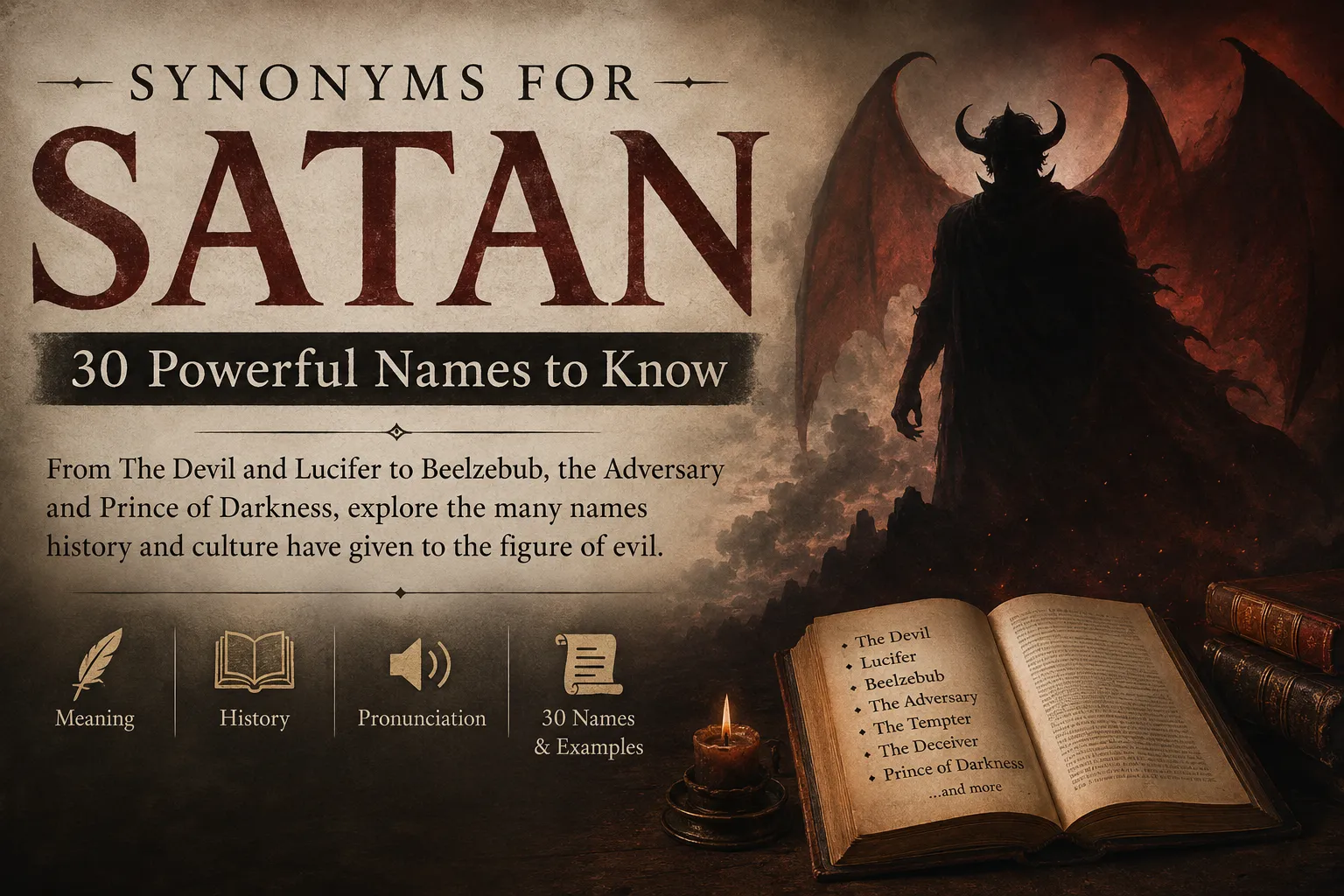
Satan refers to a figure in religious tradition associated with evil, temptation, and opposition to God. Common names and titles include the Devil, Lucifer, Beelzebub, the Adversary, the Tempter, the Deceiver, and Prince of Darkness. The best choice depends on your context, with some terms being biblical, literary, folkloric, or informal.
Picture an old horror film where a character whispers a warning about the devil, and the room suddenly feels colder. Few names carry as much cultural weight as Satan, a word tied to religious tradition, folklore, and centuries of storytelling about evil and temptation.
Satan appears constantly in literature, religious texts, film, and everyday expressions, which is exactly why writers reach for different names to avoid repeating the same word again and again. Learning synonyms for a name like this helps English learners, writers, and students understand the many titles history has attached to this single figure.
This article breaks down the full meaning of Satan, its emotional tone, its history, its pronunciation, and its word family. Then it walks through thirty names and titles associated with this figure, each with a simple meaning and clear examples, so you can choose the right term for any piece of writing.
Meaning of Satan
Definition
Satan (Proper Noun): A figure in religious tradition, particularly Christianity and Judaism, representing evil, temptation, and opposition to God.
Examples
- The novel described Satan as a cunning, persuasive character rather than a simple villain.
- In the sermon, the pastor spoke about resisting the temptations associated with Satan.
Connotative Meaning
Satan carries a heavy, serious emotional tone in most contexts.
- Positive tone: Rarely positive, though some fictional or symbolic works portray the figure as a complex antihero rather than pure evil.
- Negative tone: Strongly associated with evil, deception, temptation, and moral corruption across most religious and cultural contexts.
- Neutral tone: Occasionally used in academic, historical, or literary discussions without strong emotional judgment attached.
(Connotation: the emotional feeling or association a word carries beyond its basic dictionary meaning.)
Etymology
Satan comes from ancient religious texts, carrying a specific meaning tied to opposition and accusation.
- Old English (450 to 1100): The term entered English through biblical translation, derived from Hebrew, where satan originally meant adversary or accuser rather than a proper name.
- Middle English (1100 to 1500): As biblical texts spread through medieval Europe, Satan solidified into a proper noun referring specifically to the central figure of evil in Christian theology.
- Modern English (1500 to Present): By the time of widely printed English Bibles, Satan had become firmly established as the primary name for this religious figure, alongside various other titles used in literature and folklore.
Pronunciation (IPA)
- IPA: /ˈseɪtən/
- Syllables: Sa tan
Affixation Pattern of Satan
- Root: From Hebrew satan, meaning adversary or accuser
- Prefix: none
- Suffix: none
- Word formations:
- Satan (proper noun)
- Satanic (adjective, relating to or resembling Satan)
- Satanist (noun, a follower of Satanism)
- Satanism (noun, a belief system or practice associated with Satan)
30 Synonyms of Satan With Meaning and Examples
1. The Devil (Noun)
Meaning: The most common general term for the central figure of evil in Christian tradition.
Examples:
- The old story warned children never to make a deal with the devil.
- The film portrayed the devil as a charming, well dressed businessman.
2. Lucifer (Proper Noun)
Meaning: A name often used for Satan, associated with a fallen angel of light.
Examples:
- The poem described Lucifer’s fall from heaven in vivid detail.
- Some texts distinguish Lucifer as Satan’s name before his fall.
3. Beelzebub (Proper Noun)
Meaning: A name for a powerful demon, sometimes used interchangeably with Satan.
Examples:
- The ancient text referred to Beelzebub as a lord among demons.
- The character summoned Beelzebub in the classic gothic novel.
4. Prince of Darkness (Noun Phrase)
Meaning: A title emphasizing Satan’s rule over evil and darkness.
Examples:
- The sermon referred to Satan as the Prince of Darkness.
- The novel’s villain claimed loyalty to the Prince of Darkness.
5. The Evil One (Noun Phrase)
Meaning: A general title emphasizing Satan’s role as the source of evil.
Examples:
- The prayer asked for protection from the Evil One.
- The children’s story described the Evil One as a shadowy figure.
6. The Adversary (Noun)
Meaning: A title reflecting the original Hebrew meaning of Satan as an opposing force.
Examples:
- The theologian explained that Adversary was the earliest meaning of the name.
- The text described the Adversary as a constant tempter of humanity.
7. The Tempter (Noun)
Meaning: A title emphasizing Satan’s role in tempting people toward sin.
Examples:
- The story described the Tempter offering forbidden knowledge.
- The sermon warned against listening to the Tempter’s promises.
8. Mephistopheles (Proper Noun)
Meaning: A demonic figure representing Satan in literary works, especially the Faust legend.
Examples:
- The opera featured Mephistopheles as a cunning, persuasive character.
- The professor traded his soul to Mephistopheles in the classic tale.
9. The Fiend (Noun)
Meaning: A general term describing an evil, demonic figure often associated with Satan.
Examples:
- The old ballad described the fiend haunting the countryside.
- The villagers blamed the fiend for the strange misfortunes.
10. Old Nick (Noun, Informal)
Meaning: An old fashioned, informal nickname for the devil.
Examples:
- The grandmother joked that Old Nick himself must be behind the mischief.
- The folk tale referred to the devil playfully as Old Nick.
11. The Deceiver (Noun)
Meaning: A title emphasizing Satan’s association with lies and manipulation.
Examples:
- The text warned readers about the Deceiver’s clever tricks.
- The sermon described sin as a tool of the Deceiver.
12. The Serpent (Noun)
Meaning: A symbolic title connecting Satan to the biblical account of the garden of Eden.
Examples:
- The painting depicted the Serpent whispering to Eve.
- The story described temptation as the voice of the Serpent.
13. The Dark Lord (Noun Phrase)
Meaning: A dramatic title emphasizing Satan’s rule over darkness and evil forces.
Examples:
- The fantasy novel borrowed the title Dark Lord from older religious imagery.
- The character swore allegiance to the Dark Lord in the story.
14. Prince of Demons (Noun Phrase)
Meaning: A title emphasizing Satan’s authority over other demonic beings.
Examples:
- The ancient text described Satan as the Prince of Demons.
- The exorcism scene referenced the Prince of Demons directly.
15. The Accuser (Noun)
Meaning: A title tied to the original biblical role of Satan as one who accuses.
Examples:
- The theologian explained the Accuser’s role in ancient scripture.
- The sermon described sin as a weapon of the Accuser.
16. Diabolus (Proper Noun)
Meaning: A Latin based name for the devil, often used in older or formal texts.
Examples:
- The medieval manuscript referred to the figure as Diabolus.
- The Latin phrase invoked protection against Diabolus.
17. Old Scratch (Noun, Informal)
Meaning: An old fashioned American folk nickname for the devil.
Examples:
- The folk song referenced Old Scratch coming to collect a debt.
- The storyteller used Old Scratch as a playful nickname for evil.
18. The Wicked One (Noun Phrase)
Meaning: A general title emphasizing Satan’s association with wickedness.
Examples:
- The prayer asked for strength against the Wicked One.
- The old text described temptation as the whisper of the Wicked One.
19. Father of Lies (Noun Phrase)
Meaning: A biblical title describing Satan as the ultimate source of deception.
Examples:
- The sermon quoted scripture calling Satan the Father of Lies.
- The novel’s villain embraced the title Father of Lies.
20. Apollyon (Proper Noun)
Meaning: A Greek derived name meaning destroyer, associated with Satan in certain texts.
Examples:
- The biblical passage referred to the figure as Apollyon.
- The character in the allegory battled the destroyer Apollyon.
21. The Destroyer (Noun)
Meaning: A title emphasizing Satan’s association with ruin and destruction.
Examples:
- The ancient hymn described protection from the Destroyer.
- The story portrayed the Destroyer bringing chaos wherever he went.
22. The Horned One (Noun Phrase)
Meaning: A folkloric title referencing the traditional horned depiction of the devil.
Examples:
- The old illustration showed the Horned One tempting a traveler.
- The legend described the Horned One appearing at midnight.
23. Old Harry (Noun, Informal)
Meaning: A British folk nickname historically used for the devil.
Examples:
- The old expression referenced Old Harry causing trouble.
- The villager joked that Old Harry himself must be involved.
24. The Great Deceiver (Noun Phrase)
Meaning: An emphatic title describing Satan’s mastery of deception.
Examples:
- The text warned against trusting the Great Deceiver.
- The sermon described sin as a trap set by the Great Deceiver.
25. Ruler of Darkness (Noun Phrase)
Meaning: A biblical style title emphasizing Satan’s authority over evil forces.
Examples:
- The passage described spiritual battles against the Ruler of Darkness.
- The character pledged loyalty to the Ruler of Darkness.
26. The Foul Fiend (Noun Phrase)
Meaning: An older literary term describing an evil, demonic figure.
Examples:
- The play referenced the Foul Fiend tormenting the character.
- The old text described protection from the Foul Fiend.
27. The Malignant One (Noun Phrase)
Meaning: A title emphasizing Satan’s harmful and destructive nature.
Examples:
- The sermon warned against the influence of the Malignant One.
- The story described darkness following the Malignant One.
28. The Archfiend (Noun)
Meaning: A title emphasizing Satan’s position as the chief among evil spirits.
Examples:
- The novel referred to the villain as an Archfiend of legend.
- The old text described Satan as the original Archfiend.
29. The Nether Lord (Noun Phrase)
Meaning: A dramatic, literary title associating Satan with the underworld.
Examples:
- The fantasy story referenced the Nether Lord ruling below.
- The character feared summoning the Nether Lord by mistake.
30. Clootie (Proper Noun, Scottish Folklore)
Meaning: A traditional Scottish nickname for the devil, tied to folklore about cloven hooves.
Examples:
- The old Scottish tale referenced Clootie appearing at the crossroads.
- The folklore described Clootie tempting travelers at night.
Prototype Meaning
When most people hear the name Satan, they picture a powerful, deceptive figure associated with evil, temptation, and opposition to good. This mental image often includes darkness, cunning persuasion, and a strong sense of moral danger.
Prototype Categorization
Grouping these thirty names into clear categories helps writers choose the most accurate title for any specific situation.
- Biblical and Theological Titles: The Adversary, the Accuser, Father of Lies, Ruler of Darkness, the Tempter
- Classic Literary Names: Lucifer, Mephistopheles, Apollyon, Beelzebub
- Folk and Informal Nicknames: Old Nick, Old Scratch, Old Harry, Clootie
- Titles Emphasizing Power: Prince of Darkness, Prince of Demons, the Dark Lord, the Archfiend, the Nether Lord
- Titles Emphasizing Deception: The Deceiver, the Great Deceiver, Father of Lies
- General Descriptive Terms: The Devil, the Fiend, the Evil One, the Wicked One, the Malignant One, the Foul Fiend, the Serpent, the Destroyer, the Horned One, Diabolus
This kind of grouping helps writers instantly identify whether they need a biblical title, a literary name, or a folkloric nickname, making word choice faster and more precise.
Antonyms of Satan
- Angel (Noun): A heavenly being associated with goodness and service to God, contrasting with Satan’s association with evil.
- God (Proper Noun): In most religious traditions, the supreme good and creator figure standing in direct opposition to Satan.
- Savior (Noun): A figure associated with rescue and redemption, contrasting with Satan’s role in temptation and downfall.
- Guardian (Noun): A protective figure associated with safety and goodness, opposite to Satan’s association with harm.
Short Questions and Answers
What does Satan mean?
Satan refers to a figure in religious tradition representing evil, temptation, and opposition to God, particularly within Christian and Jewish theology.
When should Satan be used?
Use Satan in religious, literary, historical, or academic contexts when specifically referring to this traditional figure of evil.
Is Satan positive or negative?
Satan is almost universally associated with a negative connotation, tied to evil, deception, and moral corruption across most cultural contexts.
How is it different from similar words?
While terms like demon or fiend can describe evil beings generally, Satan specifically refers to one particular figure recognized as the primary source of evil in many religious traditions.
Conclusion
Learning synonyms for Satan does far more than expand your vocabulary. It strengthens your writing by giving you historically accurate and varied options instead of repeating the same name throughout a story, essay, or article.
Understanding titles like Lucifer, the Adversary, and Prince of Darkness helps you write with more nuance, whether you are working on academic research, creative fiction, or religious studies.
Make a habit of practicing new vocabulary daily, even a few words at a time. Over time, this steady practice builds real confidence and noticeably improves both your written and spoken English.
Explore More: Synonyms for Sweater: 30 Cozy Words to Know

Hi, I’m Ayesha, the creator of InstantSynonyms.com. I believe the right word can transform a sentence, strengthen an idea, and make communication more impactful. That’s why I created this site, to help writers, students, professionals, and English learners find accurate synonyms, antonyms, and better word choices quickly and effortlessly.