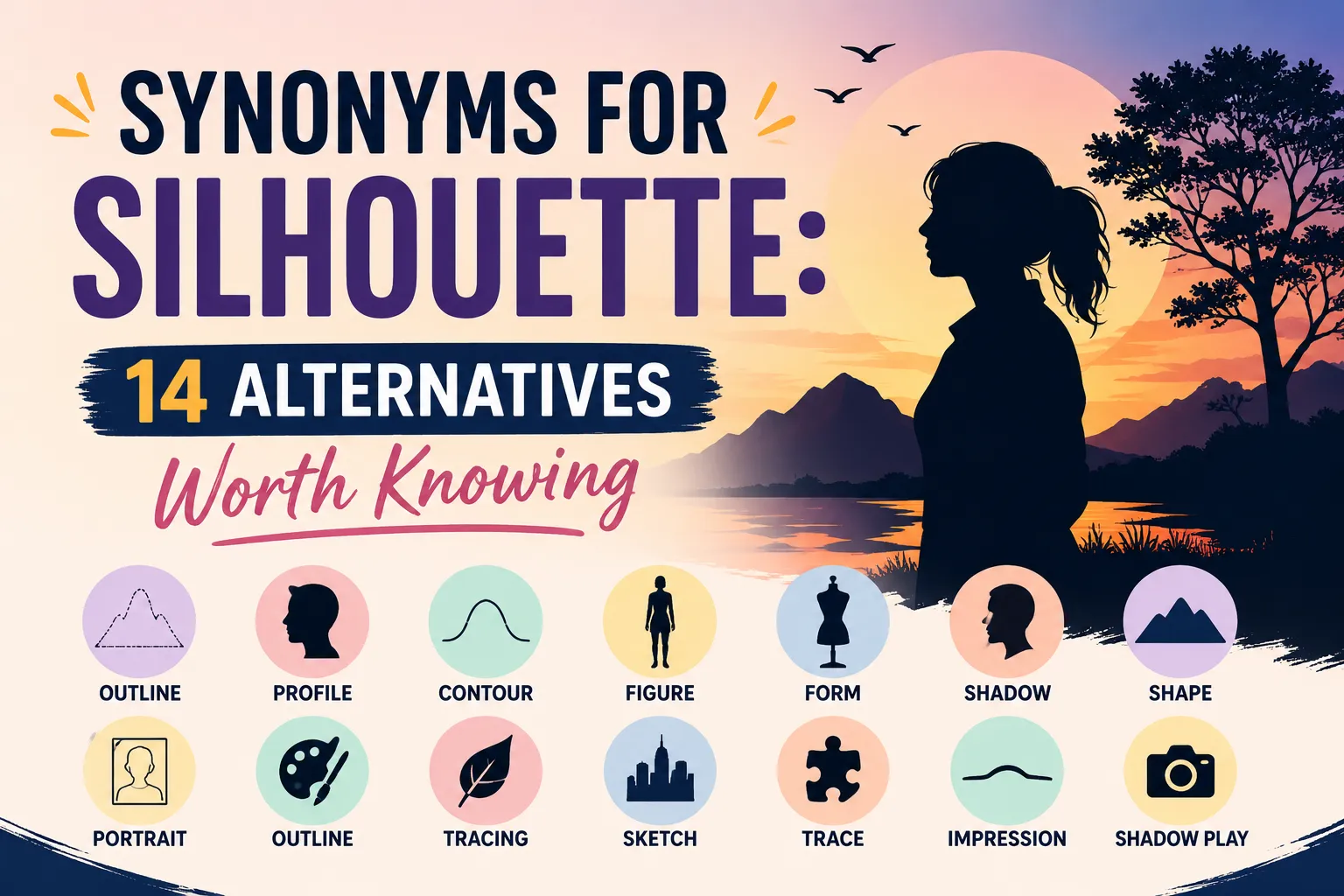
A silhouette is a solid dark shape or outline seen against a lighter background. The closest alternatives are outline, profile, contour, and figure, each suited to a slightly different context, from art and design to describing a body shape.
Meaning of Silhouette
A silhouette is the outline of a person, object, or scene, filled in as a solid shape, usually dark, against a lighter background. It shows the edge of something without any internal detail.
The word also describes a specific art form: a portrait made this way, often cut from black paper or painted as a flat dark shape.
The sun dropped low, turning the trees into a row of black silhouettes against the sky.
She kept the artist’s silhouette of her grandmother on the mantel.
Connotation and Nuance
“Silhouette” carries a mostly neutral, often artistic or slightly romantic tone. It suggests simplicity and mystery, since a silhouette hides detail while still clearly showing shape. When used to describe a person’s body, it usually appears in fashion or design contexts and tends to sound flattering or descriptive rather than critical.
Pronunciation
Silhouette is pronounced /ˌsɪl.uˈet/. It has three syllables: sil, ou, ette, with the stress on the final syllable.
Etymology
“Silhouette” comes from the name of Étienne de Silhouette, a French finance minister in the 1700s. His unpopular budget cuts led people to associate his name with anything done cheaply or without much detail, including the simple black paper cutout portraits that were popular at the time. The word kept that meaning and eventually lost its connection to the actual person.
Best Synonyms for Silhouette
Outline. The most general and widely usable alternative, appropriate in almost any context. It works whether you are describing a shape against the sky or a sketch on paper. “The mountain’s outline was sharp against the sunset.”
Profile. Best when describing the side view of a face or head, or a person’s shape seen from the side. “His profile looked familiar even in the dim light.”
Contour. Common in art, design, and anatomy, where the smooth curved edge of a shape matters. “The dress followed the contour of her shoulders.”
Figure. Useful specifically for describing a person’s body shape, often in fashion or descriptive writing. “The coat flattered her figure without hiding it.”
Shadow. Fits naturally when the dark shape is literally cast by light, rather than drawn or designed. “His shadow stretched long across the pavement.”
14 Synonyms for Silhouette
1. Outline
Part of Speech: Noun
Classification: Close synonym
Meaning: The line or shape that marks the outer edge of something.
Best Use: General writing, art, design, and everyday description.
Examples: The building’s outline was visible even in the fog. She traced the outline of the leaf onto the page.
2. Profile
Part of Speech: Noun
Classification: Near synonym
Meaning: The outline of a face or object seen from the side.
Best Use: Describing faces, heads, or objects viewed from a side angle.
Difference: More specific than silhouette, since it usually implies a side view rather than any dark shape.
Examples: She recognized his profile from across the room. The coin shows the king’s profile in relief.
3. Contour
Part of Speech: Noun
Classification: Near synonym
Meaning: The outline of a curved or irregular shape, often used in art, anatomy, or design.
Best Use: Art, fashion, sculpture, or descriptions of physical form.
Examples: The sculptor smoothed every contour of the marble figure. The map lines show the contour of the hillside.
4. Shape
Part of Speech: Noun
Classification: Near synonym
Meaning: The overall form or outline of something, without reference to darkness or contrast.
Best Use: General, everyday description.
Difference: Broader than silhouette, since it does not require a dark shape against a light background.
Examples: The clouds formed a strange shape overhead. She could tell it was a cat by its shape alone.
5. Form
Part of Speech: Noun
Classification: Near synonym
Meaning: The visible shape or structure of something, often used in a literary or artistic sense.
Best Use: Literary writing, art criticism, formal description.
Examples: A dark form moved through the fog. The dancer’s form was outlined against the stage lights.
6. Figure
Part of Speech: Noun
Classification: Contextual alternative
Meaning: The shape of a person’s body, or a person seen as a shape rather than in detail.
Best Use: Describing a person’s body shape, or a person glimpsed at a distance.
Difference: Refers specifically to people, unlike silhouette, which can describe any object.
Examples: A lone figure stood at the end of the pier. The dress suited her figure well.
7. Shadow
Part of Speech: Noun
Classification: Contextual alternative
Meaning: A dark shape cast by an object blocking light.
Best Use: Describing an actual shadow, rather than a drawn or designed shape.
Difference: A shadow is specifically caused by blocked light, while a silhouette can also be drawn, cut, or painted.
Examples: Her shadow fell across the kitchen floor. The trees cast long shadows as the sun set.
8. Cutout
Part of Speech: Noun
Classification: Contextual alternative
Meaning: A shape cut from paper or another material, often used for silhouette portraits or decorations.
Best Use: Craft, art, and decoration contexts.
Examples: She made a cutout of a bird for the card. The classroom windows were decorated with paper cutouts.
9. Delineation
Part of Speech: Noun
Classification: Close synonym, formal register
Meaning: A precise outline or description of the shape or boundary of something.
Best Use: Formal, technical, or literary writing.
Examples: The architect’s drawing offered a clear delineation of the building’s edges. The report gave a careful delineation of the property boundaries.
10. Tracing
Part of Speech: Noun
Classification: Contextual alternative
Meaning: An outline created by tracing over an existing shape.
Best Use: Art, drafting, or instructional contexts.
Examples: She made a tracing of the leaf for her science project. The tailor used a tracing of the pattern piece.
11. Physique
Part of Speech: Noun
Classification: Contextual alternative
Meaning: The general shape and build of a person’s body.
Best Use: Describing body build in fitness, fashion, or descriptive writing.
Difference: Refers to overall build rather than a visible outline against light.
Examples: Years of training had shaped his lean physique. The uniform was tailored to fit every physique.
12. Sketch
Part of Speech: Noun
Classification: Related expression
Meaning: A rough or simple drawing, sometimes limited to an outline.
Best Use: Art and drafting contexts where the drawing itself, not just the shape, is the focus.
Difference: A sketch can include more than an outline, so it is only a loose alternative to silhouette.
Examples: He made a quick sketch of the skyline. Her sketch captured only the basic shape of the building.
13. Line Drawing
Part of Speech: Noun phrase
Classification: Related expression
Meaning: A drawing made using outlines rather than shading or color.
Best Use: Art, design, and instructional contexts.
Examples: The manual included a simple line drawing of the assembly steps. Her line drawing captured the shape of the mountains perfectly.
14. Shadow Figure
Part of Speech: Noun phrase
Classification: Contextual alternative
Meaning: A person or object seen only as a dark shape, usually at a distance or in low light.
Best Use: Descriptive or atmospheric writing.
Examples: A shadow figure crossed the street just before dawn. Through the curtains, she could make out a shadow figure pacing the room.
Types of Synonyms for Silhouette
General shape words: outline, shape, form, contour. These work in almost any context and do not require darkness or contrast.
Person specific words: profile, figure, physique. These describe a person’s body or face rather than any object.
Light and shadow specific words: shadow, shadow figure. These apply only when the dark shape comes from blocked light, not from drawing or cutting.
Art and craft specific words: cutout, tracing, sketch, line drawing, delineation. These fit contexts involving drawing, cutting, or precise depiction.
Common Collocations and Natural Usage
“Silhouette” pairs naturally with light sources: silhouette against the sunset, silhouette against the sky. “Profile” pairs naturally with faces and side views: his profile, a profile picture. “Contour” pairs naturally with bodies and landscapes: body contour, contour of the hills. “Figure” pairs naturally with distance and vagueness: a lone figure, a distant figure.
Silhouette vs Similar Words
Silhouette versus shadow. A silhouette can be drawn, cut, or cast by light. A shadow is always caused specifically by blocked light. Every shadow can look like a silhouette, but not every silhouette is a shadow.
Silhouette versus outline. Outline is broader and does not require darkness or contrast with a lighter background. A silhouette is always a filled, solid shape, while an outline can be just a line.
Silhouette versus profile. Profile usually implies a side view, especially of a face. Silhouette can show a shape from any angle.
How to Choose the Right Synonym
If you want a broad, neutral word, use outline or shape.
If you are describing a face or side view, use profile.
Then If you are describing a person’s body shape, use figure or physique.
Also If the dark shape comes specifically from blocked light, use shadow or shadow figure.
And If you are writing about art or craft techniques, consider cutout, tracing, or line drawing depending on the technique used.
Common Mistakes with Silhouette
Writers sometimes use “shadow” and “silhouette” interchangeably, but a silhouette does not have to be caused by light. A painted or cut silhouette is not a shadow.
Another common mistake is using “profile” for any general outline, when it more naturally refers to a side view, especially of a face.
Antonyms of Silhouette
There is no single direct antonym for silhouette, but contextual opposites include:
Detail. The visible texture, color, and features that a silhouette deliberately leaves out.
Full view. A complete, detailed view of something, rather than just its outline.
Frequently Asked Questions
What does silhouette mean?
It means a solid dark shape or outline seen against a lighter background, or a portrait made in this style.
What is another way to say silhouette?
Outline, profile, contour, and figure are all natural alternatives, depending on context.
What is the difference between silhouette and shadow?
A shadow is always caused by blocked light. A silhouette can be drawn, cut, painted, or cast by light.
Is silhouette formal or informal?
It works well in both casual and formal writing, and it is common in art, fashion, and design contexts.
How do I use silhouette in a sentence?
Use it to describe a dark shape or outline against a lighter background, such as “the skyline’s silhouette against the evening sky.”
Conclusion
“Silhouette” is precise, but its closest alternatives are not fully interchangeable. Outline works almost anywhere, profile fits faces and side views, figure and physique describe a person’s body, and shadow only applies when light is actually involved. Choosing the right word depends on whether you are describing an object, a person, or something cast by light, and how much detail your writing needs to leave out.
Read More: Synonyms for Curse: 18 Alternatives Worth Knowing

Hi, I am Abid, a writer and editor at InstantSynonyms.com, where he creates clear and reader-friendly content about synonyms, vocabulary, and English word usage. His goal is to help readers choose the right words, expand their vocabulary, and write with greater confidence.