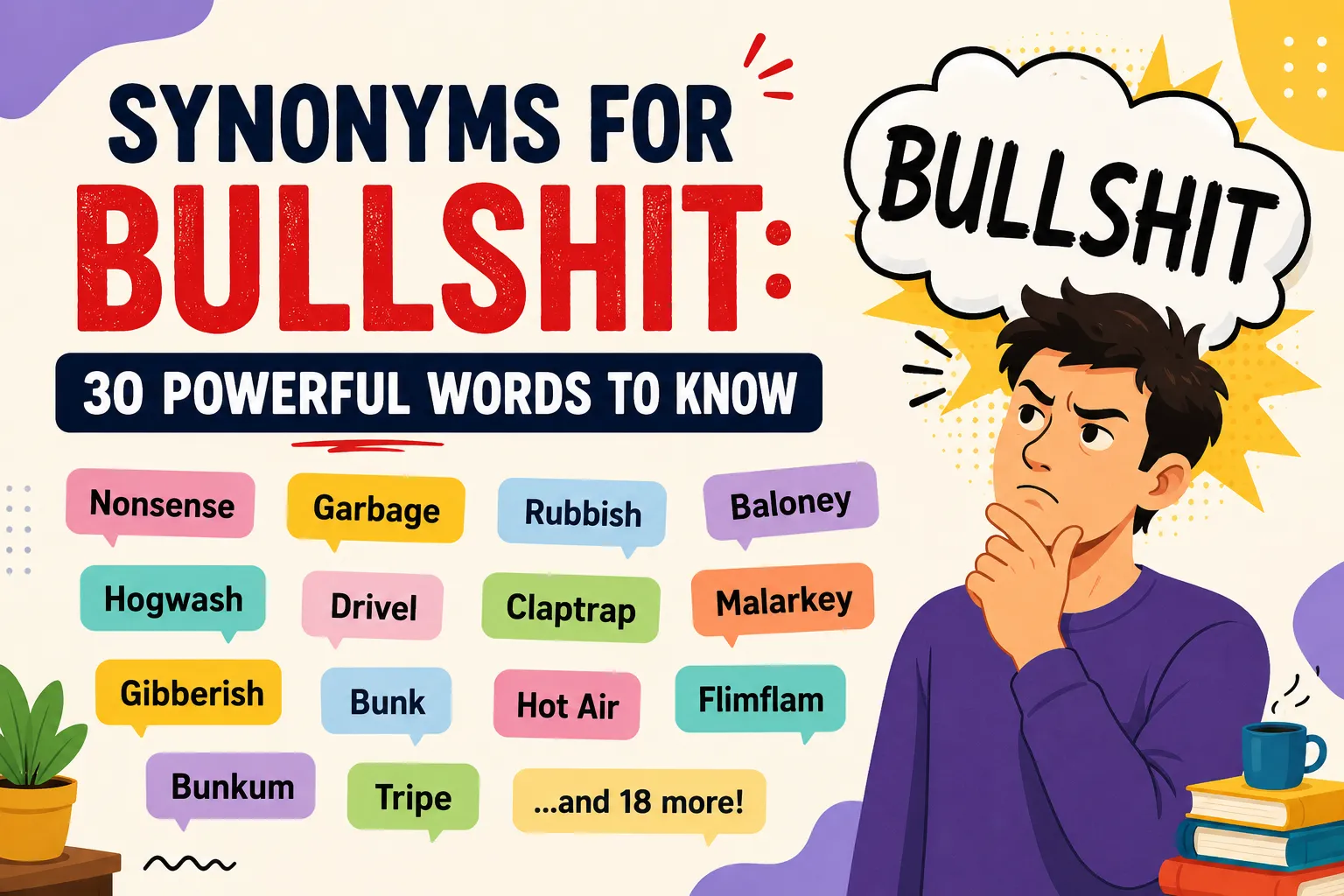
Bullshit means nonsense, lies, or exaggerated claims that have little truth or value. Depending on the context, useful synonyms include nonsense, garbage, rubbish, baloney, hogwash, drivel, claptrap, malarkey, gibberish, bunk, and hot air. For formal or professional writing, nonsense is usually the safest choice, while bullshit is much more blunt, vulgar, and informal.
Picture a coworker presenting a report full of vague claims and no real data, and someone leans over and whispers that the whole thing is bullshit. That word captures a very specific kind of frustration, the feeling that something is dishonest, exaggerated, or simply nonsense dressed up to sound important.
Bullshit is common in casual conversation because it lands with more punch than gentler words like nonsense or exaggeration. Learning synonyms for a word like this helps English learners and content writers express the same frustration with more range, more precision, and better control over tone, especially since some situations call for a milder alternative.
This article breaks down the full meaning of bullshit, its emotional tone, its history, its pronunciation, and its word family. Then it walks through thirty useful synonyms, each with a simple meaning and clear examples, so you can choose exactly the right word for every situation, from casual conversation to more polished writing.
Meaning of Bullshit
Definition
Bullshit (Noun, Informal): Nonsense, lies, or exaggerated claims that are not true or meaningful, often used to describe dishonest or misleading talk.
Examples
- Everyone in the meeting knew the excuse was complete bullshit.
- He called out the ad campaign for being full of bullshit claims.
Connotative Meaning
Bullshit carries a strong, blunt emotional charge in everyday speech.
- Positive tone: Rarely positive, though it can sometimes express blunt honesty, as in calling out someone for cutting through bullshit.
- Negative tone: Frequently expresses frustration, distrust, or contempt toward dishonest or exaggerated claims.
- Neutral tone: Occasionally used casually among friends simply to mean nonsense, without strong anger attached.
(Connotation: the emotional feeling or association a word carries beyond its basic dictionary meaning.)
Etymology
Bullshit developed in early twentieth century American slang, combining two older words into one blunt expression.
- Old English (450 to 1100): Neither root word existed yet in this combined form, though early terms for cattle and waste already existed separately in the language.
- Middle English (1100 to 1500): The word bull had already developed a secondary meaning related to trivial or false talk, appearing in expressions describing empty nonsense.
- Modern English (1500 to Present): By the early twentieth century, bull and shit merged into bullshit, first appearing in American military and working class slang before spreading into mainstream informal English.
Pronunciation (IPA)
- IPA: /ˈbʊlʃɪt/
- Syllables: bull shit
Affixation Pattern of Bullshit
- Root: bull, combined with shit
- Prefix: none
- Suffix: none, formed as a compound word rather than through affixation
- Word formations:
- Bullshit (noun)
- Bullshit (verb, informal, meaning to lie or exaggerate)
- Bullshitter (noun, someone who habitually exaggerates or lies)
- Bullshitting (verb, present participle)
30 Synonyms of Bullshit With Meaning and Examples
1. Nonsense (Noun)
Meaning: Ideas or statements that make no sense or have no real value.
Examples:
- The manager dismissed the report as complete nonsense.
- She refused to listen to any more nonsense about the project timeline.
2. Garbage (Noun)
Meaning: Worthless or meaningless information presented as if it matters.
Examples:
- His excuse sounded like garbage to everyone in the room.
- The article was full of garbage statistics with no real sources.
3. Rubbish (Noun)
Meaning: Foolish or worthless talk, often used in British English.
Examples:
- She called his explanation absolute rubbish.
- The whole presentation felt like rubbish from start to finish.
4. Baloney (Noun)
Meaning: Foolish or exaggerated talk that is clearly untrue.
Examples:
- He waved off the rumor as pure baloney.
- The salesman’s promises sounded like complete baloney.
5. Hogwash (Noun)
Meaning: Nonsense or ridiculous claims not based on truth.
Examples:
- The scientist called the theory hogwash without any real evidence.
- She rolled her eyes at his hogwash excuse for being late.
6. Drivel (Noun)
Meaning: Silly or meaningless talk with little real substance.
Examples:
- The speech was mostly drivel with no clear point.
- He tuned out the drivel coming from the radio host.
7. Claptrap (Noun)
Meaning: Pretentious or empty language meant to sound impressive.
Examples:
- The politician’s speech was full of claptrap and empty promises.
- She saw through the claptrap immediately during the interview.
8. Poppycock (Noun)
Meaning: Absurd or nonsensical talk, often used humorously.
Examples:
- He laughed and called the conspiracy theory poppycock.
- The old man dismissed modern trends as pure poppycock.
9. Malarkey (Noun)
Meaning: Exaggerated or foolish talk meant to deceive.
Examples:
- She told him to cut the malarkey and speak honestly.
- The report was mostly malarkey dressed up with fancy language.
10. Tripe (Noun)
Meaning: Worthless or nonsensical writing or speech.
Examples:
- Critics called the film’s script complete tripe.
- He refused to read another page of that tripe.
11. Hooey (Noun)
Meaning: Foolish nonsense, often used casually or humorously.
Examples:
- That excuse sounds like a bunch of hooey to me.
- She brushed off his story as pure hooey.
12. Gibberish (Noun)
Meaning: Speech or writing that makes no logical sense.
Examples:
- The instructions were written in confusing gibberish.
- He mumbled something that sounded like gibberish.
13. Humbug (Noun)
Meaning: Deceptive nonsense meant to trick or mislead someone.
Examples:
- The old man called the holiday advertisements pure humbug.
- She saw the scheme for what it was, complete humbug.
14. Bunkum (Noun)
Meaning: Nonsense talk, often political or exaggerated in nature.
Examples:
- Critics dismissed the campaign promises as bunkum.
- The speech was mostly bunkum meant to please the crowd.
15. Rot (Noun, Informal)
Meaning: Nonsense or foolish talk, often used in older British slang.
Examples:
- He told his brother to stop talking rot.
- The whole theory sounded like complete rot to her.
16. Twaddle (Noun)
Meaning: Silly or trivial talk with no real meaning.
Examples:
- She grew tired of his constant twaddle during meetings.
- The article was mostly twaddle padded with vague claims.
17. Balderdash (Noun)
Meaning: Nonsensical talk or writing, often used humorously.
Examples:
- He called the rumor pure balderdash.
- The old professor dismissed the theory as balderdash.
18. Bosh (Noun, Informal)
Meaning: Nonsense or empty talk, considered somewhat old fashioned.
Examples:
- She waved her hand and said the whole idea was bosh.
- His explanation sounded like complete bosh to the committee.
19. Horsefeathers (Noun, Informal)
Meaning: Nonsense, often used as a lighthearted exclamation.
Examples:
- He shouted horsefeathers when he heard the ridiculous claim.
- The old cartoon used horsefeathers as a playful insult.
20. Gobbledygook (Noun)
Meaning: Confusing language filled with jargon and little clarity.
Examples:
- The legal document was full of gobbledygook.
- She asked him to explain the gobbledygook in plain English.
21. Flapdoodle (Noun)
Meaning: Foolish or nonsensical talk, considered somewhat playful.
Examples:
- He dismissed the entire theory as flapdoodle.
- The comedian joked about political flapdoodle during his set.
22. Eyewash (Noun, Informal)
Meaning: Deceptive nonsense meant to mislead or distract.
Examples:
- The report was mostly eyewash meant to hide the real numbers.
- She saw through the eyewash immediately during the review.
23. Bilge (Noun, Informal)
Meaning: Nonsense talk, often used dismissively.
Examples:
- He called the entire pitch complete bilge.
- The article was filled with bilge instead of real facts.
24. Codswallop (Noun, British Informal)
Meaning: Nonsense, often used humorously in British English.
Examples:
- She laughed and called the story codswallop.
- The excuse sounded like complete codswallop to everyone listening.
25. Fiddle Faddle (Noun, Informal)
Meaning: Trivial or foolish nonsense, often old fashioned in tone.
Examples:
- The grandmother dismissed the gossip as fiddle faddle.
- He waved off the rumor as harmless fiddle faddle.
26. Tommyrot (Noun, Informal)
Meaning: Absolute nonsense, considered an older, informal term.
Examples:
- He called the theory complete tommyrot.
- The old man dismissed modern slang as tommyrot.
27. Bunk (Noun, Informal)
Meaning: Nonsense or false claims presented as fact.
Examples:
- She told him the entire story sounded like bunk.
- The advertisement was mostly bunk with no real proof.
28. Piffle (Noun, Informal)
Meaning: Trivial nonsense, often used dismissively.
Examples:
- He rolled his eyes and called the excuse piffle.
- The whole argument sounded like piffle to the judges.
29. Blather (Noun)
Meaning: Foolish or excessive talk with little real content.
Examples:
- She grew tired of his constant blather during the call.
- The speech was mostly blather with no clear direction.
30. Hot Air (Noun, Idiom)
Meaning: Empty, boastful talk with no real substance behind it.
Examples:
- Critics called his promises nothing but hot air.
- The presentation was full of hot air and few real numbers.
Prototype Meaning
When most people hear the word bullshit, they picture dishonest, exaggerated, or empty talk meant to mislead someone or avoid a real answer. This mental image often includes a strong sense of frustration or distrust, along with the feeling that someone is not being straightforward.
Prototype Categorization
Grouping these thirty synonyms into clear categories helps writers choose the most accurate word for any specific situation.
- Blunt and Direct Terms: Garbage, rubbish, bunk, bosh
- Playful or Old Fashioned Terms: Poppycock, balderdash, hooey, horsefeathers, fiddle faddle, tommyrot, flapdoodle
- Formal or Polished Alternatives: Nonsense, gibberish, gobbledygook
- Terms Implying Deception: Humbug, eyewash, malarkey, baloney, hogwash
- British Leaning Terms: Rubbish, rot, codswallop, twaddle
- Terms Describing Empty Talk: Drivel, blather, claptrap, tripe, hot air, bilge, piffle, bunkum
This kind of grouping helps writers instantly identify whether they need a blunt word, a playful word, or a more formal alternative, making word choice faster and more precise.
Antonyms of Bullshit
- Truth (Noun): Something that is factually accurate and honest, the direct opposite of dishonest or misleading talk.
- Fact (Noun): A piece of information that is verifiably true and supported by evidence.
- Honesty (Noun): The quality of being truthful and straightforward, without exaggeration or deception.
- Sincerity (Noun): Genuine and honest expression, free from pretense or false claims.
Short Questions and Answers
What does bullshit mean?
Bullshit means nonsense, lies, or exaggerated claims that are not true or meaningful, often used to describe dishonest or misleading talk.
When should bullshit be used?
Use bullshit in casual, informal contexts to express strong frustration or disbelief, but choose a milder synonym in formal or professional writing.
Is bullshit positive or negative?
Bullshit almost always carries a negative connotation, expressing distrust, frustration, or contempt toward dishonest or meaningless statements.
How is it different from similar words?
While words like nonsense and rubbish feel milder and more acceptable in formal writing, bullshit carries a much stronger, more vulgar tone better suited to casual speech.
Conclusion
Learning synonyms for bullshit does far more than expand your vocabulary. It strengthens your writing and speaking by giving you precise, varied options instead of relying on one blunt, informal word in every situation.
Understanding words like nonsense, malarkey, and claptrap helps you match your tone to your audience, whether you are writing a formal report or chatting casually with friends.
Make a habit of practicing new vocabulary daily, even a few words at a time. Over time, this steady practice builds real confidence and noticeably improves both your written and spoken English.
Explore More: Synonyms for Satan: 30 Powerful Names to Know

Hi, I’m Ayesha, the creator of InstantSynonyms.com. I believe the right word can transform a sentence, strengthen an idea, and make communication more impactful. That’s why I created this site, to help writers, students, professionals, and English learners find accurate synonyms, antonyms, and better word choices quickly and effortlessly.
Every article is easy to understand, and designed to save you time while improving your vocabulary and writing. Whether you’re searching for a stronger alternative, a more precise expression, or simply expanding your word knowledge, my goal is to make finding the perfect word simple, fast, and reliable.