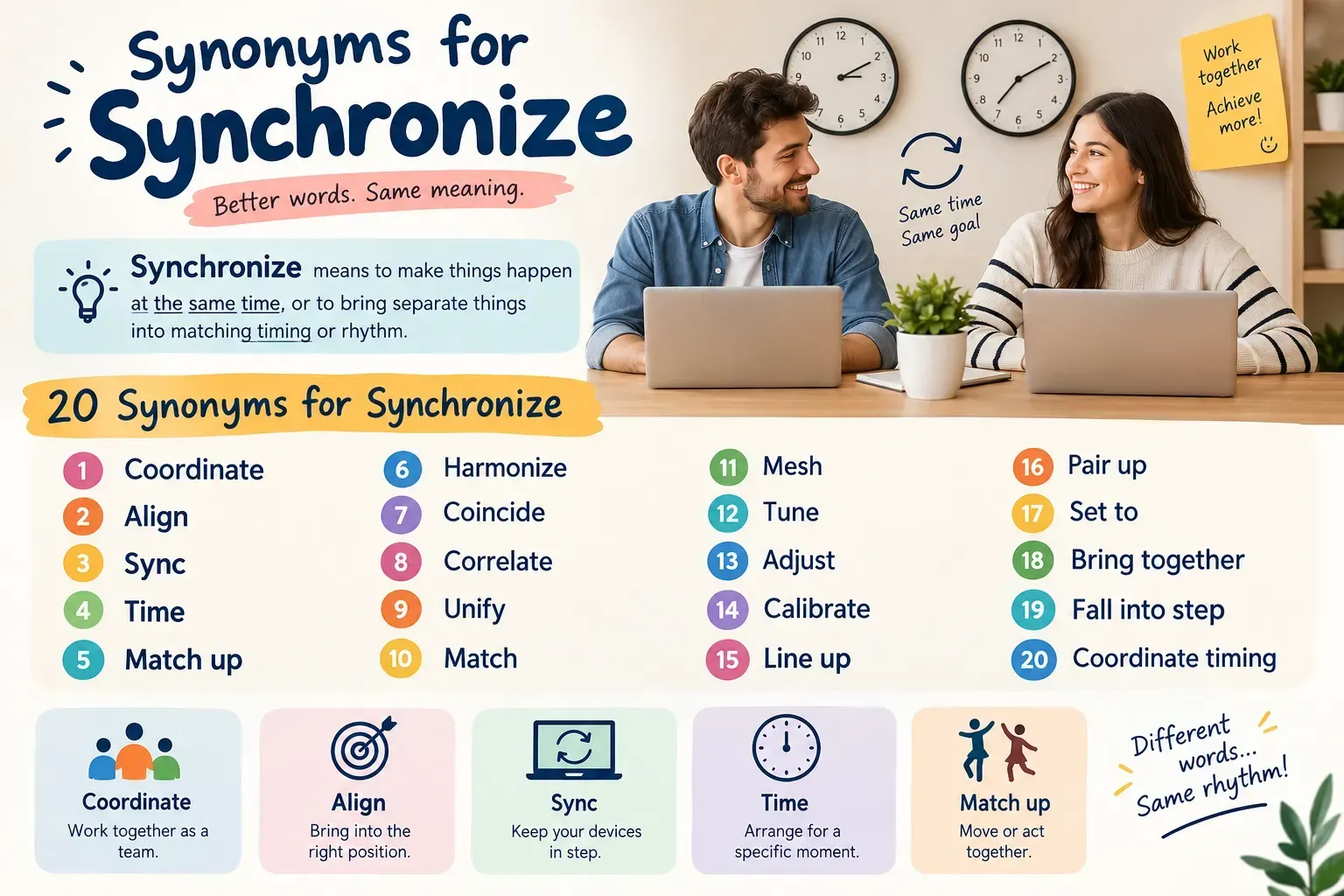
Synchronize means to make things happen at the same time, or to bring separate things into matching timing or rhythm. Strong alternatives include coordinate, align, and time. For technical or digital contexts, use sync. For matching movement or rhythm specifically, use match up.
Meaning of Synchronize
Synchronize is a verb meaning to cause two or more things to occur, operate, or move at the same time, or to bring them into a matching pattern of timing. You will hear it in everyday phrases like “synchronize your watches,” and also in technical contexts, as in “synchronize the files across both devices.”
The word carries two closely related but distinct uses. The first involves timing events so they happen simultaneously, such as fireworks synchronized to music. The second involves matching an ongoing rhythm or state over time, such as two dancers synchronizing their movements throughout a routine, not just at one single moment.
Synchronize functions as a transitive verb in most everyday use, meaning it typically takes a direct object, as in “synchronize the alarms” or “synchronize your calendars.” It can occasionally appear intransitively too, as in “the two systems synchronize automatically every hour.”
Pronunciation
Synchronize is pronounced SINK ruh nyze in standard American and British English, with stress falling on the first syllable. The middle syllable often reduces to a quick, unstressed sound, which is why the word can feel like it moves quickly when spoken aloud.
Etymology
Synchronize comes from the Greek roots syn, meaning together, and chronos, meaning time. Together, they form the idea of shared timing. The word entered English through French and Latin influence, and its meaning has stayed remarkably close to its original Greek sense throughout its history.
Word Formation
The prefix syn appears in many related English words, all carrying a sense of togetherness or unity, including symphony, synthesis, and symmetry. The root chronos also appears widely, forming words like chronology and chronic, all connected to the concept of time.
From synchronize, English derives several related forms. Synchronization is the noun describing the process or result of synchronizing. Synchronized functions as the past tense and also as an adjective, as in “synchronized swimming.” Synchronous describes something happening at the same time as something else, often used in technical or scientific writing, as in “synchronous communication.”
Best Synonyms for Synchronize
Coordinate works especially well when multiple people or moving parts need to work together smoothly, not necessarily at the exact same second. It suits teamwork, planning, and organizational contexts particularly well.
Align emphasizes bringing separate elements into a matching position or state, useful in both literal timing contexts and more abstract ones, such as aligning goals or aligning schedules.
Sync is the informal, shortened form used constantly in technology and casual speech, especially for digital devices, playlists, or calendars. It carries the same meaning as synchronize but in a much more casual register.
Time works as a verb in specific contexts, meaning to arrange something to happen at a particular moment, as in “time your entrance with the music.” It is more limited than synchronize, since it usually applies to a single event rather than ongoing coordination.
Match up suits situations involving rhythm, movement, or pattern, particularly in casual or descriptive writing, as in “the dancers matched up their steps perfectly.”
20 Synonyms for Synchronize
- Coordinate
- Align
- Sync
- Time
- Match up
- Harmonize
- Coincide
- Correlate
- Unify
- Match
- Mesh
- Tune
- Adjust
- Calibrate
- Line up
- Pair up
- Set to
- Bring together
- Fall into step
- Coordinate timing
Several of these deserve extra attention. Harmonize leans toward musical or metaphorical contexts, suggesting things fit together pleasantly, not just at the same time. Coincide applies specifically when two events happen to occur simultaneously, often without deliberate effort, as in “her birthday coincides with the holiday.” Correlate is more statistical and analytical, describing a relationship between patterns rather than deliberate timing.
Calibrate and adjust both suggest fine tuning a system so it operates correctly, often used for instruments or devices rather than people or events. Fall into step is an idiomatic phrase, useful for describing people gradually matching pace or rhythm with each other, often figuratively, as in “the new employee quickly fell into step with the team.”
1. Coordinate
Part of Speech: Verb
Meaning: To organize different people, parts, or activities so they work together effectively.
Best Use: Team projects, event planning, and logistics, where multiple moving pieces need to work smoothly together.
Difference: Coordinate does not always require exact matching timing, only effective cooperation.
Examples: The event planner coordinated three vendors for the wedding. Coordinate your outfits before the family photo.
2. Align
Part of Speech: Verb
Meaning: To bring separate things into a matching position, direction, or state.
Best Use: Business strategy, scheduling, and abstract contexts like goals or values, as well as literal physical positioning.
Difference: Align often applies beyond timing, covering positions, opinions, and priorities too.
Examples: The two departments aligned their quarterly goals. Please align the shelf brackets before drilling.
3. Sync
Part of Speech: Verb (informal)
Meaning: To make two or more things match or update together, especially digital data.
Best Use: Technology, casual conversation, and messaging between colleagues or friends.
Difference: Sync is far more informal than synchronize and dominates in tech contexts specifically.
Examples: My phone synced with the new laptop automatically. Let us sync on the plan tomorrow morning.
4. Harmonize
Part of Speech: Verb
Meaning: To bring elements into agreement or pleasant combination, often musically or figuratively.
Best Use: Music, relationships, and situations where cooperation feels smooth rather than merely timed.
Difference: Harmonize implies pleasant compatibility, while synchronize simply implies matching timing.
Examples: The two singers harmonized beautifully during the chorus. The new policy harmonizes with existing regulations.
5. Coincide
Part of Speech: Verb
Meaning: To happen at the same time, often without deliberate planning.
Best Use: Describing unplanned overlaps between events, dates, or circumstances.
Difference: Coincide usually implies chance, while synchronize implies intentional effort.
Examples: Her graduation coincided with her brother’s wedding. The two holidays coincide this year.
Types of Synonyms for Synchronize
Exact or close synonyms: coordinate, align, sync, match up, coordinate timing.
Contextual alternatives: harmonize (musical or metaphorical), calibrate (technical devices), correlate (data and statistics).
Idiomatic alternatives: fall into step, line up, pair up.
Not every word here fits every context equally well. Correlate, for example, works in a research paper but would sound strange applied to two friends synchronizing weekend plans.
Common Collocations and Natural Usage
“Synchronize watches” is a classic, fixed phrase, especially in film and heist scenarios. “Synchronize schedules” and “synchronize calendars” are both natural in workplace contexts. “Sync up” is common informal spoken English, as in “let’s sync up before the meeting.”
“Align” pairs naturally with goals, values, and strategies, as in “align our priorities,” while “synchronize” sounds slightly more mechanical or precise in the same context. “Coordinate” pairs naturally with efforts, teams, and logistics, as in “coordinate the volunteers.”
Synchronize vs Similar Words
Synchronize vs Coordinate: synchronize focuses specifically on matching timing, while coordinate focuses more broadly on organizing people or tasks to work well together, which may or may not involve exact timing.
Synchronize vs Coincide: synchronize implies intentional effort to match timing, while coincide often describes things happening at the same time by chance, without deliberate planning.
Synchronize vs Align: align can apply to physical position, values, or opinions, not only timing, making it a broader word than synchronize in some contexts.
How to Choose the Right Synonym
If you mean matching exact timing, use synchronize or time.
If you mean organizing people or tasks generally, use coordinate.
If you are writing about technology or devices, use sync.
If the emphasis is on rhythm or movement, use match up or fall into step.
If two things happen together by chance rather than plan, use coincide instead of synchronize.
If you are writing a technical manual or software document, sync or synchronize both work, though sync feels slightly more natural in user facing instructions, as in “tap sync to update your files,” while synchronize suits formal documentation, as in “the system will synchronize automatically every night.”
If you are describing a pleasant musical or interpersonal fit rather than plain timing, harmonize captures that nuance better than any of the more mechanical alternatives on this list.
Contextual Usage
In technical and software writing, sync and synchronize are often used side by side, with sync appearing in buttons, menus, and quick instructions, while synchronize appears in longer documentation or explanatory text. In creative or narrative writing, harmonize and fall into step add warmth and rhythm that plainer alternatives like coordinate cannot quite match. In business writing, coordinate and align dominate, since they emphasize teamwork and shared direction rather than exact timing.
Common Mistakes with Synchronize
Do not use coincide when deliberate coordination is actually involved. Coincide implies chance timing, not planning, so “we coincided our vacation dates” sounds odd compared to “we synchronized our vacation dates.”
Avoid using sync in highly formal writing. It works fine in technical documentation and casual speech, but a formal report typically calls for the full word synchronize.
Be careful with align when timing specifically matters. Align can describe matching values or positions without any reference to time at all, so it does not always substitute cleanly for synchronize.
Antonyms of Synchronize
Desynchronize, misalign, and stagger work as reasonable opposites, describing things that happen at different times or fall out of matching rhythm. Stagger in particular is useful when describing intentionally spaced timing, such as staggered work shifts, the deliberate opposite of synchronized timing.
Related Words
Some words connect closely to synchronize without functioning as true synonyms. Simultaneous is an adjective describing events happening at the same time, useful for describing the result of synchronizing rather than the act itself, as in “the launches were simultaneous.” Concurrent carries a similar meaning, often used in scheduling or legal contexts, as in “concurrent sentences” or “concurrent programs running on a server.”
Rhythm and tempo relate to synchronize in musical or physical contexts, describing the pattern that synchronized elements might follow, but neither word means to synchronize on its own. Understanding these related terms helps writers avoid mislabeling them as direct substitutes for the verb itself.
FAQ
What does synchronize mean? It means to make things happen at the same time, or to bring them into matching timing or rhythm.
What is another way to say synchronize? Coordinate, align, and sync are the most natural common alternatives, depending on context.
What is the difference between synchronize and coordinate? Synchronize focuses on exact timing, while coordinate focuses more broadly on organizing people or tasks together.
Is sync the same as synchronize? Yes, sync is simply an informal, shortened form of synchronize, used especially in technology and casual speech.
What is the opposite of synchronize? Desynchronize or stagger, describing things happening at different times rather than together.
Can synchronize be used for people, not just machines? Yes, people can synchronize schedules, movements, or efforts, not only digital devices or mechanical systems.
Is synchronize a formal word? It sits comfortably in both formal and everyday writing, though its shortened form, sync, is reserved almost entirely for casual or technical contexts.
Conclusion
Synchronize is a precise word built around the idea of shared timing, and its many alternatives each shift that meaning slightly. Coordinate broadens the focus to teamwork, sync casualizes it for technology, and coincide removes the intention entirely. Choosing the right word depends on whether timing, effort, chance, or rhythm matters most in your specific sentence. Consider whether your writing calls for precision, warmth, or casual ease, and let that guide you toward coordinate, harmonize, or sync rather than defaulting to synchronize every time.
Read More: Synonyms for Able To: 15 Useful Alternatives

Hi, I’m Ayesha, the creator of InstantSynonyms.com. I believe the right word can transform a sentence, strengthen an idea, and make communication more impactful. That’s why I created this site, to help writers, students, professionals, and English learners find accurate synonyms, antonyms, and better word choices quickly and effortlessly.
Every article is easy to understand, and designed to save you time while improving your vocabulary and writing. Whether you’re searching for a stronger alternative, a more precise expression, or simply expanding your word knowledge, my goal is to make finding the perfect word simple, fast, and reliable.