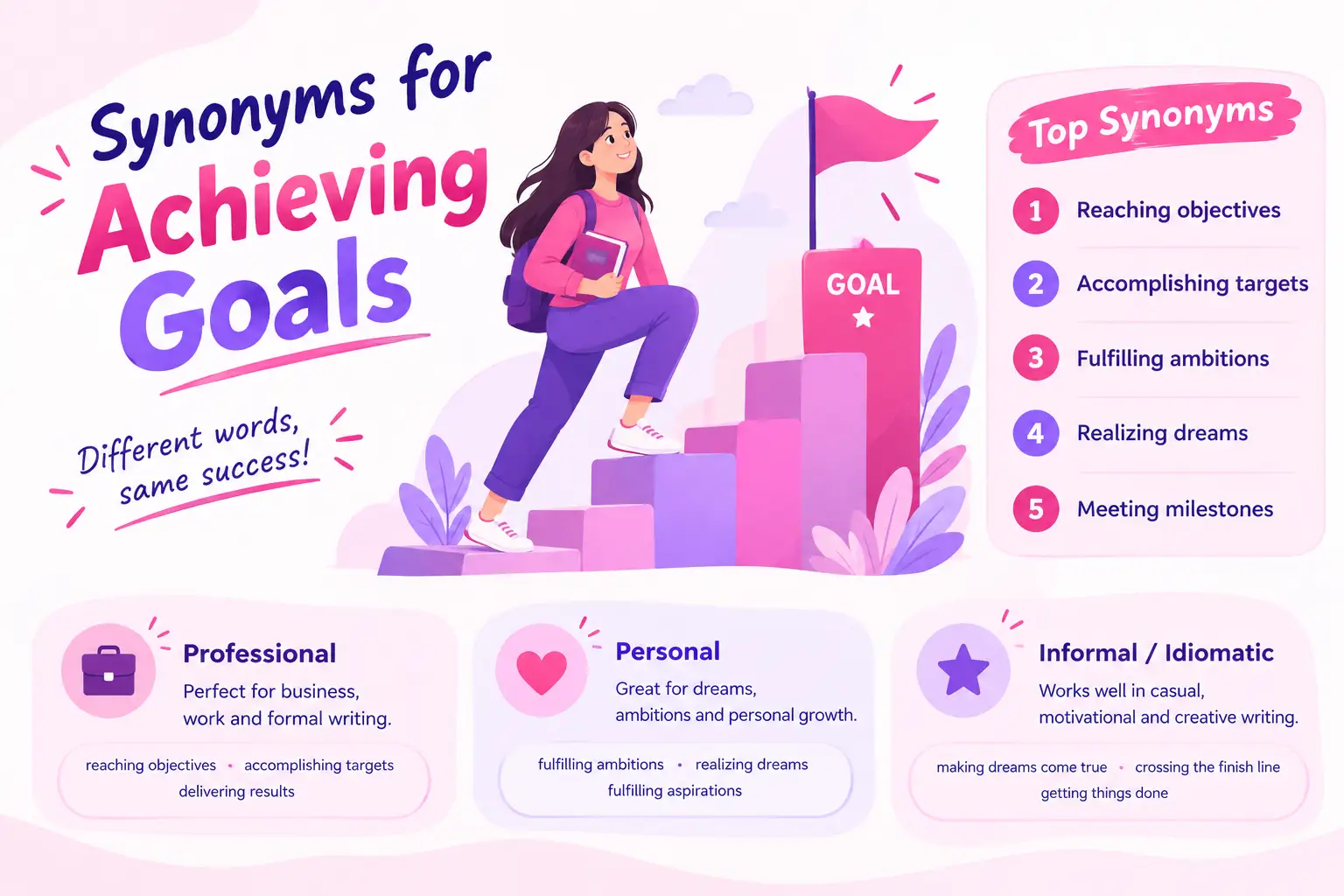
Achieving goals means successfully reaching the objectives a person or organization has set out to accomplish. Strong alternatives include reaching objectives and accomplishing targets for professional writing, and fulfilling ambitions or realizing dreams for more personal, reflective contexts. The right choice depends on how formal the writing is and whether the goal is practical or deeply personal.
Meaning of Achieving Goals
Achieving goals is a verb phrase describing the successful completion of objectives that a person, team, or organization has intentionally set out to reach. It combines the verb achieve, meaning to successfully complete or reach through effort, with the noun goals, meaning specific desired outcomes.
The phrase is used across a wide range of contexts, from personal development and fitness, as in “she is achieving her goals one step at a time,” to business and education, as in “the team is focused on achieving quarterly goals.” Because it is so common, especially in resumes, self help writing, and workplace communication, it can start to feel generic, which is exactly why so many writers search for stronger, more specific alternatives.
Connotation and Nuance
Achieving goals carries a positive, forward looking tone, but it is fairly neutral and somewhat overused in professional writing. It does not specify how difficult the goal was, how long it took, or how significant the outcome is, which is why many of the alternatives below exist to add exactly that kind of nuance, whether that means emphasizing effort, difficulty, speed, or emotional significance.
Best Synonyms for Achieving Goals
1. Reaching Objectives
Part of Speech: Verb phrase
Meaning: Successfully arriving at specific, often measurable targets set in advance.
Best Use: Works especially well in business, project management, and academic writing, where objectives are usually clearly defined and tracked.
Tone or Register: Formal to neutral, common in professional and organizational contexts.
Difference: Objectives often implies something more specific and measurable than goals, so this phrase fits especially well when outcomes are tracked with clear metrics.
Examples: The marketing team celebrated after reaching every objective set for the quarter. Reaching objectives on schedule required careful planning from the entire department.
2. Accomplishing Targets
Part of Speech: Verb phrase
Meaning: Successfully completing specific tasks or benchmarks set to measure progress.
Best Use: Works well in sales, performance reviews, and any context involving numeric or measurable benchmarks.
Tone or Register: Neutral to formal, common in business and performance related writing.
Difference: Targets implies a more quantifiable, often numeric benchmark compared to the broader, more general idea of goals.
Examples: The sales team focused entirely on accomplishing targets before the fiscal year ended. Accomplishing targets consistently earned her a promotion within eighteen months.
3. Fulfilling Ambitions
Part of Speech: Verb phrase
Meaning: Successfully realizing deep, often long held personal aspirations.
Best Use: Works especially well in personal, reflective, or motivational writing, rather than routine business contexts.
Tone or Register: Formal to literary, common in memoirs, speeches, and personal essays.
Difference: Ambitions carries more emotional and personal weight than goals, suggesting something deeply desired over a long period rather than a routine task.
Examples: After years of studying at night, she finally fulfilled her ambition of becoming a doctor. Fulfilling his ambitions meant leaving behind a stable but unfulfilling career.
4. Realizing Dreams
Part of Speech: Verb phrase
Meaning: Successfully turning a long imagined desire or vision into reality.
Best Use: Works best in emotional, personal, or inspirational writing, particularly when the achievement feels significant or life changing.
Tone or Register: Literary and emotionally warm, common in speeches and personal storytelling.
Difference: Dreams implies something more emotionally significant and less measurable than goals, often involving a long personal journey rather than a short term task.
Examples: Opening her own bakery was the moment she finally realized her dream. He spent a decade realizing the dream of running his own company.
5. Meeting Milestones
Part of Speech: Verb phrase
Meaning: Successfully completing important stages along the way toward a larger goal.
Best Use: Works well when describing progress within a longer process rather than a single final achievement.
Tone or Register: Neutral, common in project management and development contexts.
Difference: Milestones implies intermediate steps within a longer process, while achieving goals can refer to a single, final outcome rather than a sequence of smaller stages.
Examples: The construction project kept meeting milestones ahead of the original schedule. Meeting milestones early gave the team confidence going into the final phase.
25 Synonyms for Achieving Goals
- Reaching objectives
- Accomplishing targets
- Fulfilling ambitions
- Realizing dreams
- Meeting milestones
- Attaining goals
- Achieving objectives
- Reaching targets
- Fulfilling goals
- Attaining aims
- Accomplishing aims
- Succeeding in objectives
- Hitting targets
- Delivering results
- Making dreams come true (idiomatic)
- Turning goals into reality (idiomatic)
- Bringing goals to fruition (formal)
- Seeing goals through (idiomatic)
- Crossing the finish line (idiomatic, contextual)
- Getting things done (informal)
- Checking off goals (informal)
- Reaching the finish line (idiomatic, contextual)
- Hitting benchmarks (contextual, for measurable goals)
- Making progress toward goals (weaker, implies ongoing rather than completed)
- Fulfilling aspirations (formal, literary)
Types of Synonyms for Achieving Goals
Formal, professional alternatives such as reaching objectives, accomplishing targets, and delivering results fit business writing, resumes, and performance reviews.
Personal, emotional alternatives such as fulfilling ambitions, realizing dreams, and fulfilling aspirations fit reflective writing, speeches, and personal storytelling.
Idiomatic, informal alternatives such as making dreams come true, crossing the finish line, and getting things done work well in casual or motivational writing but would sound out of place in a formal report.
Progress focused alternatives such as meeting milestones and making progress toward goals describe ongoing steps rather than a single, completed achievement, so they should not be used interchangeably with fully finished accomplishments.
Achieving Goals vs Similar Phrases
Achieving Goals vs Meeting Milestones: Achieving goals typically implies a completed, final outcome, while meeting milestones describes intermediate steps within a longer process, so the two are not interchangeable when describing a single final accomplishment.
Achieving Goals vs Making Progress Toward Goals: Making progress implies an ongoing, unfinished effort, while achieving goals implies the goal has actually been reached, making this an important distinction in professional writing where completion matters.
Achieving Goals vs Fulfilling Dreams: Fulfilling dreams carries far more emotional and personal weight than the more neutral, practical phrase achieving goals, which fits routine, everyday objectives just as well as major life accomplishments.
How to Choose the Right Synonym
If you are writing a resume, business report, or performance review, reaching objectives, accomplishing targets, or delivering results sound precise and professional. If you are writing a personal essay, speech, or reflective piece, fulfilling ambitions or realizing dreams captures the emotional weight of the achievement more accurately. If you are describing an ongoing project rather than a finished outcome, meeting milestones or making progress toward goals avoids implying the work is already complete. If your writing is casual or motivational, idiomatic phrases like crossing the finish line or making dreams come true add energy without sounding overly formal.
Common Mistakes with Achieving Goals
A common mistake is using achieving goals interchangeably with meeting milestones, when milestones specifically describe intermediate steps rather than a final, completed outcome. Another mistake is using emotionally weighted phrases like realizing dreams for small, routine tasks, which can sound exaggerated, as in “she realized her dream of finishing the laundry.” Writers also sometimes overuse achieving goals throughout an entire document, when varying the phrasing with alternatives like reaching objectives or accomplishing targets would sound more natural and less repetitive.
Antonyms of Achieving Goals
Failing to reach goals, falling short of objectives, missing targets, abandoning ambitions.
FAQ
What does achieving goals mean? Achieving goals means successfully completing objectives that a person or organization intentionally set out to reach.
What is another way to say achieving goals? Reaching objectives, accomplishing targets, and fulfilling ambitions are common alternatives, depending on whether the tone is professional or personal.
What is the most formal alternative to achieving goals? Reaching objectives and accomplishing targets are among the most formal, professional choices, common in business and academic writing.
What is the difference between achieving goals and meeting milestones? Meeting milestones refers to intermediate steps within a longer process, while achieving goals typically refers to a final, completed outcome.
Are these phrases interchangeable? Not entirely. Emotional alternatives like realizing dreams fit personal, reflective writing, while formal alternatives like reaching objectives fit business and professional contexts, so the right choice depends on tone and setting.
What is the opposite of achieving goals? Failing to reach goals, falling short of objectives, and missing targets are common opposites.
How do I use achieving goals in a sentence? You can say, “Our team is focused on achieving our goals before the end of the quarter,” for a professional context, or “She finally achieved her lifelong goal of running a marathon,” for a personal one.
Conclusion
Achieving goals is a useful, flexible phrase, but it appears so often in resumes, reviews, and everyday writing that it can start to feel generic. Reaching objectives and accomplishing targets add precision for professional contexts, fulfilling ambitions and realizing dreams add emotional depth for personal writing, and meeting milestones adds clarity when describing progress rather than a finished result. Choosing the right alternative depends on how formal your writing needs to be, how emotionally significant the achievement is, and whether the goal has actually been completed or is still in progress.
Read More: Synonyms for Gate: 30 Useful Alternatives

Hi, I’m Ayesha, the creator of InstantSynonyms.com. I believe the right word can transform a sentence, strengthen an idea, and make communication more impactful. That’s why I created this site, to help writers, students, professionals, and English learners find accurate synonyms, antonyms, and better word choices quickly and effortlessly.
Every article is easy to understand, and designed to save you time while improving your vocabulary and writing. Whether you’re searching for a stronger alternative, a more precise expression, or simply expanding your word knowledge, my goal is to make finding the perfect word simple, fast, and reliable.