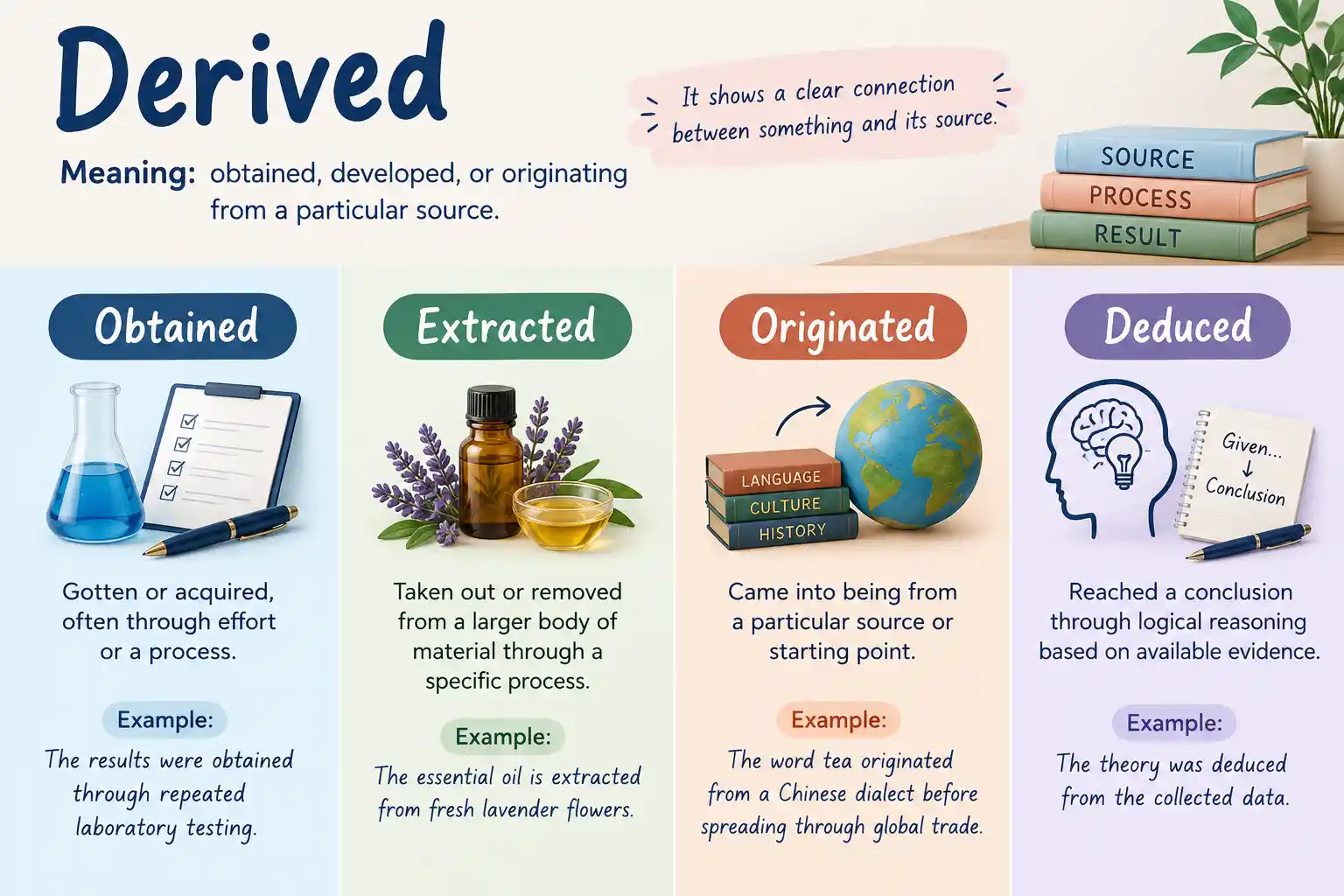
Derived means obtained, developed, or originating from a particular source. Strong alternatives include obtained and originated for general use, extracted for something taken from a larger body of material, and deduced or inferred for conclusions reached through reasoning. The right choice depends on whether you mean a physical source, a linguistic origin, or a logical conclusion.
Meaning of Derived
Derived is the past tense and past participle of the verb derive, and it commonly functions as an adjective describing something that comes from, or has developed out of, another source. The most common everyday use describes origin, as in “many English words are derived from Latin,” meaning they developed from that earlier language.
A closely related sense describes something obtained through a process, often from a larger body of material, as in “the flavoring is derived from natural plant extracts.” Here, derived emphasizes that something specific has been produced or extracted from a broader source.
A third sense, common in reasoning, mathematics, and law, describes conclusions or rules reached through logical steps, as in “this formula is derived from the original equation,” or “the ruling was derived from established legal precedent.” In this sense, derived is closer in meaning to concluded or deduced than to simply sourced or originated.
Connotation and Nuance
Derived is a fairly neutral, precise word. It does not carry strong positive or negative connotation, but it does imply a clear, traceable connection between something and its source, which is why it appears so often in etymology, science, and legal writing, where establishing exactly where something came from matters.
Word Formation
Derived comes from the base verb derive, and the word family includes derivation, the noun describing the process or origin itself, and derivative, both a noun and adjective describing something that has been derived, often used in finance, chemistry, and linguistics. Recognizing this family helps distinguish between derived, the descriptive term for something’s origin, and derivative, which more often labels the resulting product or substance itself.
Pronunciation
Derived is pronounced /dɪˈraɪvd/ (dih RYVD) in both American and British English.
Etymology
Derive comes from Latin derivare, meaning to draw off, formed from de meaning away and rivus meaning stream or river. The original image was literally drawing water away from a main stream into a smaller channel. This root explains the modern sense of derived remarkably well, since the word still describes something drawn out from an original, larger source, whether that source is a language, a substance, or a body of ideas.
Best Synonyms for Derived
1. Obtained
Part of Speech: Adjective or past participle
Meaning: Gotten or acquired, often through effort or a specific process.
Best Use: Works especially well in scientific, technical, or procedural writing describing how a result or product was produced.
Tone or Register: Neutral to formal, common in scientific and business writing.
Difference: Obtained is more general than derived and does not necessarily imply a traceable origin or source, only that something was successfully acquired.
Examples: The results were obtained through repeated laboratory testing. Consent must be obtained before any personal data is collected.
2. Originated
Part of Speech: Verb (past tense) or adjective
Meaning: Came into being from a particular source or starting point.
Best Use: Works well when describing the historical or geographical starting point of something, especially languages, customs, or ideas.
Tone or Register: Neutral, common in historical and linguistic writing.
Difference: Originated focuses on the point of beginning itself, while derived emphasizes the ongoing connection or development from that source.
Examples: The word tea originated from a Chinese dialect before spreading through global trade. This tradition originated centuries ago in a small coastal village.
3. Extracted
Part of Speech: Adjective or past participle
Meaning: Taken out or removed from a larger body of material through a specific process.
Best Use: Works especially well for physical or chemical substances taken from a larger source, such as oils, minerals, or data.
Tone or Register: Neutral to technical, common in chemistry, cooking, and data analysis.
Difference: Extracted implies a physical or deliberate removal process, while derived can describe a broader range of connections, including abstract or linguistic ones.
Examples: The essential oil is extracted from fresh lavender flowers. Key statistics were extracted from the larger survey dataset.
4. Deduced
Part of Speech: Verb (past tense) or adjective
Meaning: Reached a conclusion through logical reasoning based on available evidence.
Best Use: Works well specifically for the reasoning sense of derived, particularly in mathematics, science, and detective style analysis.
Tone or Register: Formal, common in academic and analytical writing.
Difference: Deduced applies specifically to logical conclusions, while derived can also describe simple, non logical origin, such as a word derived from another language.
Examples: Detectives deduced the timeline of events from the scattered evidence. The formula can be deduced directly from the two earlier equations.
5. Stemmed
Part of Speech: Verb (past tense, usually followed by from)
Meaning: Arose or developed as a direct result of a particular cause or origin.
Best Use: Works especially well for describing consequences, feelings, or situations that grew out of an earlier cause.
Tone or Register: Neutral to literary, common in narrative and explanatory writing.
Difference: Stemmed usually applies to abstract causes, such as emotions or conflicts, while derived applies more broadly across physical, linguistic, and logical sources.
Examples: Her fear of public speaking stemmed from a difficult experience in school. The disagreement stemmed from a simple miscommunication early in the project.
26 Synonyms for Derived
- Obtained
- Originated
- Extracted
- Deduced
- Stemmed
- Sourced
- Developed
- Concluded
- Inferred
- Formed
- Produced
- Traced (contextual, implies tracking origin)
- Drawn (contextual, as in a conclusion drawn from evidence)
- Descended (contextual, mainly for languages or lineage)
- Adapted (contextual, implies modification from an original)
- Rooted (contextual, implies a stable, foundational origin)
- Culled (contextual, implies selective extraction)
- Distilled (contextual, implies refinement from a larger source)
- Taken from (descriptive phrase)
- Based on (descriptive phrase, contextual)
- Coming from (informal, descriptive phrase)
- Arising from (formal, descriptive phrase)
- Resulting from (formal, descriptive phrase)
- Evolved from (contextual, implies gradual change)
- Borrowed (contextual, mainly for language, implies adoption from another source)
- Modeled on (contextual, implies deliberate imitation of a source)
Types of Synonyms for Derived
Source or origin alternatives such as originated, sourced, and rooted describe where something historically or physically came from.
Extraction alternatives such as extracted, distilled, and culled describe a deliberate process of taking something out of a larger body of material.
Reasoning alternatives such as deduced, inferred, and concluded apply specifically to the logical sense of derived, used in mathematics, science, and analysis.
Linguistic alternatives such as descended and borrowed apply narrowly to the origins of words and languages, and should not be used outside that specific context.
Derived vs Similar Words
1.Derived vs Inferred: Inferred applies specifically to conclusions reached through reasoning about evidence, while derived can describe both logical conclusions and simple, non logical origin, such as linguistic or chemical sources.
2.Derived vs Extracted: Extracted implies a physical or deliberate process of removal, often from a tangible source, while derived is broader and can describe abstract or linguistic connections that involve no physical extraction at all.
3.Derived vs Originated: Originated emphasizes the starting point itself, while derived emphasizes the connection between something and that starting point, often implying a process of development rather than a single moment of origin.
How to Choose the Right Synonym
If you are describing where a word or tradition historically comes from, originated or descended fits naturally. And If you are describing a physical or chemical substance taken from a larger source, extracted or distilled communicates that process precisely. If you are describing a conclusion reached through reasoning, deduced or inferred is the more accurate, logically precise choice. Then If you are describing an emotional or situational cause, stemmed captures that connection more naturally than the more general derived. If you simply need a neutral, general term for how something was acquired, obtained or sourced works well without implying any particular process.
Common Mistakes with Derived
A common mistake is using derived and inferred interchangeably in all contexts, when inferred applies specifically to reasoning and conclusions, while derived can describe simple origin without any reasoning involved at all, such as a word derived from Latin. Another mistake is using extracted for abstract or linguistic origins, since extracted implies a physical or deliberate removal process that does not apply to ideas, words, or emotions in the same way. Writers also sometimes confuse derived with derivative, using the adjective describing origin interchangeably with the noun that names the resulting product itself, which can create confusing or grammatically awkward sentences.
Antonyms of Derived
Original, native, innate, inherent, primary.
FAQ
What does derived mean? Derived means obtained, developed, or originating from a particular source, and it can apply to language, substances, or logical conclusions.
What is another way to say derived? Obtained, originated, and extracted are common general alternatives, while deduced and inferred fit specifically when a conclusion is reached through reasoning.
What is the difference between derived and deduced? Deduced applies specifically to conclusions reached through logical reasoning, while derived is broader and can describe simple origin, such as a word derived from another language, without any reasoning involved.
Is derived the same as extracted? Not exactly. Extracted implies a physical or deliberate process of removal from a larger source, while derived can describe both physical and abstract connections to an origin.
What is the opposite of derived? Original, native, and innate are common opposites, since they describe something that exists independently rather than coming from another source.
How do I use derived in a sentence? You can say, “The word chocolate is derived from an ancient Nahuatl word,” to describe linguistic origin, or “This conclusion was derived from three separate studies,” to describe a reasoned result.
Can derived describe both physical and abstract things? Yes. Derived applies to physical substances, such as oils extracted from plants, as well as abstract concepts, such as words, ideas, and logical conclusions, which is part of why it remains such a flexible, widely used word.
Conclusion
Derived is a precise, flexible word, but its best synonym depends heavily on exactly what kind of connection you are describing. Originated and sourced work well for historical or geographical origin, extracted and distilled work well for physical processes, and deduced or inferred work best for conclusions reached through reasoning. Paying attention to whether your context involves a physical source, a linguistic origin, or a logical process will help you choose a synonym that captures the connection accurately rather than one that only sounds similar.
Read More: Synonyms for Sympathetic: 28 Useful Alternatives

Hi, I am Abid, a writer and editor at InstantSynonyms.com, where he creates clear and reader-friendly content about synonyms, vocabulary, and English word usage. His goal is to help readers choose the right words, expand their vocabulary, and write with greater confidence.