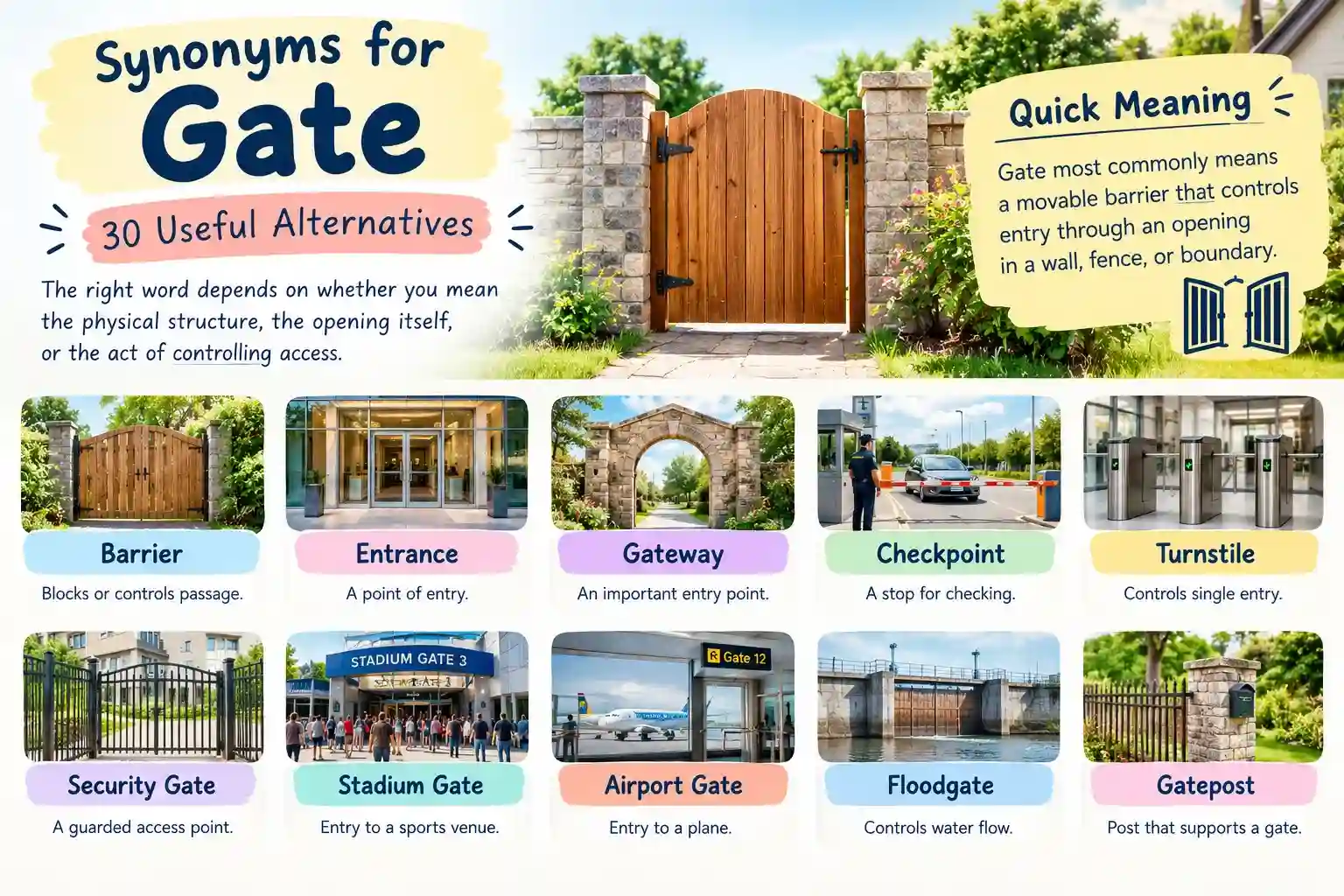
Gate most commonly means a movable barrier that controls entry through an opening in a wall, fence, or boundary. Strong alternatives include barrier, entrance, and gateway for general use, turnstile and checkpoint for controlled access points, and portal for a more dramatic or literary entrance. The right choice depends on whether you mean the physical structure, the opening itself, or the act of controlling access.
Meaning of Gate
Gate is primarily a noun referring to a hinged or sliding barrier used to close off an opening in a fence, wall, or other boundary, as in “close the gate behind you.” It can also refer more broadly to any controlled entry point, such as an airport gate, a stadium gate, or a security gate at a building entrance.
A secondary, related meaning describes the total number of people attending an event, as in “the gate for the concert was twenty thousand,” a usage borrowed from the idea of counting people as they pass through the physical gates of a venue.
As a verb, to gate means to restrict or control access to something, as in “the community is gated,” or in academic contexts, to prevent a student from progressing, as in “he was gated after failing the exam.” In slang and internet usage, gate also appears as a suffix attached to scandal names, such as Watergate, though this use functions differently from the standalone noun.
Pronunciation
Gate is pronounced /ɡeɪt/ (rhymes with late) in both American and British English.
Etymology
Gate comes from Old English geat, meaning an opening, gap, or passage, related to Old Norse gat, meaning an opening or hole. The word has existed in English since before the twelfth century, and its core meaning, a controlled opening in a barrier, has remained remarkably stable for over a thousand years, even as new applications, like airport gates and event attendance figures, developed much later.
Word Formation
Gate combines easily with other words to form compound nouns that describe specific types of gates or gate related concepts. Common examples include gateway, gatepost, gatekeeper, floodgate, tailgate, and gatecrasher. These compounds show how flexible the base word gate remains, extending its core meaning of a controlled opening into dozens of specialized contexts, from plumbing to parties.
Best Synonyms for Gate
1. Barrier
Part of Speech: Noun
Meaning: A structure that blocks or controls passage through a space.
Best Use: Works well when the emphasis is on blocking access rather than the specific mechanism used to do it.
Tone or Register: Neutral, suitable for both technical and everyday writing.
Difference: Barrier is broader than gate. A barrier does not necessarily open or close, while a gate is specifically designed to swing, slide, or lift to allow passage when needed.
Examples: The construction crew set up a barrier to keep pedestrians away from the site. Security lowered the barrier once the last car had passed through.
2. Entrance
Part of Speech: Noun
Meaning: A point of entry into a place, often referring to the opening itself rather than any physical barrier.
Best Use: Works well when describing where people enter a building or space, rather than the mechanism controlling that entry.
Tone or Register: Neutral, common in everyday and formal writing alike.
Difference: Entrance refers to the opening or point of access, while gate specifically implies a physical, often movable structure at that opening.
Examples: Visitors should use the main entrance on the north side of the building. The entrance was crowded with people waiting for the doors to open.
3. Gateway
Part of Speech: Noun
Meaning: An opening or passage that serves as an entry point, often with a sense of significance or transition.
Best Use: Works well in both literal contexts, such as a physical structure marking an entrance, and figurative contexts, such as “a gateway to new opportunities.”
Tone or Register: Slightly more formal or literary than gate, especially in figurative use.
Difference: Gateway often carries symbolic weight that plain gate does not, and it frequently appears in metaphorical expressions.
Examples: The old stone gateway marked the entrance to the university campus. Learning the basics is the gateway to mastering any new skill.
4. Checkpoint
Part of Speech: Noun
Meaning: A designated point where people or vehicles are stopped and checked before being allowed to proceed.
Best Use: Works best in security, military, or controlled access contexts, rather than everyday residential or agricultural gates.
Tone or Register: Neutral to formal, common in security and travel contexts.
Difference: A checkpoint emphasizes the inspection or verification process, while a gate simply refers to the physical barrier itself, whether or not inspection occurs.
Examples: Travelers passed through a security checkpoint before boarding the flight. The border checkpoint was busy with long lines of vehicles.
5. Turnstile
Part of Speech: Noun
Meaning: A mechanical gate that allows one person to pass at a time, often used to control entry and count visitors.
Best Use: Works specifically for stadiums, subway stations, and other venues that need to manage crowd flow and count entries.
Tone or Register: Neutral, technical in tone.
Difference: Turnstile is a much more specific and narrow term than gate, referring to a particular mechanical design rather than any general barrier.
Examples: Fans pushed through the turnstile as the gates opened before kickoff. The subway turnstile rejected her card twice before it finally worked.
30 Synonyms for Gate
- Barrier
- Entrance
- Gateway
- Checkpoint
- Turnstile
- Door
- Doorway
- Portal
- Opening
- Access point
- Wicket (contextual, older or regional usage for a small gate)
- Gatepost (contextual, refers to the post, not the gate itself)
- Barricade
- Threshold
- Passage
- Toll gate (contextual)
- Floodgate (contextual, for water control)
- Tollbooth (contextual)
- Fence gate
- Security gate
- Entry point
- Boom gate (contextual, common in parking and toll settings)
- Gate valve (contextual, mechanical or plumbing)
- Portcullis (contextual, historical, castle gate)
- Sluice gate (contextual, water management)
- Farm gate
- Automatic gate
- Sliding gate
- Swing gate
- Ranch gate (regional, common in American usage)
Types of Synonyms for Gate
General alternatives such as barrier, entrance, and opening apply broadly across contexts and do not require any specific setting.
Technical or specialized alternatives such as sluice gate, gate valve, and turnstile apply narrowly to particular industries like plumbing, engineering, or crowd management.
Historical or literary alternatives such as portcullis and portal are less common in everyday speech but appear naturally in historical writing, fantasy fiction, or poetic description.
Regional or contextual alternatives such as farm gate, ranch gate, and boom gate depend heavily on setting and geography, and would sound odd if used outside their natural context.
Common Collocations and Natural Usage
You typically say open the gate or close the gate, and these same verbs pair naturally with barrier and door as well. However, entrance is rarely paired with open or close directly; instead, you say use the entrance or find the entrance. Toll gate and floodgate are fixed compound terms and should not be separated into toll and gate as independent words in most contexts. Gatekeeper is also a fixed compound, referring to a person or system controlling access, and should not be confused with the physical gate itself.
Gate vs Similar Words
Gate vs Door: A gate is typically part of an outdoor boundary, such as a fence or wall, while a door is usually part of a building’s structure. Both control access, but their typical materials, locations, and designs differ.
Gate vs Entrance: Entrance refers to the point of entry itself, an opening or access route, while gate refers to the physical barrier that may or may not be present at that entrance. A building can have an entrance without any gate at all.
Gate vs Barrier: Barrier is a broader category that includes gates but also includes fixed structures that never open, such as concrete blocks or walls. A gate is specifically designed to allow controlled passage, while many barriers are not.
How to Choose the Right Synonym
If you are describing a physical, hinged or sliding barrier, gate or its close alternatives like swing gate and sliding gate work best. If you want to emphasize the point of entry rather than any physical structure, entrance or access point fits better. If security screening is involved, checkpoint communicates that process clearly. If you are writing about crowd management at an event, turnstile is the precise, technical choice. If the context is historical or fictional, portal or portcullis adds appropriate atmosphere without sounding anachronistic.
Common Mistakes with Gate
A frequent mistake is using gate and door interchangeably in formal or technical writing, when the two words actually describe structures in different settings, outdoor boundaries versus building openings. Another mistake is using gateway when a simple, literal gate is meant, since gateway often implies a broader or more symbolic sense of entry that can sound overly dramatic in plain, practical writing. Writers also sometimes confuse gate, meaning the physical barrier, with gate used as an attendance figure, as in “a strong gate,” which can confuse readers unfamiliar with that specific sports and event usage.
Antonyms of Gate
There is no single word antonym for gate as a physical object, since a gate’s function, controlling access, does not have a direct opposite object. However, contextual opposites include open space, unrestricted access, and wall, the last of which represents a permanent, non passable barrier rather than a controlled one.
FAQ
What does gate mean? Gate means a movable barrier that controls access through an opening in a fence, wall, or boundary. It can also refer to a controlled entry point, such as an airport gate.
What is another way to say gate? Barrier, entrance, and gateway are common general alternatives, while turnstile and checkpoint apply in more specific, controlled access contexts.
What is the difference between a gate and a door? A gate typically belongs to an outdoor boundary like a fence, while a door is part of a building. They serve a similar function but differ in typical location and design.
Is gateway the same as gate? Not exactly. Gateway often carries a broader or symbolic meaning, especially in figurative use, while gate usually refers to the literal, physical structure.
What is the opposite of gate? There is no direct single word opposite, though open space and unrestricted access serve as contextual opposites.
How do I use gate in a sentence? You can say, “Please close the gate when you leave the yard,” for the literal meaning, or “The gate for tonight’s game was over thirty thousand fans,” for the attendance sense.
Can gate be used as a verb? Yes. To gate something means to restrict or control access to it, as in “the neighborhood is gated” or, in academic contexts, “the student was gated from the next course.”
Conclusion
Gate is a simple, ancient word, but its synonyms cover a wide range of specific situations, from a swinging farm gate to a controlled airport checkpoint. Barrier and entrance work as general alternatives, turnstile and checkpoint apply to controlled access settings, and gateway and portal carry more symbolic or literary weight. Choosing the right word depends on whether you are describing a literal physical structure, a point of entry, or a broader, more figurative kind of access, and paying attention to that distinction will make your writing more precise and natural.
Read More: Synonyms for Critic: 27 Useful Alternatives

Hi, I am Abid, a writer and editor at InstantSynonyms.com, where he creates clear and reader-friendly content about synonyms, vocabulary, and English word usage. His goal is to help readers choose the right words, expand their vocabulary, and write with greater confidence.