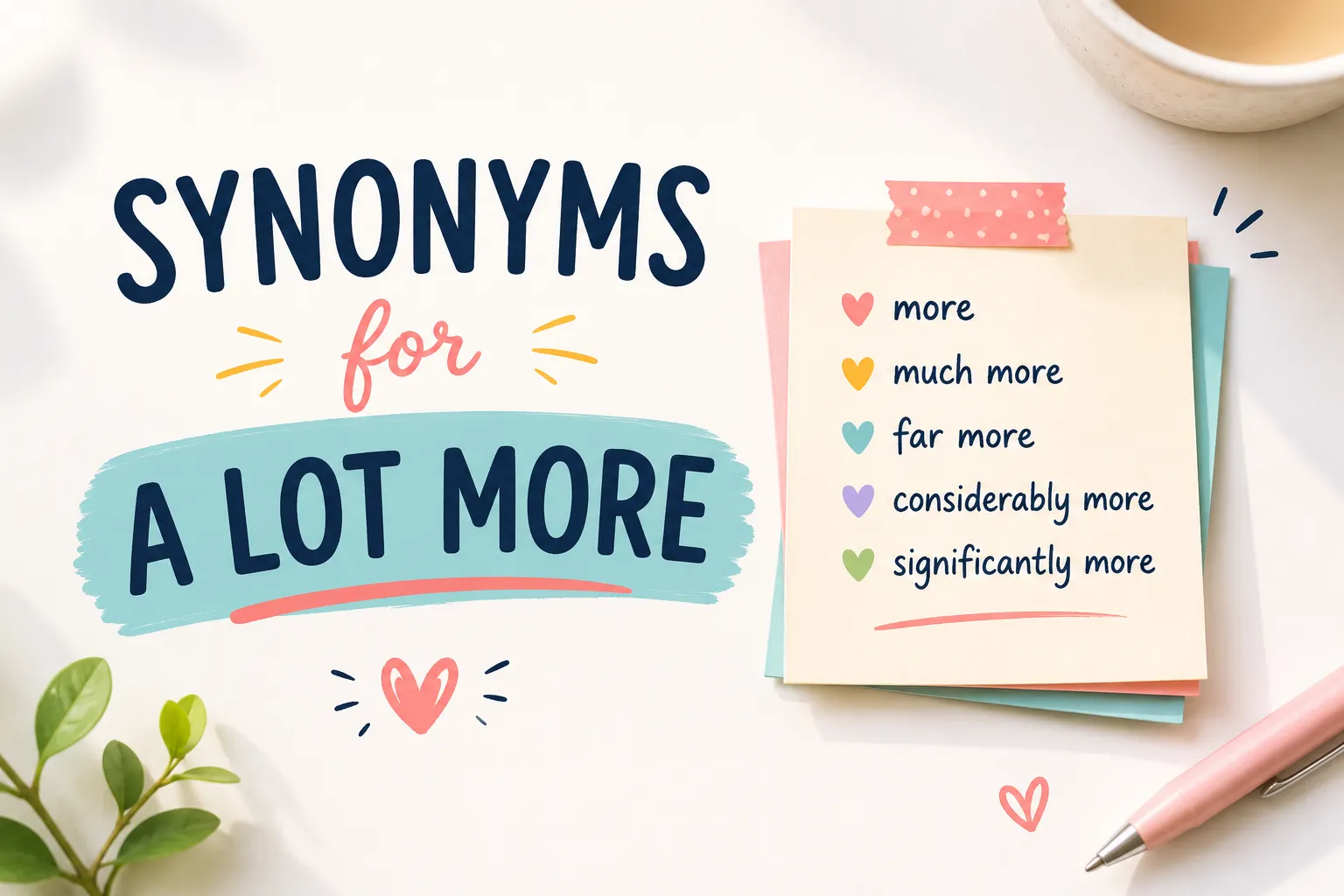
A lot more means a clearly greater amount, degree, or number than something else. Strong alternatives include far more, considerably more, way more, a great deal more, and significantly more, each suited to a different tone, from casual conversation to formal analysis. The right choice depends on how formal your writing is and how large the difference really is.
Meaning of A Lot More
A lot more is an adverbial phrase built from a lot (an informal noun phrase meaning a large quantity) and more (the comparative form of much and many). It describes a difference in amount, degree, or number, and it works with both countable and uncountable nouns, which explains why it shows up so often in speech and writing.
I need a lot more time to finish this properly. The new apartment has a lot more natural light than the old one.
A lot more always implies a comparison, either stated directly or clear from context. On its own, without any point of reference, the phrase can sound incomplete.
Connotation and Nuance
A lot more carries no built in emotional charge. The feeling comes from what surrounds it, not the phrase itself.
Positive tone: gaining a lot more confidence, earning a lot more respect. Negative tone: facing a lot more debt, dealing with a lot more stress. Neutral tone: the store gets a lot more foot traffic on weekends.
In formal writing, a lot more can feel slightly casual next to sharper alternatives like considerably more or significantly more. In conversation, that casual feel is exactly what makes it work.
Pronunciation
A lot more is pronounced /ə lɒt mɔːr/ in British English and /ə lɑːt mɔːr/ in American English. The stress lands on lot and more, while a reduces to a quick, unstressed schwa, just as it would in ordinary connected speech.
Etymology
Lot traces back to the Old English word hlot, originally meaning a share or portion, often used in the context of drawing lots to divide property or settle a decision. Over time its meaning broadened from a specific portion to a general sense of a large quantity, a usage that became especially common in informal American English by the nineteenth century.
More descends from the Old English māra, the comparative form of micel, meaning great or large. Its role as the standard comparative of much and many has stayed consistent throughout the history of English.
The phrase a lot more was not coined deliberately. It formed naturally as everyday speakers paired a casual quantity word with a standard comparative, the kind of combination that emerges through use rather than invention.
Word Formation
A lot more is a phrase rather than a single word, so it does not take prefixes or suffixes as a unit. Its parts still connect to a few genuine related forms worth knowing.
Lots functions as an informal plural, as in lots of time. Allot is a related verb meaning to give a designated share of something, sharing the same root sense of a portion. Most is the superlative form that more belongs to, used for the highest degree rather than a comparison between two things.
These are true morphological relatives, not just words that happen to look similar.
Best Synonyms for A Lot More
If you only remember a handful of alternatives, start here.
Far more works almost everywhere. It fits casual writing and formal writing equally well, which makes it the safest general purpose swap. This model performs far more efficiently than the last one.
Considerably more is the dependable choice for reports, essays, and professional communication. It signals a substantial, measured increase without sounding dramatic. The renovation cost considerably more than we budgeted.
Way more carries real energy and belongs in conversation and informal writing. That hike was way more tiring than the map made it look.
A great deal more suits abstract qualities like patience, courage, or effort, and it adds a touch of warmth that plainer alternatives lack. She showed a great deal more courage than anyone expected.
Significantly more is the standard in academic, scientific, and data driven writing, since it implies the increase can be measured or observed, not just felt. The treatment group showed significantly more improvement than the control group.
22 Synonyms for A Lot More
Each entry below is genuinely useful. Weak, awkward, or overly obscure alternatives have been left out on purpose, even though that means stopping short of thirty.
1. Far More
Part of Speech: Adverbial phrase Classification: Exact synonym Meaning: A notably greater amount or degree. Best Use: General writing and speech, formal or casual. Examples: This route is far more direct than the one we usually take. Her portfolio shows far more range than her resume suggests.
2. Much More
Part of Speech: Adverbial phrase Classification: Exact synonym Meaning: A greater amount, most natural with uncountable nouns. Best Use: Everyday speech and writing. Difference: Slightly plainer and less emphatic than a lot more. Examples: I need much more context before I can weigh in. The coastline gets much more rainfall than the interior.
3. Significantly More
Part of Speech: Adverbial phrase Classification: Close synonym Meaning: A measurable, noteworthy increase. Best Use: Academic, scientific, or business writing. Difference: Implies the increase can be observed or proven, not just sensed. Examples: Customer retention improved significantly more than the team projected. The second sample showed significantly more variation.
4. Considerably More
Part of Speech: Adverbial phrase Classification: Close synonym Meaning: A substantial, noteworthy increase. Best Use: Formal reports, professional emails, essays. Examples: The client asked for considerably more detail in the next draft. His second novel received considerably more attention than his first.
5. Substantially More
Part of Speech: Adverbial phrase Classification: Close synonym Meaning: A large, meaningful increase, often paired with measurable amounts. Best Use: Financial, legal, or technical writing. Examples: The updated contract requires substantially more collateral. Server load increased substantially more after the product launch.
6. Way More
Part of Speech: Adverbial phrase Classification: Exact synonym, informal register Meaning: A large increase, expressed casually. Best Use: Conversation, texting, informal writing. Examples: This recipe takes way more prep than the video made it look. He knows way more about vintage cars than anyone else at the shop.
7. A Great Deal More
Part of Speech: Noun phrase functioning adverbially Classification: Close synonym Meaning: A large, meaningful increase, often used with abstract qualities. Best Use: Formal or literary writing, or speech that wants warmth. Examples: The old house needs a great deal more work than the listing let on. He showed a great deal more restraint than his brother would have.
8. A Good Deal More
Part of Speech: Noun phrase functioning adverbially Classification: Close synonym Meaning: A sizable additional amount, slightly less formal than a great deal more. Best Use: General writing and speech. Examples: We have a good deal more ground to cover before the deadline. He earns a good deal more than he did two years ago.
9. Markedly More
Part of Speech: Adverbial phrase Classification: Close synonym Meaning: Clearly and noticeably more, often describing a measurable shift. Best Use: Academic and analytical writing. Examples: The results were markedly more consistent in the second trial. Her confidence grew markedly more after the internship.
10. Noticeably More
Part of Speech: Adverbial phrase Classification: Close synonym Meaning: More in a way that is easy to observe. Best Use: Descriptive writing, reviews, everyday speech. Examples: The office felt noticeably more relaxed after the reorganization. Tickets are noticeably more expensive this year.
11. Vastly More
Part of Speech: Adverbial phrase Classification: Near synonym, stronger intensity Meaning: An enormous, sweeping increase. Difference: Considerably stronger than a lot more, best reserved for genuinely large gaps. Best Use: Formal or literary writing that wants strong emphasis. Examples: The updated model offers vastly more detail than its predecessor. Her grasp of tax law is vastly more advanced than mine.
12. Immensely More
Part of Speech: Adverbial phrase Classification: Near synonym, stronger intensity Meaning: A very large increase, emphasizing scale. Best Use: Formal or emotionally expressive writing. Examples: The crew felt immensely more prepared after the second rehearsal. This edition contains immensely more detail than the original printing.
13. Enormously More
Part of Speech: Adverbial phrase Classification: Near synonym, stronger intensity Meaning: A very large, striking increase. Best Use: Formal writing or strong emphasis in speech. Examples: The neighborhood has grown enormously more expensive over the past decade. This process is enormously more efficient than the one we used before.
14. A Whole Lot More
Part of Speech: Noun phrase functioning adverbially Classification: Exact synonym, informal register Meaning: A large amount, expressed with extra casual emphasis. Best Use: Conversation, informal writing, storytelling. Examples: There is a whole lot more going on here than you realize. We need a whole lot more rehearsal before opening night.
15. Loads More
Part of Speech: Adverbial phrase Classification: Exact synonym, British informal Meaning: A large amount, common in British conversational English. Best Use: Casual British English. Examples: There is loads more room in the new flat than the old one. He has loads more patience with the kids than I do.
16. Tons More
Part of Speech: Adverbial phrase Classification: Exact synonym, informal Meaning: A large amount, informal and slightly exaggerated. Best Use: Casual speech and writing. Examples: There is tons more to see if you have another day here. This role pays tons more than my last one did.
17. Plenty More
Part of Speech: Adverbial phrase Classification: Contextual alternative Meaning: An ample, sufficient additional amount. Difference: Focuses on sufficiency and reassurance rather than sheer emphasis, softer than a lot more. Best Use: Reassuring or casual contexts. Examples: Do not worry, there is plenty more where that came from. We still have plenty more to review before the meeting ends.
18. Appreciably More
Part of Speech: Adverbial phrase Classification: Close synonym Meaning: A noticeable, measurable increase, slightly formal in tone. Best Use: Academic and technical writing. Examples: The revised model performs appreciably more accurately under load. Costs rose appreciably more than the initial estimate.
19. Distinctly More
Part of Speech: Adverbial phrase Classification: Close synonym Meaning: Clearly, unmistakably more. Best Use: Descriptive or comparative writing. Examples: The final draft reads distinctly more clearly than the one before it. This part of town feels distinctly more residential.
20. Dramatically More
Part of Speech: Adverbial phrase Classification: Near synonym, stronger intensity Meaning: A striking, sudden, or large increase. Best Use: News, business, and emphatic writing. Examples: Applications rose dramatically more than the admissions office expected. The redesign looks dramatically more modern than the original site.
21. Several Times More
Part of Speech: Adverbial phrase Classification: Contextual alternative Meaning: A multiplied increase, often implying at least two or three times the original amount. Difference: Unlike most entries here, this implies a specific multiplier rather than a general sense of more. Best Use: Technical, financial, or scientific comparisons. Examples: The new server handles several times more traffic than the old one could. This plan costs several times more than the basic tier.
22. A Great Many More
Part of Speech: Determiner phrase Classification: Contextual alternative Meaning: A large additional number. Difference: Works only with countable nouns, never with amounts or degrees. You cannot say a great many more patience. Best Use: Formal writing describing countable items. Examples: A great many more applicants came forward this year than last. There are a great many more options on the menu now.
Types of Synonyms for A Lot More
Grouping these alternatives by function makes it easier to pick the right one on the spot.
Formal alternatives: significantly more, considerably more, substantially more, markedly more, appreciably more. These fit reports, essays, and professional communication.
Informal alternatives: way more, a whole lot more, tons more, loads more. These belong in conversation, texting, and casual writing.
Stronger alternatives: vastly more, immensely more, enormously more, dramatically more. Reach for these only when the difference genuinely is large, not for everyday comparisons.
Countable specific alternatives: a great many more, several times more. These carry grammatical restrictions the others do not, so they cannot simply be swapped in anywhere.
Contextual alternatives: plenty more shifts the meaning slightly toward sufficiency rather than emphasis, which makes it useful in reassuring situations rather than dramatic ones.
Intensity Scale
Moderate: far more, much more, noticeably more, a whole lot more. Strong: considerably more, significantly more, substantially more, markedly more, appreciably more, distinctly more. Very strong: vastly more, immensely more, enormously more, dramatically more.
This scale is a general guide, not a fixed rule. Context can make a moderate word land hard, or a strong word feel mild, depending on what surrounds it.
Common Collocations and Natural Usage
Significantly more and substantially more pair naturally with data, revenue, and research results, since both imply a measurable increase.
A great deal more fits comfortably with abstract nouns like patience, effort, and courage, but sounds awkward with simple countable objects.
Loads more and tons more tend to appear with everyday nouns like space, time, and food in casual speech, rarely in formal writing.
Native speakers rarely say vastly more time for a short delay. Vastly more fits bigger, more formal gaps, such as vastly more resources or vastly more experience, not small everyday differences.
A Lot More vs Similar Words
A lot more vs many more: a lot more works with both countable and uncountable nouns, while many more only works with countable nouns. You can say a lot more water, but not many more water.
A lot more vs way more: both express a large increase, but way more belongs in casual speech, while a lot more sits comfortably in slightly more neutral contexts too. Swapping one for the other changes the tone of a sentence noticeably.
A lot more vs significantly more: significantly more implies a measurable or provable increase, often backed by data. A lot more is looser and works fine for subjective impressions, such as feeling a lot more confident after a good night of sleep.
How to Choose the Right Synonym
If you want a neutral, everyday alternative, use far more or much more.
If you are writing formally, choose considerably more, significantly more, or substantially more.
If you are speaking casually, way more, tons more, or a whole lot more all fit naturally.
If the difference is genuinely huge, reach for vastly more, immensely more, or enormously more instead of overusing a lot more.
If the noun is countable and specific, check whether many more or a great many more fits better than any of the more phrases above.
If you are describing a specific multiplier rather than a general increase, several times more is more precise than a lot more.
Common Mistakes with A Lot More
Pairing many more with uncountable nouns produces errors like many more information instead of the correct a lot more information or much more information.
Overusing a lot more in formal writing can sound casual next to sharper options like considerably more or significantly more, especially in reports meant to read as precise.
Reaching for very strong words like vastly more or immensely more to describe small, everyday differences can make writing sound exaggerated. Save those for genuinely large gaps.
Using a lot more without any stated or implied point of comparison can leave a sentence feeling incomplete. Saying I need a lot more only works if the reader already knows more than what.
Antonyms of A Lot More
A lot less: a significantly smaller amount. Far less: a notably smaller amount, the direct opposite of far more. Considerably less: a formal way to describe a smaller amount. Slightly less: a small, modest decrease.
Frequently Asked Questions
What does a lot more mean? It means a clearly greater amount, degree, or number compared to something else, whether that comparison is stated directly or understood from context.
What is another way to say a lot more? Far more, considerably more, and way more are all natural, widely used alternatives, each suited to a different tone.
What is the strongest synonym for a lot more? Vastly more, immensely more, and enormously more all carry noticeably stronger intensity than a lot more.
What is the most formal alternative to a lot more? Significantly more and substantially more are the most common choices in academic and business writing.
Are these synonyms interchangeable? Not completely. Some lean informal, some imply measurable data, some require countable nouns, and one, plenty more, shifts the meaning toward sufficiency rather than emphasis.
What is the difference between a lot more and many more? A lot more works with both countable and uncountable nouns. Many more only works with countable nouns, so a lot more water is correct while many more water is not.
What is the opposite of a lot more? A lot less, far less, and considerably less all express the opposite idea of a smaller amount.
Conclusion
A lot more earns its place in everyday English because it is flexible, but that same flexibility is why it gets repeated so often. Choosing between alternatives like far more, considerably more, or vastly more comes down to three questions: how formal the writing is, how large the difference actually is, and whether the noun is countable or not. Treat these words as tools with slightly different strengths rather than interchangeable substitutes, and your sentences will read with more precision and confidence.
Read More: Synonyms for Curse: 18 Alternatives Worth Knowing

Hi, I am Abid, a writer and editor at InstantSynonyms.com, where he creates clear and reader-friendly content about synonyms, vocabulary, and English word usage. His goal is to help readers choose the right words, expand their vocabulary, and write with greater confidence.