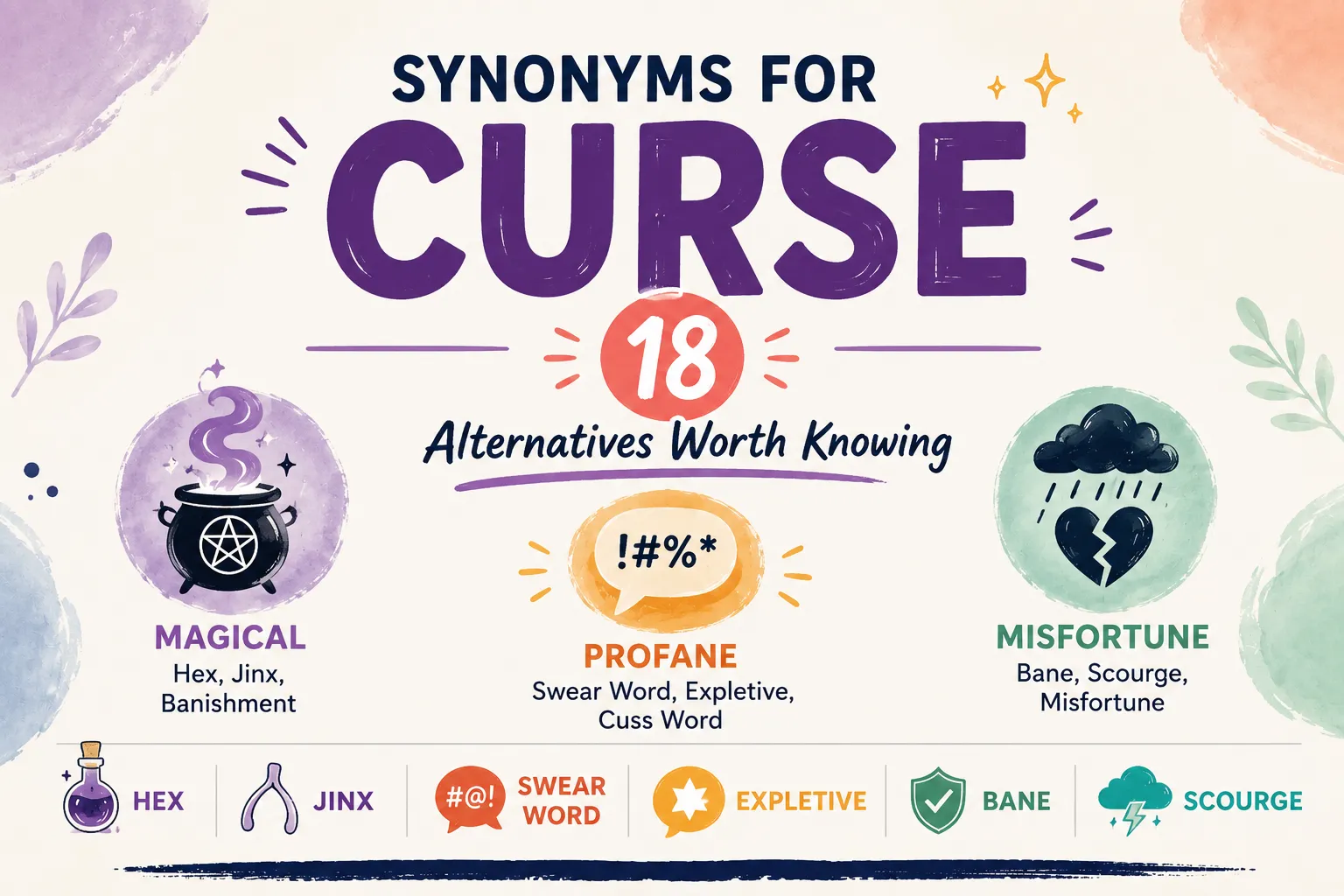
“Curse” can mean a spoken spell meant to bring harm, a swear word, or a source of ongoing misfortune. Depending on which meaning you intend, the strongest alternatives are hex, jinx, swear word, expletive, bane, and scourge.
Meaning of Curse
“Curse” has three distinct everyday meanings, and choosing the right synonym depends on which one you intend.
Supernatural sense (noun or verb): words spoken to invoke harm on someone through magic or superstition.
The witch in the story places a curse on the village.
Profanity sense (noun or verb): a swear word, or the act of using one.
He let out a curse when he hit his thumb with the hammer.
Misfortune sense (noun): a lasting source of trouble or bad luck, used metaphorically.
Injuries have been a curse for this team all season.
Connotation and Nuance
All three senses of “curse” carry a negative charge, but the intensity differs. The supernatural sense often appears in fiction and folklore and can feel dramatic or even playful, depending on tone. The profanity sense is blunt and can range from mildly rude to genuinely offensive, depending on the specific word. The misfortune sense is more figurative and often shows up in sports, business, and everyday complaints about persistent bad luck.
Etymology
“Curse” comes from the Old English word curs, meaning an invocation of evil or harm. Its exact origin before Old English is uncertain, and linguists have not settled on a confirmed root, so it is best to treat the word’s earliest history as unclear rather than fixed.
Best Synonyms for Curse
Hex. The clearest choice when you mean a spoken spell intended to cause harm, common in fiction and folklore. “The old woman claimed she could hex anyone who crossed her.”
Swear word. The plain, neutral term for a profane word, useful in everyday writing and conversation. “The film was rated for strong language and swear words.”
Bane. A literary, slightly formal choice for something that causes persistent trouble, especially in writing. “Traffic has become the bane of her daily commute.”
Jinx. A lighter, more casual alternative to hex, often used for bad luck rather than deliberate harm. “Don’t jinx it by talking about the win too early.”
Scourge. A strong, formal word for something that causes widespread suffering, best reserved for serious situations. “Malaria remains a scourge in many parts of the world.”
18 Synonyms for Curse
1. Hex
Part of Speech: Noun or verb
Classification: Exact synonym (supernatural sense)
Meaning: A spell or spoken curse intended to cause harm through magic.
Best Use: Fiction, folklore, and casual references to superstition.
Examples: According to local legend, the house carries an old hex. She joked that her sister had hexed her bad luck with tests.
2. Jinx
Part of Speech: Noun or verb
Classification: Close synonym (supernatural or luck sense)
Meaning: A cause of bad luck, often used casually rather than seriously.
Best Use: Everyday conversation about superstition or luck.
Difference: Lighter and less menacing than hex, often used half jokingly.
Examples: He refuses to say the score out loud in case he jinxes the team. The old car felt jinxed after its third breakdown that month.
3. Malediction
Part of Speech: Noun
Classification: Exact synonym (supernatural sense), formal register
Meaning: A formal or literary word for a spoken curse.
Best Use: Literary or formal writing.
Examples: The priest’s malediction echoed through the empty church. The novel opens with an ancient malediction placed on the family line.
4. Spell
Part of Speech: Noun
Classification: Near synonym (supernatural sense)
Meaning: A set of words believed to have magical power.
Best Use: Fiction and folklore.
Difference: Broader than curse, since a spell is not always harmful.
Examples: The wizard cast a spell to unlock the door. Not every spell in the story is meant to harm.
5. Swear Word
Part of Speech: Noun phrase
Classification: Exact synonym (profanity sense)
Meaning: A word considered offensive or vulgar.
Best Use: Everyday writing and conversation about language and media ratings.
Examples: The comedian’s set was full of swear words. Parents complained about the swear words in the game’s dialogue.
6. Expletive
Part of Speech: Noun
Classification: Close synonym (profanity sense), formal register
Meaning: A swear word, often used in more formal or journalistic writing.
Best Use: News writing, transcripts, and formal contexts describing offensive language.
Examples: The recording included several expletives that were later censored. The report quoted the coach’s outburst, expletives included.
7. Cuss Word
Part of Speech: Noun phrase
Classification: Close synonym (profanity sense), informal register
Meaning: A casual, mainly American way to describe a swear word.
Best Use: Casual conversation and informal writing.
Examples: My grandmother never allowed cuss words in her house. He muttered a cuss word under his breath after missing the shot.
8. Obscenity
Part of Speech: Noun
Classification: Near synonym (profanity sense)
Meaning: Offensive or indecent language, often broader than a single swear word.
Best Use: Formal or legal contexts discussing offensive language.
Difference: Can refer to indecent content generally, not just individual words.
Examples: The station received complaints about the obscenity used during the broadcast. The law defines certain public obscenity as a punishable offense.
9. Oath
Part of Speech: Noun
Classification: Near synonym (profanity sense), somewhat dated
Meaning: A sworn or exclaimed word, historically used to describe cursing.
Best Use: Older or literary writing.
Difference: Modern readers usually associate oath with a formal promise, so this sense can sound dated.
Examples: The sailor let out an oath as the rope snapped. In older novels, characters often mutter an oath instead of a modern swear word.
10. Bane
Part of Speech: Noun
Classification: Close synonym (misfortune sense), literary register
Meaning: A persistent source of harm, trouble, or annoyance.
Best Use: Writing that wants a slightly literary tone.
Examples: Slow internet has been the bane of remote work for years. Procrastination remained the bane of his college career.
11. Scourge
Part of Speech: Noun
Classification: Close synonym (misfortune sense), formal and strong
Meaning: A cause of widespread suffering or serious trouble.
Best Use: Formal writing about serious, large scale problems.
Difference: Stronger and more serious than bane, better suited to major issues rather than minor annoyances.
Examples: Drought has become a scourge for farmers in the region. Historians describe the plague as a scourge that reshaped Europe.
12. Plague
Part of Speech: Noun or verb
Classification: Near synonym (misfortune sense)
Meaning: A persistent, troubling problem, used metaphorically outside its literal disease sense.
Best Use: Describing ongoing, widespread problems.
Examples: Injuries have plagued the team since the season began. Delays have plagued the construction project for months.
13. Affliction
Part of Speech: Noun
Classification: Near synonym (misfortune sense)
Meaning: A condition or problem that causes ongoing suffering or difficulty.
Best Use: Formal or medical writing, as well as figurative use.
Examples: Chronic pain has been a lasting affliction for her. Debt became an affliction the family struggled to escape.
14. Blight
Part of Speech: Noun
Classification: Near synonym (misfortune sense)
Meaning: Something that damages or spoils, used both literally for plant disease and figuratively for other harm.
Best Use: Writing about decline, damage, or lasting harm.
Examples: Corruption has been a blight on the city’s politics for decades. The abandoned factories are a blight on the neighborhood.
15. Swear
Part of Speech: Verb
Classification: Exact synonym (profanity sense, verb form)
Meaning: To use offensive or vulgar language.
Best Use: Everyday speech and writing about someone’s language.
Examples: He swore loudly after stubbing his toe. She rarely swears, even under pressure.
16. Cuss
Part of Speech: Verb
Classification: Close synonym (profanity sense, verb form), informal register
Meaning: To swear, mainly used in casual American English.
Best Use: Casual conversation and informal writing.
Examples: He cussed under his breath when the printer jammed again. She never cussed in front of her kids.
17. Damn
Part of Speech: Verb
Classification: Near synonym (supernatural or condemnation sense)
Meaning: To condemn someone or something, historically tied to religious or moral judgment.
Best Use: Literary, religious, or dramatic writing.
Difference: Focuses on condemnation or judgment rather than a spoken magical curse.
Examples: The old text warns that lying will damn the soul. Critics damned the film before it even opened.
18. Condemn
Part of Speech: Verb
Classification: Related expression
Meaning: To express strong disapproval, or to sentence someone to a negative fate.
Best Use: Formal writing, especially about judgment or punishment.
Difference: Broader than curse, since it does not require any magical or supernatural element.
Examples: The committee condemned the decision as reckless. His silence condemned him in the eyes of the jury.
Types of Synonyms for Curse
Supernatural sense: hex, jinx, malediction, spell. These describe a spoken or magical curse, common in fiction and folklore.
Profanity sense: swear word, expletive, cuss word, obscenity, oath, swear, cuss. These describe offensive language or the act of using it.
Misfortune sense: bane, scourge, plague, affliction, blight. These describe a lasting source of trouble, used mostly in figurative writing.
Condemnation sense: damn, condemn. These relate to judgment or moral disapproval, overlapping with curse only in specific contexts.
Choosing the right category first will point you to the right word faster than scanning the full list.
Formality Scale
For the profanity sense, register shifts noticeably: cuss word and cuss sit on the casual end, swear word and swear sit in the middle, and expletive and obscenity belong to formal or journalistic writing.
For the misfortune sense, bane and plague read as moderately literary, while scourge and affliction lean more formal and serious.
Common Collocations and Natural Usage
“Bane” almost always appears with “of,” as in the bane of his existence or the bane of modern life. “Scourge” pairs naturally with large scale problems: a scourge of violence, a scourge on society. “Swear word” and “cuss word” pair naturally with “use” or “say,” while “expletive” often appears in the phrase “expletive deleted” in journalism.
Curse vs Similar Words
Curse versus jinx. A curse often implies a deliberate, sometimes serious act, while a jinx is usually lighter and can happen accidentally or superstitiously.
Curse versus swear word. Curse can refer to the supernatural sense, the profanity sense, or the misfortune sense. Swear word refers only to offensive language, so it is more precise when that is the intended meaning.
Curse versus scourge. Scourge is reserved for serious, large scale harm, such as disease or violence. Curse can describe something far smaller, like ongoing bad luck.
How to Choose the Right Synonym
If you mean a spoken magical curse, use hex, malediction, or spell depending on tone.
If you mean a swear word, choose swear word for neutral writing, expletive for formal writing, or cuss word for casual writing.
Also If you mean a lasting source of trouble, bane fits smaller annoyances, while scourge fits serious, widespread harm.
And If you are describing someone’s language rather than the words themselves, use swear or cuss as verbs.
Common Mistakes with Curse
Writers sometimes use “scourge” for minor annoyances, when the word is better reserved for serious, large scale harm like disease, violence, or widespread suffering.
Another common mistake is treating “oath” as a modern synonym for swearing. In contemporary English, oath usually means a formal promise, so using it to mean profanity can confuse readers unfamiliar with the older sense.
Antonyms of Curse
Blessing. The clearest opposite of the supernatural and misfortune senses, meaning something that brings good fortune or favor.
Compliment. A contextual opposite of the profanity sense, meaning kind or polite language rather than offensive language.
Frequently Asked Questions
What does curse mean?
It can mean a spoken spell intended to cause harm, a swear word, or a lasting source of misfortune, depending on context.
What is another way to say curse?
Hex or malediction for the supernatural sense, swear word or expletive for profanity, and bane or scourge for lasting misfortune.
What is the strongest synonym for curse?
Scourge is the strongest choice for the misfortune sense, since it implies serious, widespread harm.
What is the most formal alternative?
Malediction, expletive, and scourge all suit formal or literary writing.
Are these synonyms interchangeable?
No. They split across three distinct meanings, so choosing the right one depends on whether you mean magic, profanity, or lasting trouble.
What is the opposite of curse?
Blessing is the clearest opposite for the supernatural and misfortune senses.
Conclusion
“Curse” covers three different ideas, and the best synonym depends entirely on which one you mean. Hex and malediction suit magic and folklore, swear word and expletive suit offensive language, and bane and scourge suit lasting trouble, with scourge reserved for genuinely serious harm. Once you identify which sense fits your sentence, choosing the right word becomes straightforward.
Read More: Synonyms for Camera: 31 Powerful Words to Know

Hi, I’m Ayesha, the creator of InstantSynonyms.com. I believe the right word can transform a sentence, strengthen an idea, and make communication more impactful. That’s why I created this site, to help writers, students, professionals, and English learners find accurate synonyms, antonyms, and better word choices quickly and effortlessly.
Every article is easy to understand, and designed to save you time while improving your vocabulary and writing. Whether you’re searching for a stronger alternative, a more precise expression, or simply expanding your word knowledge, my goal is to make finding the perfect word simple, fast, and reliable.