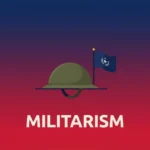
Militarism is a belief that a nation should build strong armed forces and use them aggressively. Strong synonyms include warmongering, hawkishness, saber rattling, and military buildup.
Throughout history, some nations have built their entire identity around military strength, believing that armed power is the surest path to security and prestige. This belief and the culture built around it is called militarism, a word that appears often in history books, political commentary, and news analysis of nations expanding their armies or glorifying war. Picture a country pouring most of its budget into weapons and soldiers while celebrating military parades as a symbol of national pride. Learning synonyms for militarism gives writers, students, and history enthusiasts a wider vocabulary for describing this mindset with precision instead of repeating the same term throughout an essay. This article covers the meaning of militarism, its origin, pronunciation, and word formation, followed by twenty two synonyms with clear meanings and examples, plus categorization, antonyms, and frequently asked questions.
Meaning of Militarism
Definition
Militarism (Noun): A belief or policy that a country should maintain strong armed forces and be ready and willing to use them aggressively to defend or promote national interests.
Examples
- Rising militarism in the region worried neighboring countries.
- Historians point to militarism as a major cause of the war.
Connotative Meaning
Positive tone: There is little to no positive connotation, though supporters within a militaristic culture may view it as strength and pride. Negative tone: It usually carries a critical tone, suggesting aggression, danger, and the risk of conflict. Neutral tone: In academic history and political science, the term is used analytically to describe a nation’s policies without added judgment.
(Connotation: the emotional association a word carries beyond its literal meaning.)
Etymology
Old English (450 to 1100): The word did not exist in Old English, though early Germanic peoples certainly held cultures centered on warfare and martial honor. Middle English (1100 to 1500): Related vocabulary around soldiers and warfare, borrowed from French and Latin, began entering English, though the specific term militarism had not yet formed. Modern English (1500 to Present): Militarism entered English in the 1800s from French “militarisme,” built from Latin “miles,” meaning soldier, becoming widely used in the late 1800s and early 1900s to describe the policies of nations building large standing armies.
Pronunciation (IPA)
IPA: /ˈmɪlɪtərɪzəm/ Syllables: mil i tar ism, four syllables total
Affixation Pattern of Militarism
Root: miles, Latin for soldier Prefix: none Suffix: ism, forming a noun describing a belief system or practice Word formations:
- Militarism (noun)
- Militarist (noun, a believer in militarism)
- Militaristic (adjective)
- Militarize (verb)
- Militarization (noun)
22 Synonyms of Militarism With Meaning and Examples
1. Warmongering (Noun)
Meaning: The act of encouraging or promoting war, often for political or economic gain. Examples:
- Critics accused the leader of warmongering to distract from domestic problems.
- The speech was widely condemned as reckless warmongering.
2. Belligerence (Noun)
Meaning: An aggressive and hostile readiness to fight or go to war. Examples:
- The country’s belligerence alarmed its trading partners.
- Diplomats tried to calm the belligerence before it escalated further.
3. Jingoism (Noun)
Meaning: Extreme, aggressive patriotism that favors a warlike foreign policy. Examples:
- Jingoism swept through the press ahead of the declaration of war.
- His speeches leaned heavily on jingoism rather than careful policy.
4. Saber Rattling (Noun Phrase)
Meaning: Displaying military power or threatening war to intimidate an opponent. Examples:
- The border dispute triggered months of saber rattling on both sides.
- Analysts dismissed the announcement as mere saber rattling.
5. Bellicosity (Noun)
Meaning: A tendency or inclination to be aggressive and eager for conflict. Examples:
- The general’s bellicosity worried even his own advisors.
- Years of bellicosity finally pushed the region toward open conflict.
6. Martial Spirit (Noun Phrase)
Meaning: A cultural or national attitude that values military discipline, honor, and readiness for combat. Examples:
- The empire’s martial spirit shaped its education and public celebrations.
- Statues throughout the capital celebrated the nation’s martial spirit.
7. Hawkishness (Noun)
Meaning: A strong preference for aggressive or military solutions to political problems. Examples:
- Hawkishness within the cabinet pushed the country toward intervention.
- Voters grew wary of the candidate’s hawkishness on foreign policy.
8. Military Buildup (Noun Phrase)
Meaning: A significant increase in a country’s armed forces, weapons, or defense spending. Examples:
- The military buildup along the border raised international concern.
- Economists debated whether the military buildup was sustainable long term.
9. Aggressive Nationalism (Noun Phrase)
Meaning: A form of national pride combined with a willingness to use force against other nations. Examples:
- Aggressive nationalism fueled the expansionist campaigns of the era.
- Historians link the war to a surge in aggressive nationalism.
10. War Footing (Noun Phrase)
Meaning: A state of readiness and mobilization for war, even before fighting begins. Examples:
- The economy shifted onto a war footing within weeks of the crisis.
- Factories were converted for production as the nation moved to a war footing.
11. Gunboat Diplomacy (Noun Phrase)
Meaning: The use of visible military force or threats to achieve diplomatic goals. Examples:
- Nineteenth century powers often relied on gunboat diplomacy in trade disputes.
- The naval deployment was widely seen as an act of gunboat diplomacy.
12. War Culture (Noun Phrase)
Meaning: A society’s values, media, and traditions that glorify or normalize warfare. Examples:
- Decades of war culture shaped how young people viewed military service.
- Films and textbooks alike reflected the nation’s war culture.
13. Militant Nationalism (Noun Phrase)
Meaning: A combative form of nationalism that promotes conflict as a means of achieving national goals. Examples:
- Militant nationalism drove much of the era’s territorial expansion.
- The movement combined militant nationalism with strong anti immigrant rhetoric.
14. Arms Race Mentality (Noun Phrase)
Meaning: A mindset in which nations continuously build up weapons to match or exceed rivals. Examples:
- The arms race mentality of the era drained national budgets.
- Analysts warned that the arms race mentality could spiral out of control.
15. Power Politics (Noun Phrase)
Meaning: A political approach based on military and economic strength rather than diplomacy or cooperation. Examples:
- Power politics dominated relations between the rival empires.
- Critics argued that power politics ignored the human cost of conflict.
16. Force Projection (Noun Phrase)
Meaning: The ability of a nation to deploy and sustain military power beyond its own borders. Examples:
- The new bases expanded the country’s force projection across the region.
- Force projection became central to the nation’s foreign policy strategy.
17. Pro War Stance (Noun Phrase)
Meaning: A public or political position that favors military action over diplomacy. Examples:
- His pro war stance cost him support among moderate voters.
- The newspaper openly took a pro war stance during the crisis.
18. Martial Mindset (Noun Phrase)
Meaning: A way of thinking shaped by military values such as discipline, hierarchy, and readiness for combat. Examples:
- Years in the army left him with a lasting martial mindset.
- The academy was designed to instill a martial mindset in its students.
19. War Readiness (Noun Phrase)
Meaning: A state of preparedness for armed conflict, including troops, weapons, and logistics. Examples:
- The drills were meant to test the nation’s war readiness.
- War readiness became a constant theme in government spending debates.
20. Expansionist Policy (Noun Phrase)
Meaning: A government approach favoring territorial growth, often backed by military force. Examples:
- The empire’s expansionist policy relied heavily on its growing army.
- Neighboring states grew nervous under the pressure of expansionist policy.
21. Military Supremacy (Noun Phrase)
Meaning: The pursuit or achievement of the strongest possible armed forces relative to rivals. Examples:
- The arms buildup aimed squarely at achieving military supremacy.
- Military supremacy became the nation’s central strategic goal.
22. Chauvinistic Nationalism (Noun Phrase)
Meaning: An extreme, prideful nationalism that often justifies aggression and military action. Examples:
- Chauvinistic nationalism painted every rival nation as an enemy.
- The regime used chauvinistic nationalism to justify its military campaigns.
Prototype Meaning
When people picture militarism, they typically imagine a country with a massive standing army, frequent military parades, heavy defense spending, and political leaders who favor force over negotiation. The prototypical case involves a national culture that celebrates soldiers and weapons as symbols of pride, often at the expense of civilian priorities.
Prototype Categorization
The synonyms above fall into a few useful groups.
- Attitudes and mindsets: Bellicosity, hawkishness, martial spirit, martial mindset, jingoism. These describe internal beliefs and dispositions.
- Policies and strategies: Military buildup, war footing, force projection, expansionist policy, arms race mentality, military supremacy. These describe concrete government actions.
- Rhetoric and diplomacy: Warmongering, saber rattling, gunboat diplomacy, pro war stance, power politics. These describe how militarism is expressed or communicated.
- National ideology: Aggressive nationalism, militant nationalism, chauvinistic nationalism, war culture. These describe broader cultural and ideological framing.
Choosing among these depends on whether you want to emphasize belief, policy, communication, or national ideology.
Antonyms of Militarism
- Pacifism (Noun): A belief in resolving conflict through peaceful means, opposing war and violence.
- Demilitarization (Noun): The process of reducing or eliminating military forces and weapons.
- Diplomacy (Noun): The practice of resolving disputes through negotiation rather than force.
- Disarmament (Noun): The reduction or elimination of weapons and armed forces.
- Nonviolence (Noun): A commitment to achieving goals without the use of physical force.
Short Questions and Answers
What does militarism mean? It refers to a belief or policy that favors a strong military and a readiness to use force to achieve national goals.
When should militarism be used? Use it when discussing a nation’s aggressive buildup of armed forces, its glorification of war, or a culture centered on military strength.
Is militarism positive or negative? It is generally viewed negatively in modern discourse, associated with aggression, conflict, and the risk of war, though some cultures historically framed it as a source of pride.
How is it different from similar words? Nationalism describes pride in one’s country broadly, while militarism specifically emphasizes military strength and the willingness to use armed force to pursue national interests.
Conclusion
Learning militarism and its many synonyms strengthens historical, political, and academic writing. Instead of repeating the same word, writers can choose from mindset terms like hawkishness and bellicosity, policy terms like military buildup and war footing, or ideological terms like aggressive nationalism and war culture. This vocabulary range improves both writing and speaking, sharpens historical analysis, and builds real confidence in English communication. Make it a habit to study new vocabulary daily and notice how much more precisely you can describe complex political ideas.
Read More: Synonyms for Baseball: 18 Words and Phrases to Know

Hi, I’m Ayesha, the creator of InstantSynonyms.com. I believe the right word can transform a sentence, strengthen an idea, and make communication more impactful. That’s why I created this site, to help writers, students, professionals, and English learners find accurate synonyms, antonyms, and better word choices quickly and effortlessly.