Crab mentality means pulling others down out of envy instead of celebrating their success. Strong synonyms include tall poppy syndrome, schadenfreude, sabotage, and zero sum thinking.
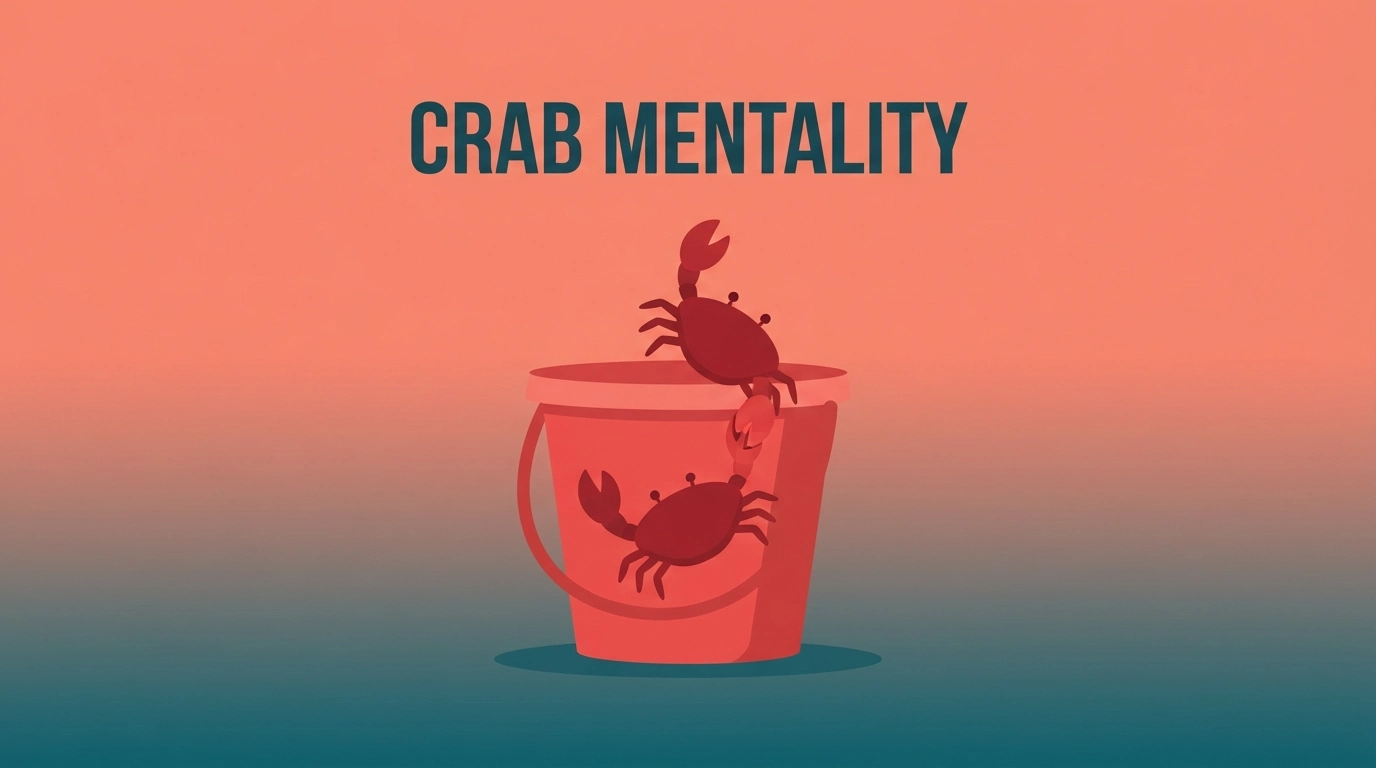
Picture a bucket full of live crabs. Any single crab could easily climb out and escape, but the moment one gets close to the top, the others grab and pull it back down. None of them escape, and all of them stay trapped together. This image gave rise to the phrase crab mentality, used to describe people who would rather see others fail than watch them succeed. It shows up in offices where a coworker undermines a promotion, in friend groups where success is met with cold silence instead of celebration, and in communities where ambition is quietly punished. Understanding crab mentality and its many synonyms helps English learners, writers, and everyday speakers describe this behavior with precision instead of repeating the same phrase over and over. This article walks through the meaning of crab mentality, its origin, pronunciation, and word formation, followed by twenty five synonyms complete with meanings and examples, along with categorization, antonyms, and common questions.
Meaning of Crab Mentality
Definition
Crab mentality (Noun Phrase): A way of thinking in which people try to bring down anyone who tries to rise above the group, often out of envy or fear of being left behind.
Examples
- Her coworkers showed crab mentality when they mocked her for applying to a leadership role.
- Crab mentality kept the whole team stuck, since no one wanted anyone else to shine.
Connotative Meaning
Positive tone: There is no positive connotation. The phrase always points to something harmful. Negative tone: It carries a sharply critical tone, describing envy, sabotage, and small mindedness. Neutral tone: In academic or sociological writing, it can appear in a more neutral, descriptive way when analyzing group behavior.
(Connotation: the emotional association a word carries beyond its literal meaning.)
Etymology
Old English (450 to 1100): The word crab comes from the Old English “crabba,” referring to the crustacean, with no figurative use at this stage. Middle English (1100 to 1500): Crab entered common use for the animal and, separately, began to describe a bad tempered or irritable person, an early hint of its later negative associations. Modern English (1500 to Present): The specific phrase crab mentality is a twentieth century coinage, popularized in the Philippines and widely used across Asia and beyond by the late 1900s to describe collective envy that drags down individual success.
Pronunciation (IPA)
IPA: /kræb mɛnˈtæləti/ Syllables: crab (1) men tal i ty (4), five syllables total
Affixation Pattern of Crab Mentality
Root: crab (noun) plus mentality (from Latin mens, meaning mind) Prefix: none Suffix: ality, forming an abstract noun from the root ment Word formations:
- Crab (noun)
- Crabby (adjective, irritable)
- Mentality (noun, a way of thinking)
- Mental (adjective)
25 Synonyms of Crab Mentality With Meaning and Examples
1. Crabs in a Bucket (Noun Phrase)
Meaning: The literal image behind the idiom, used interchangeably with crab mentality. Examples:
- The startup collapsed because the founders acted like crabs in a bucket.
- It felt like crabs in a bucket whenever anyone tried to stand out.
2. Tall Poppy Syndrome (Noun Phrase)
Meaning: The tendency to criticize or cut down people who become more successful than their peers. Examples:
- Australians sometimes joke about tall poppy syndrome when a star athlete gets mocked at home.
- Tall poppy syndrome made her hide her promotion from old classmates.
3. Begrudgery (Noun)
Meaning: A habit of resenting other people’s achievements or good fortune. Examples:
- Begrudgery ran through the small town whenever a local family did well.
- His success was met with begrudgery rather than praise.
4. Schadenfreude (Noun)
Meaning: Pleasure taken from another person’s misfortune or failure. Examples:
- There was a hint of schadenfreude in her laugh when the rival team lost.
- Online comments often reveal schadenfreude toward celebrities who stumble publicly.
5. Envy (Noun)
Meaning: A feeling of discontent caused by someone else’s success or possessions. Examples:
- Envy, not honesty, drove his harsh review of her work.
- Pure envy explained why they never congratulated the winner.
6. Jealousy (Noun)
Meaning: Resentment against someone seen as a rival or as having an advantage. Examples:
- Jealousy poisoned the friendship once one of them got famous.
- His jealousy showed every time she was praised in meetings.
7. Spite (Noun)
Meaning: A desire to hurt or upset someone, often out of resentment. Examples:
- Out of spite, he refused to share the client contact.
- The rumor was spread purely out of spite.
8. Malice (Noun)
Meaning: A deep intention to harm or see someone suffer. Examples:
- There was real malice in the way she undermined the new hire.
- The sabotage was carried out with quiet malice.
9. Resentment (Noun)
Meaning: Bitter feelings caused by a sense of unfair treatment or another’s success. Examples:
- Resentment built up among the staff who were passed over for the role.
- She could not hide her resentment toward her more successful sister.
10. Backbiting (Noun)
Meaning: Speaking badly about someone behind their back, often out of envy. Examples:
- Backbiting among the staff made the office feel unsafe.
- The backbiting only stopped after management addressed it directly.
11. Sabotage (Noun/Verb)
Meaning: Deliberately damaging or undermining someone’s efforts or success. Examples:
- Sabotage of her project came from a colleague afraid of being outperformed.
- He tried to sabotage the plan rather than admit it was better than his own.
12. Underminement (Noun)
Meaning: The act of gradually weakening someone’s position or confidence. Examples:
- Constant underminement from her manager damaged her confidence over time.
- The underminement was subtle, a comment here, a delay there.
13. One Upmanship (Noun)
Meaning: Constantly trying to outdo or outperform someone in a petty way. Examples:
- Their friendship turned into a contest of one upmanship.
- He answered every achievement with one upmanship instead of applause.
14. Sour Grapes (Noun Phrase)
Meaning: Pretending not to want something after failing to get it, often paired with criticizing those who succeeded. Examples:
- His complaints about the award sounded like sour grapes.
- That is just sour grapes talking, not honest feedback.
15. Dog in the Manger Attitude (Noun Phrase)
Meaning: Refusing to let others enjoy something even though you have no use for it yourself. Examples:
- His dog in the manger attitude kept the tools locked away, unused by anyone.
- She blocked the transfer out of a dog in the manger attitude.
16. Zero Sum Thinking (Noun Phrase)
Meaning: The belief that one person’s gain must mean another person’s loss. Examples:
- Zero sum thinking made him treat every coworker’s win as his own defeat.
- The negotiation stalled because both sides fell into zero sum thinking.
17. Scarcity Mindset (Noun Phrase)
Meaning: A belief that resources, opportunities, or success are limited, encouraging hoarding and rivalry. Examples:
- A scarcity mindset made the team compete instead of collaborate.
- Growing up poor left him with a lasting scarcity mindset.
18. Petty Rivalry (Noun Phrase)
Meaning: Small minded competition often rooted in envy rather than real conflict. Examples:
- Petty rivalry between the two departments slowed every joint project.
- Their petty rivalry started over a parking spot and never really ended.
19. Toxic Competitiveness (Noun Phrase)
Meaning: An unhealthy drive to win that damages relationships and cooperation. Examples:
- Toxic competitiveness among the siblings ruined family gatherings.
- The coach discouraged toxic competitiveness in favor of teamwork.
20. Hater Mentality (Noun Phrase)
Meaning: A pattern of criticizing or dismissing others’ success out of envy, often used informally. Examples:
- Ignore the hater mentality online and keep posting your work.
- Hater mentality online rarely reflects how people act in person.
21. Pulling Down Syndrome (Noun Phrase)
Meaning: An informal term for the tendency to drag down anyone who tries to rise, closely tied to crab mentality. Examples:
- Pulling down syndrome is common in workplaces where promotions feel scarce.
- He called it pulling down syndrome when his ideas kept getting quietly rejected.
22. Invidiousness (Noun)
Meaning: A quality of causing resentment or ill will, often through unfair comparison. Examples:
- The invidiousness of the ranking system pitted classmates against each other.
- Her comment had an invidiousness that felt calculated.
23. Small Mindedness (Noun)
Meaning: A narrow, ungenerous way of thinking that resents others’ broader success. Examples:
- Small mindedness kept the town from celebrating its own success stories.
- His small mindedness showed whenever someone outshined him.
24. Spitefulness (Noun)
Meaning: A tendency to act out of spite, often to hurt or hinder someone else. Examples:
- Her spitefulness led her to withhold information the new employee needed.
- Spitefulness, more than principle, guided his complaint to management.
25. Begrudging Attitude (Noun Phrase)
Meaning: A reluctant, resentful way of acknowledging someone else’s success. Examples:
- He offered only a begrudging attitude of congratulations.
- Her begrudging attitude made the celebration feel hollow.
Prototype Meaning
When most people hear crab mentality, they imagine a specific scene: a group of coworkers, friends, or family members reacting coldly or cruelly when one person tries to improve their life. The prototypical case involves envy dressed up as criticism, someone saying a promotion was undeserved, a friend was just lucky, or an idea will never work, all to keep that person from rising above the group. It is less about open conflict and more about quiet, persistent resistance to another person’s progress.
Prototype Categorization
The synonyms above fall into a few useful groups for writers choosing the right word.
- Emotional roots: Envy, jealousy, resentment, spite, malice. These describe the feeling behind the behavior.
- Behavioral acts: Sabotage, underminement, backbiting, pulling down syndrome. These describe what people actually do.
- Mindsets and belief systems: Zero sum thinking, scarcity mindset, small mindedness. These describe the underlying worldview.
- Named phenomena: Crabs in a bucket, tall poppy syndrome, schadenfreude, dog in the manger attitude, sour grapes. These are recognizable cultural or psychological terms.
- Everyday or informal terms: Hater mentality, petty rivalry, toxic competitiveness, one upmanship. These fit casual speech and online writing.
Choosing the right category depends on whether you are describing a feeling, an action, a belief system, or referencing a well known concept.
Antonyms of Crab Mentality
- Generosity of spirit (Noun Phrase): A willingness to celebrate others’ success without envy.
- Mentorship mindset (Noun Phrase): An attitude of helping others rise rather than holding them back.
- Camaraderie (Noun): A spirit of mutual trust and support among people.
- Encouragement (Noun): The act of supporting and motivating someone’s efforts.
- Solidarity (Noun): Unity and mutual support, especially in shared goals.
Short Questions and Answers
What does crab mentality mean? It describes people trying to pull down anyone who rises above the group instead of supporting them.
When should crab mentality be used? Use it when describing envy driven sabotage in workplaces, families, or communities where someone’s success is met with resistance.
Is crab mentality positive or negative? It is always negative. There is no context where the phrase carries a positive or complimentary meaning.
How is it different from similar words? Envy and jealousy describe a feeling, while crab mentality describes a pattern of behavior, often shared by a group, aimed at preventing someone else’s rise.
Conclusion
Learning crab mentality and its many synonyms gives writers and speakers a richer, more precise vocabulary for describing envy driven behavior. Instead of repeating the same phrase, you can choose from emotional terms like resentment and spite, behavioral terms like sabotage and backbiting, or named concepts like tall poppy syndrome and schadenfreude. This range strengthens both writing and speaking, helps avoid repetition, and builds real confidence in English communication. Make it a habit to study a few synonyms daily, and notice how much more precisely you can describe the world around you.
Read More: Synonyms for Militarism: 22 Powerful Words to Know

Hi, I am Abid, a writer and editor at InstantSynonyms.com, where he creates clear and reader-friendly content about synonyms, vocabulary, and English word usage. His goal is to help readers choose the right words, expand their vocabulary, and write with greater confidence.