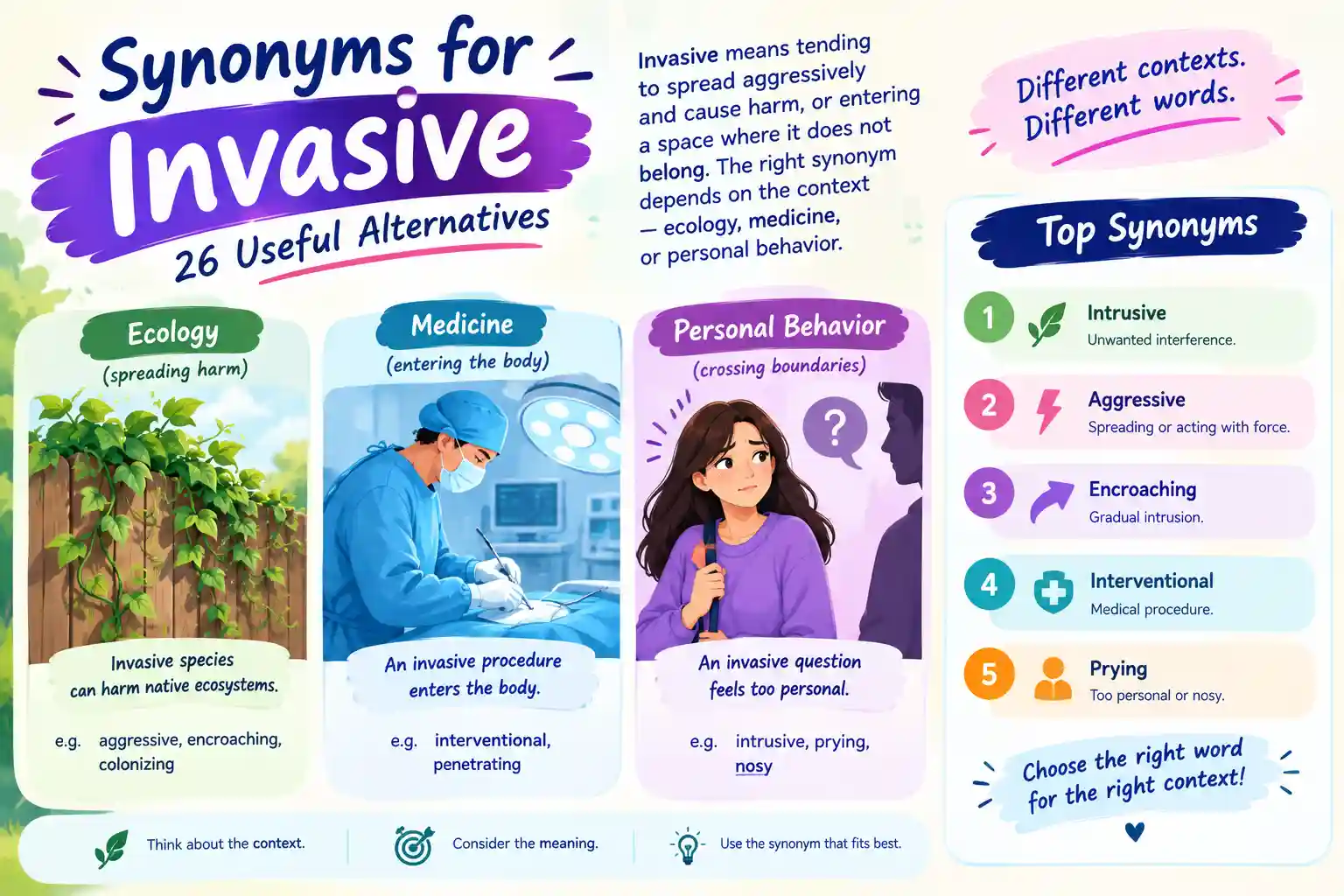
Invasive means tending to spread aggressively and cause harm, like an invasive plant species. It can also describe a medical procedure that enters the body, or a question that feels too personal. Good alternatives include intrusive and aggressive for spreading harm, and interventional for medical procedures.
Meaning of Invasive
Invasive is an adjective with three main uses.
The first use describes species, plants, or diseases that spread quickly and cause harm to their new environment. For example, “Zebra mussels are an invasive species in many American lakes.”
The second use is medical. It describes a procedure that enters the body, often through surgery or a needle, rather than staying outside it. For example, “The surgery was minimally invasive, using only small incisions.”
The third use is more personal. It describes behavior, especially questions, that feel too personal or intrusive. For example, “Her questions about my salary felt invasive.”
All three uses share one idea. Something invasive pushes into a space where it does not naturally belong.
Connotation and Nuance
Invasive almost always carries a negative feeling, though the strength of that negativity depends on context.
In the species and disease sense, invasive sounds alarming. It signals real damage and difficulty controlling the spread.
In the medical sense, invasive stays more neutral. It simply describes a method, not a judgment. A highly invasive surgery is not automatically bad, just more serious than a minimally invasive one.
In the personal sense, invasive feels uncomfortable and intrusive. It implies someone crossed a boundary they should have respected.
Pronunciation
Say invasive like this: in VAY siv. Both American and British English use the same pattern.
Etymology
Invasive comes from the Latin verb invadere, meaning to enter or attack. That word combines in, meaning into, with vadere, meaning to go or walk.
English adopted invasive by the nineteenth century. The word kept its core idea of entering somewhere, often aggressively, while its use expanded over time into ecology, medicine, and everyday personal behavior.
Word Formation
Invasive comes from the noun invasion and the verb invade. A few related words matter here.
Invasively is the adverb form. Invader names a person or thing that invades. And noninvasive is the negative form, common in medicine to describe a procedure that does not enter the body at all.
Best Synonyms for Invasive
1. Intrusive
Part of Speech: Adjective
Meaning: Entering or interfering somewhere without permission or welcome.
Best Use: This word fits the personal sense of invasive well. Use it for questions, behavior, or unwanted attention.
Tone or Register: Neutral to formal. Common in everyday and professional writing.
Difference: Intrusive focuses on unwanted interference, especially in personal or private matters. It rarely describes plants or medical procedures.
Examples: The reporter’s intrusive questions made the athlete visibly uncomfortable. Constant notifications from the app felt intrusive during work hours.
2. Aggressive
Part of Speech: Adjective
Meaning: Spreading or acting with force, often in a harmful or overwhelming way.
Best Use: This word fits the species and disease sense of invasive well, especially when describing rapid, damaging growth.
Tone or Register: Neutral to formal. Common in scientific and medical writing.
Difference: Aggressive emphasizes force and speed. Invasive emphasizes the act of entering a space that does not belong to it.
Examples: The aggressive vine choked out every native plant in the garden within a season. Doctors described the cancer as aggressive, requiring immediate treatment.
3. Encroaching
Part of Speech: Adjective or verb (present participle)
Meaning: Gradually intruding on territory, rights, or space that belongs to something else.
Best Use: This word fits slow, creeping spread, whether describing plants, urban development, or personal boundaries.
Tone or Register: Neutral to formal.
Difference: Encroaching implies a gradual, creeping process. Invasive can describe both sudden and gradual spread.
Examples: The encroaching forest slowly reclaimed the abandoned farmland. Residents worried about new developments encroaching on the wetland.
4. Interventional
Part of Speech: Adjective
Meaning: Involving direct medical action, often entering the body through a procedure.
Best Use: This word fits the medical sense of invasive precisely. It appears often in clinical and hospital settings.
Tone or Register: Formal, technical. Common in medical writing.
Difference: Interventional applies specifically to medical procedures. It has no use in the species or personal sense of invasive at all.
Examples: The cardiologist recommended an interventional procedure to clear the blocked artery. Interventional radiology allows doctors to treat conditions without major surgery.
5. Prying
Part of Speech: Adjective or verb (present participle)
Meaning: Asking about or examining something private in an unwelcome way.
Best Use: This word fits the personal sense of invasive especially well, particularly for questions or curiosity that feels rude.
Tone or Register: Informal to neutral. Common in everyday conversation.
Difference: Prying focuses specifically on curiosity about private matters. It applies to people’s behavior, never to plants or medical procedures.
Examples: His prying neighbor always asked about their finances. She hated prying questions about her divorce.
26 Synonyms for Invasive
- Intrusive
- Aggressive
- Encroaching
- Interventional
- Prying
- Spreading (weaker, general)
- Overrunning
- Nosy (informal, personal sense)
- Obtrusive
- Penetrating (contextual, medical sense)
- Overreaching
- Uninvited
- Overwhelming
- Nonnative (contextual, ecological sense, related but not identical)
- Disruptive
- Overbearing (contextual, personal sense)
- Meddlesome (informal, personal sense)
- Overgrown (contextual, plant sense)
- Rapidly spreading (descriptive phrase)
- Colonizing (contextual, ecological sense)
- Boundary crossing (descriptive phrase, personal sense)
- Probing (contextual, both medical and personal sense)
- Surgical (contextual, medical, weaker connection)
- Overstepping (contextual, personal sense)
- Domineering (contextual, personal behavior)
- Unwelcome (weaker, general)
Types of Synonyms for Invasive
Some words fit ecology and disease. Aggressive, overrunning, and colonizing describe species or growths spreading where they should not.
Some words fit medicine specifically. Interventional and penetrating describe procedures that enter the body.
Some words fit personal behavior. Intrusive, prying, and nosy describe unwanted attention into someone’s private life.
Some words work loosely across more than one sense. Encroaching and overstepping can apply to land, boundaries, or personal space, depending on context.
Invasive vs Similar Words
1.Invasive vs Intrusive: Intrusive almost always applies to personal behavior, like questions or unwanted attention. Invasive covers a wider range, including plants, disease, and medical procedures.
2.Invasive vs Aggressive: Aggressive emphasizes force and speed. Invasive emphasizes entering a space uninvited, whether or not that entry happens quickly.
3.Invasive vs Noninvasive: These two words work as direct opposites specifically in medicine. Noninvasive describes a procedure that does not enter the body, while invasive describes one that does.
How to Choose the Right Synonym
Writing about ecology or disease? Try aggressive, overrunning, or colonizing.
Writing about a medical procedure? Use interventional or penetrating, since these fit clinical language precisely.
Describing someone’s overly personal questions or behavior? Try intrusive, prying, or nosy.
Describing slow, gradual spread, like development or plant growth? Try encroaching.
Common Mistakes with Invasive
Some writers use invasive and aggressive interchangeably in every context. But aggressive fits force and speed, while invasive fits the idea of entering somewhere uninvited, and the two do not always overlap.
Some writers use invasive in a medical context to sound automatically negative. That is inaccurate. A highly invasive surgery is not automatically bad, just more serious than a noninvasive one.
Some writers use intrusive for plants or medical procedures. That usually sounds odd, since intrusive fits personal behavior far more naturally than ecology or medicine.
Antonyms of Invasive
Noninvasive, native (in the ecological sense), respectful of boundaries, unobtrusive, minimal.
FAQ
What does invasive mean? It means tending to spread aggressively and cause harm, like an invasive species. It can also describe a medical procedure that enters the body, or personal behavior that crosses boundaries.
What is another way to say invasive? Try aggressive or encroaching for species and spread, Try interventional for medical procedures. Try intrusive or prying for personal behavior.
Is invasive always negative? Mostly, yes, especially in the species and personal sense. In medicine, it stays more neutral, simply describing a method rather than making a judgment.
What is the difference between invasive and intrusive? Intrusive almost always applies to personal behavior. Invasive covers a wider range, including plants, disease, and medical procedures.
What is the opposite of invasive? Noninvasive works as the direct opposite in medicine. Native works as the opposite in ecology.
How do I use invasive in a sentence? Try this: “The lake now struggles with an invasive fish species.” Or this: “The surgery was minimally invasive, so recovery took only a few days.”
Can invasive describe a question? Yes. An invasive question feels too personal or intrusive, crossing a boundary the other person expected to stay private.
Conclusion
Invasive stretches across ecology, medicine, and personal behavior, so the right synonym depends entirely on which sense you mean. Aggressive and encroaching fit species and disease. Interventional fits medical procedures precisely. Intrusive and prying fit personal behavior that crosses a line.
Before choosing a synonym, ask yourself one question. Are you describing spreading harm, a medical method, or someone crossing a personal boundary? That answer points you to the right word every time.
Read More: Synonyms for Derived: 26 Useful Alternatives

Hi, I am Abid, a writer and editor at InstantSynonyms.com, where he creates clear and reader-friendly content about synonyms, vocabulary, and English word usage. His goal is to help readers choose the right words, expand their vocabulary, and write with greater confidence.