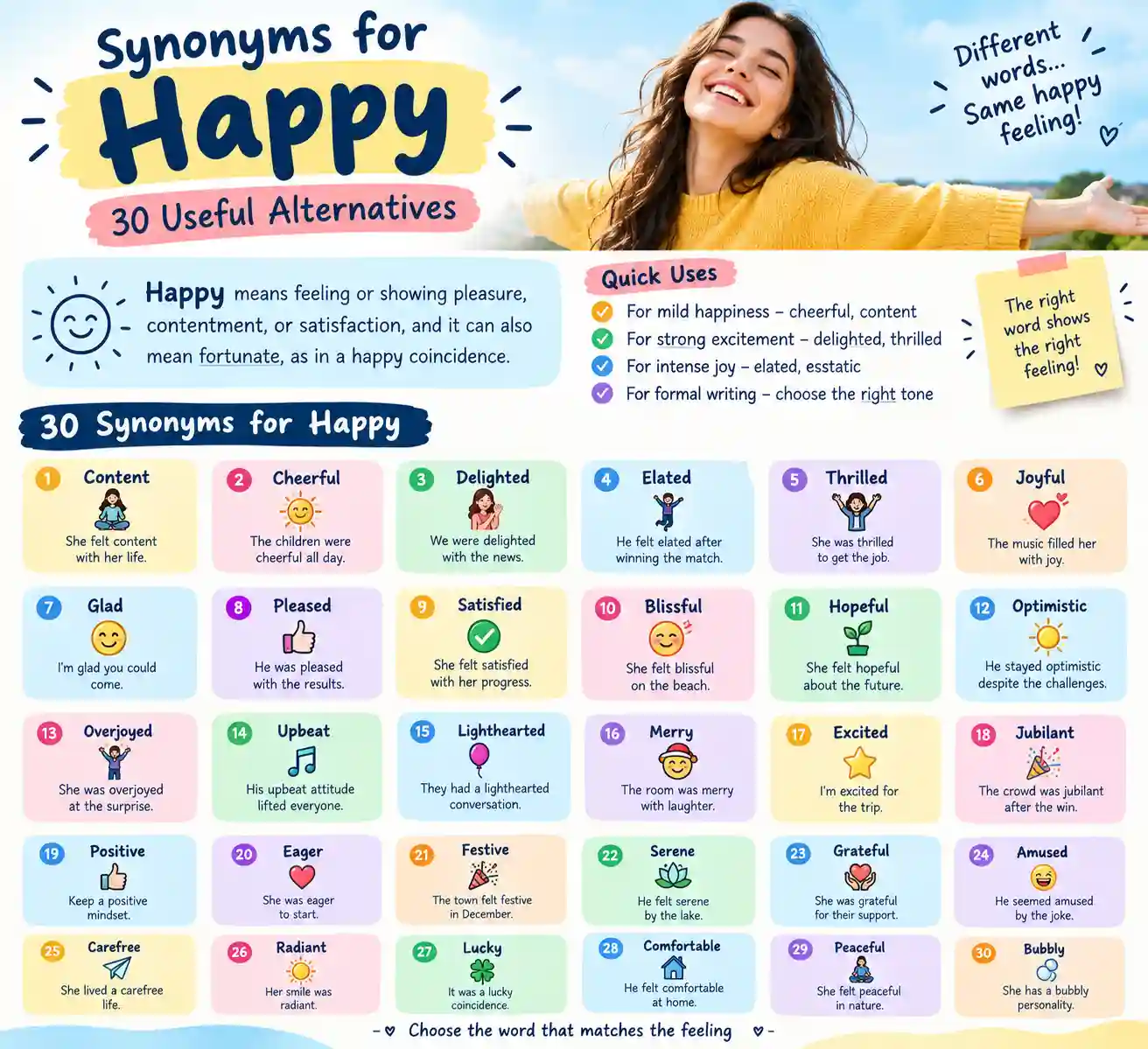
Happy means feeling or showing pleasure, contentment, or satisfaction, and it can also mean fortunate, as in a happy coincidence. Strong alternatives include cheerful and content for mild, everyday happiness, delighted and thrilled for stronger excitement, and elated or ecstatic for the most intense joy. The right choice depends on how strong the feeling is and how formal the writing needs to be.
Meaning of Happy
Happy is an adjective with two main senses. The first and most common describes feeling or showing pleasure, contentment, or enjoyment, as in “she felt happy after finishing the project.” The second, less common sense means fortunate or lucky, particularly in the fixed phrase “a happy coincidence” or “a happy accident,” where happy describes a fortunate outcome rather than an emotional state.
Happy can also express willingness or agreement, as in “I would be happy to help,” where it functions more as polite acceptance than genuine emotional joy. This usage is extremely common in professional and everyday English.
Connotation and Nuance
Happy sits at a fairly neutral, moderate point on the emotional scale. It is warmer than merely content but far less intense than ecstatic or overjoyed. Because happy is such a common, general word, it often needs a more specific synonym when a writer wants to communicate exactly how strong, how brief, or how deep the feeling actually is.
Pronunciation
Happy is pronounced /ˈhæp.i/ (HAP ee) in both American and British English.
Etymology
Happy comes from the Middle English word hap, meaning luck or chance, related to Old Norse happ, meaning good fortune. This explains why happy still carries a secondary meaning of lucky or fortunate today, even though its dominant modern sense has shifted toward describing an emotional state of pleasure or contentment, a change that became firmly established by the sixteenth century.
Best Synonyms for Happy
1. Content
Part of Speech: Adjective
Meaning: Feeling satisfied with what one has, without necessarily feeling strong excitement.
Best Use: Works well when describing a calm, settled kind of happiness, rather than an energetic or excited one.
Tone or Register: Neutral, common in both everyday and reflective writing.
Difference: Content is quieter and calmer than happy, and it often implies acceptance of one’s situation rather than active joy.
Examples: After years of searching, she finally felt content with her career. He seemed perfectly content just sitting on the porch with his coffee.
2. Cheerful
Part of Speech: Adjective
Meaning: Showing or feeling bright, positive spirits, often visible in one’s manner or expression.
Best Use: Works well for describing someone’s general disposition or mood, especially in social or everyday settings.
Tone or Register: Neutral to warm, common in casual and descriptive writing.
Difference: Cheerful focuses on outward, visible positivity, while happy can describe a more internal, private feeling that is not necessarily expressed outwardly.
Examples: The cheerful barista greeted every customer by name. Despite the rain, the children stayed cheerful throughout the hike.
3. Delighted
Part of Speech: Adjective
Meaning: Feeling great pleasure or satisfaction, often in response to a specific event or piece of news.
Best Use: Works especially well in polite, professional, or formal contexts to express enthusiastic pleasure.
Tone or Register: Formal to neutral, common in professional correspondence.
Difference: Delighted is stronger and more specific than happy, and it almost always responds to a particular cause rather than describing a general state.
Examples: We are delighted to announce the launch of our new product line. She was delighted when she saw her old friend at the reunion.
4. Elated
Part of Speech: Adjective
Meaning: Feeling extremely happy and excited, often due to a significant success or achievement.
Best Use: Works well for describing intense, short lived bursts of joy connected to a specific victory or accomplishment.
Tone or Register: Formal to literary, less common in casual speech.
Difference: Elated is considerably stronger than happy and implies a temporary surge of intense emotion rather than a steady, ongoing state.
Examples: The team was elated after winning the championship in overtime. He felt elated the moment he received his acceptance letter.
5. Thrilled
Part of Speech: Adjective
Meaning: Feeling a strong rush of excitement and happiness, often anticipatory or immediate.
Best Use: Works well in casual and semi formal contexts to express enthusiastic, energetic happiness.
Tone or Register: Casual to neutral, common in spoken English and informal writing.
Difference: Thrilled emphasizes excitement and energy alongside happiness, while happy alone does not necessarily imply any heightened excitement.
Examples: She was thrilled to hear that the concert tickets finally arrived. We are thrilled to welcome three new members to our team this month.
30 Synonyms for Happy
- Content
- Cheerful
- Delighted
- Elated
- Thrilled
- Glad
- Pleased
- Joyful
- Joyous
- Merry
- Jovial
- Jubilant
- Ecstatic
- Overjoyed
- Blissful
- Radiant
- Buoyant
- Upbeat
- Satisfied
- Gratified
- Exuberant
- Euphoric
- Chuffed (informal, mainly British)
- On cloud nine (idiomatic)
- Over the moon (idiomatic)
- Tickled pink (idiomatic, informal)
- In good spirits
- Lighthearted
- Fortunate (contextual, only for the lucky sense of happy)
- Willing (contextual, only for the polite agreement sense, as in happy to help)
Types of Synonyms for Happy
Mild alternatives such as content, satisfied, and glad describe calm, settled happiness without strong excitement.
Moderate alternatives such as cheerful, pleased, and upbeat describe everyday positive mood, suitable for most general writing.
Strong alternatives such as delighted, thrilled, and jubilant describe more intense happiness, often tied to a specific event or achievement.
Extreme alternatives such as ecstatic, euphoric, and overjoyed describe the most intense level of joy, often overwhelming or difficult to contain.
Idiomatic alternatives such as on cloud nine and over the moon work well in casual, conversational writing but sound out of place in formal contexts.
Intensity Scale
Content and satisfied sit at the mild end. Glad and cheerful sit slightly higher, describing everyday positive mood. Happy itself sits in the middle as the general, all purpose term. Delighted and thrilled sit higher still, implying a stronger reaction. Elated, jubilant, and overjoyed sit near the top. Ecstatic and euphoric represent the most extreme, overwhelming level of joy.
Formality Scale
Casual: chuffed, over the moon, on cloud nine. Neutral: happy, glad, pleased, cheerful. Formal: delighted, gratified, content. Literary: elated, blissful, euphoric, radiant.
Common Collocations and Natural Usage
You typically say happy to help or delighted to help in professional contexts, but you would rarely say ecstatic to help, since ecstatic implies an intensity that feels mismatched with a routine, polite offer. Overjoyed and elated are almost always followed by a specific cause, as in overjoyed at the news or elated by the victory, while content is often paired with with, as in content with her life. Over the moon and on cloud nine only work in casual, spoken style writing and would feel out of place in a formal report or academic paper.
Happy vs Similar Words
1.Happy vs Content: Content implies a calmer, more settled satisfaction, often without much excitement, while happy can range from mild pleasure to strong joy depending on context.
2.Happy vs Joyful: Joyful tends to describe a deeper, sometimes more spiritual or meaningful kind of happiness, often connected to a significant event, while happy is more general and can describe ordinary, everyday pleasure.
3.Happy vs Pleased: Pleased often responds to a specific, sometimes smaller event, such as being pleased with a grade or a purchase, while happy can describe both specific reactions and a more general emotional state.
How to Choose the Right Synonym
If you want a calm, understated tone, use content or satisfied, If you are writing a polite professional message, delighted or pleased fits naturally, as in “we are pleased to inform you.” And If you want to convey strong excitement tied to a specific event, thrilled or elated works well. If you are writing casually and want a fun, expressive tone, idiomatic phrases like over the moon or on cloud nine add personality. If the context involves the older, secondary meaning of luck rather than emotion, fortunate is the more accurate word, not any emotional synonym.
Common Mistakes with Happy
A common mistake is using extreme synonyms like ecstatic or euphoric for mild, everyday situations, which can sound exaggerated or insincere, as in “I am ecstatic about my coffee this morning.” Another mistake is confusing happy in the sense of lucky, as in a happy coincidence, with any of its emotional synonyms, since words like delighted or joyful do not carry that same meaning of fortune or chance. Writers also sometimes overuse happy itself throughout a piece of writing, when a more specific synonym would better capture the actual intensity or context of the emotion.
Antonyms of Happy
Sad, unhappy, miserable, dejected, gloomy.
FAQ
What does happy mean? Happy means feeling or showing pleasure, contentment, or satisfaction, and in an older sense, it can also mean fortunate or lucky.
What is another way to say happy? Content, cheerful, delighted, and pleased are common alternatives, with the right choice depending on the strength of the feeling and the formality of the writing.
What is the strongest synonym for happy? Ecstatic and euphoric both describe the most intense, overwhelming level of joy.
What is the most formal alternative to happy? Delighted and gratified are among the more formal, professional choices.
Are these synonyms interchangeable? No. They differ significantly in intensity and formality, so swapping happy for a much stronger word like ecstatic can make ordinary situations sound exaggerated.
What is the opposite of happy? Sad, unhappy, and miserable are common opposites.
How do I use happy in a sentence? You can say, “She was happy to see her family after months apart,” using it to describe genuine emotional pleasure.
Conclusion
Happy is flexible enough to cover a huge range of emotional states, but its synonyms are not all created equal. Content and glad capture mild, everyday satisfaction, delighted and thrilled capture stronger, event driven excitement, and ecstatic and euphoric capture the most intense joy possible. Choosing the right word means paying attention to how strong the emotion really is, how formal your writing needs to be, and whether you are describing genuine feeling or simply polite willingness. Getting that balance right makes your writing feel far more precise and genuinely expressive.
Read More: Synonyms for Gate: 30 Useful Alternatives

Hi, I’m Ayesha, the creator of InstantSynonyms.com. I believe the right word can transform a sentence, strengthen an idea, and make communication more impactful. That’s why I created this site, to help writers, students, professionals, and English learners find accurate synonyms, antonyms, and better word choices quickly and effortlessly.
Every article is easy to understand, and designed to save you time while improving your vocabulary and writing. Whether you’re searching for a stronger alternative, a more precise expression, or simply expanding your word knowledge, my goal is to make finding the perfect word simple, fast, and reliable.