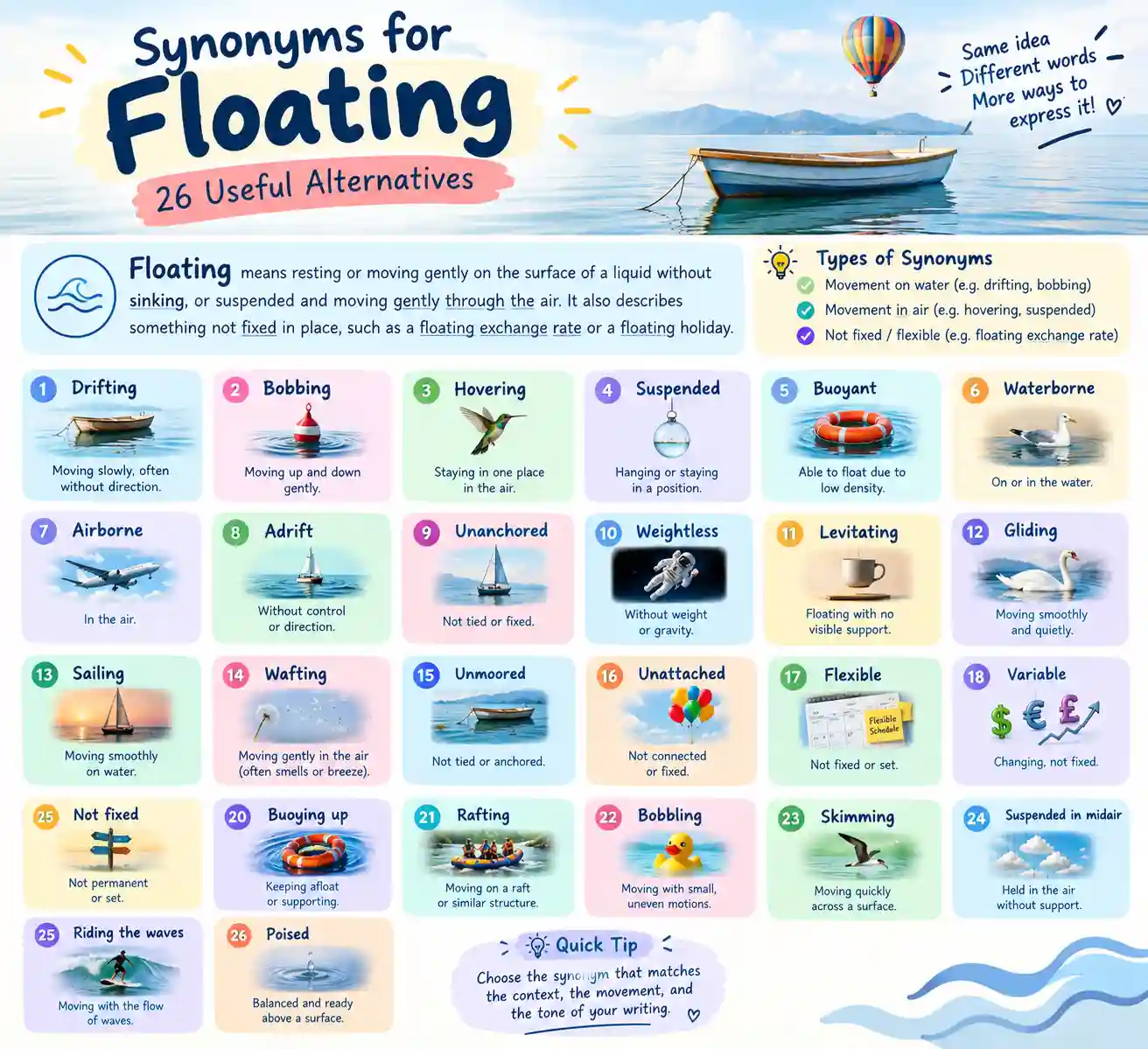
Floating means resting or moving gently on the surface of a liquid without sinking, or suspended and moving gently through the air. It also describes something not fixed in place, such as a floating exchange rate or a floating holiday. Strong alternatives include drifting and bobbing for gentle movement on water, and hovering or suspended for movement through air.
Meaning of Floating
Floating is the present participle and adjective form of float, and it carries several related meanings. The most literal sense describes an object resting on the surface of a liquid without sinking, as in “the boat was floating near the dock.” A closely related sense describes something suspended or moving gently through air, as in “the balloon was floating above the crowd.”
Floating also has a figurative and technical sense meaning not fixed, attached, or permanently assigned, as in a floating exchange rate in economics, a floating holiday at a workplace, or a floating population in demographics, all of which describe something flexible or unattached to a fixed point.
Word Formation
Floating comes directly from the base verb float, formed by adding the suffix ing, which turns the verb into a present participle or adjective. Related forms include floated, the past tense, and floater, a noun describing a person or object that floats, or, informally, a worker who fills in various roles without a fixed position. These derivatives show how the core idea of not being fixed extends naturally through the entire word family.
Pronunciation
Floating is pronounced /ˈfloʊ.tɪŋ/ (FLOH ting) in American English and /ˈfləʊ.tɪŋ/ in British English.
Etymology
Float comes from Old English flotian, meaning to float or swim, related to Old Norse flota, carrying the same core meaning. The word has kept its essential sense, staying on the surface of a liquid rather than sinking, for well over a thousand years, while gradually extending into figurative and technical uses over the past few centuries.
Best Synonyms for Floating
1. Drifting
Part of Speech: Adjective or verb (present participle)
Meaning: Moving slowly and without direction, typically carried by water or air currents.
Best Use: Works especially well when there is a sense of aimless or passive movement, rather than staying still on the surface.
Tone or Register: Neutral, common in both everyday and descriptive writing.
Difference: Drifting emphasizes movement, often without direction or control, while floating can describe something completely still on the surface as well as something moving.
Examples: The empty canoe was drifting slowly toward the far shore. Clouds drifted lazily across the summer sky.
2. Bobbing
Part of Speech: Adjective or verb (present participle)
Meaning: Moving up and down gently while on the surface of water.
Best Use: Works well specifically for small objects moving with waves or ripples, rather than large, stationary floating structures.
Tone or Register: Neutral to casual, common in everyday descriptions.
Difference: Bobbing specifically describes an up and down motion, while floating can describe something staying level and still.
Examples: The buoy kept bobbing in the choppy harbor water. Apples bobbed in the bucket during the game.
3. Hovering
Part of Speech: Adjective or verb (present participle)
Meaning: Staying suspended in one place in the air, often with minimal movement.
Best Use: Works best for describing objects or creatures suspended in air rather than on a liquid surface, such as a helicopter, a hummingbird, or a drone.
Tone or Register: Neutral, common in both technical and everyday writing.
Difference: Hovering applies specifically to air, while floating can apply to both air and liquid, making hovering the more precise choice for airborne suspension.
Examples: The drone hovered above the field, capturing aerial footage. A hummingbird hovered near the bright red flowers.
4. Suspended
Part of Speech: Adjective
Meaning: Hanging or staying in one position, often without visible support, whether in air or another substance.
Best Use: Works well in more scientific or precise writing, especially for particles or objects held in place within a medium.
Tone or Register: Formal to neutral, common in scientific and technical contexts.
Difference: Suspended is more precise and technical than floating, often implying a specific physical or scientific mechanism rather than casual, everyday movement.
Examples: Tiny particles remained suspended in the cloudy liquid. The exhibit featured sculptures suspended from the ceiling.
5. Buoyant
Part of Speech: Adjective
Meaning: Able to float or stay on the surface of a liquid, often due to low density or trapped air.
Best Use: Works best when describing the physical property that allows something to float, rather than the act of floating itself.
Tone or Register: Neutral to technical, common in physics and everyday description alike.
Difference: Buoyant describes a capability or property, while floating describes the actual state or action of staying on the surface.
Examples: The life jacket is designed to be extremely buoyant. Cork is naturally buoyant, which is why it floats so easily in water.
26 Synonyms for Floating
- Drifting
- Bobbing
- Hovering
- Suspended
- Buoyant
- Waterborne
- Airborne (contextual, for the air sense)
- Adrift
- Unanchored
- Weightless
- Levitating (contextual, implies no physical support at all)
- Gliding
- Sailing (contextual, poetic, for smooth surface movement)
- Wafting (contextual, mainly for air or scent, less common for solid objects)
- Unmoored
- Unattached (contextual, for the figurative sense of floating)
- Flexible (contextual, for floating schedules or holidays)
- Variable (contextual, for a floating exchange rate)
- Not fixed (descriptive phrase, for the figurative sense)
- Buoying up (verb phrase, informal)
- Rafting (contextual, implies a raft like structure)
- Bobbling (informal, regional variant of bobbing)
- Skimming (contextual, implies fast movement along a surface)
- Suspended in midair (descriptive phrase)
- Riding the waves (idiomatic, contextual)
- Poised (contextual, for a still, balanced state above a surface)
Types of Synonyms for Floating
Water surface alternatives such as drifting, bobbing, and buoyant apply specifically to objects resting or moving on liquid.
Air suspension alternatives such as hovering, airborne, and levitating apply specifically to objects suspended in air rather than on water.
Figurative or technical alternatives such as unattached, flexible, and variable apply to non physical uses of floating, such as a floating exchange rate, a floating holiday, or a floating population.
Floating vs Similar Words
Floating vs Drifting: Floating can describe something completely still on a surface, while drifting always implies some degree of movement, often without direction or control.
Floating vs Hovering: Floating can apply to both air and liquid, while hovering applies specifically and almost exclusively to suspension in air.
Floating vs Sinking: These are direct opposites in the literal, physical sense. Floating means staying on or near the surface, while sinking means moving downward into a liquid.
How to Choose the Right Synonym
If you are describing something resting calmly on water, floating or buoyant works well. If there is movement without clear direction, drifting captures that better. If the object bounces gently up and down on waves, bobbing is the more precise choice. If you are describing something suspended in air rather than water, hovering or airborne fits the context correctly. If you are using the figurative, non physical sense, such as a flexible schedule or exchange rate, unattached, flexible, or variable communicates that meaning far more clearly than the literal alternatives.
Common Mistakes with Floating
A common mistake is using hovering to describe something resting on water, when hovering specifically implies suspension in air, not on a liquid surface. Another mistake is using floating and drifting interchangeably in situations where stillness matters, since floating can describe something staying in one place, while drifting always implies ongoing, often uncontrolled movement. Writers sometimes also misuse floating in the figurative sense, such as describing a fixed, unchangeable schedule as floating, when the word specifically implies flexibility or the absence of a fixed point.
Antonyms of Floating
Sinking (for the physical, liquid sense), grounded (for the air sense), fixed (for the figurative sense of not being attached to a specific point).
FAQ
What does floating mean? Floating means resting or moving gently on the surface of a liquid without sinking, or suspended in air. It can also describe something not fixed in place, such as a floating schedule.
What is another way to say floating? Drifting, bobbing, and buoyant work well for the water sense, while hovering and suspended work well for the air sense.
What is the difference between floating and hovering? Floating can apply to both liquid and air, while hovering applies specifically to staying suspended in air.
Is floating the same as drifting? Not exactly. Floating can describe something perfectly still, while drifting always implies some degree of movement, often without direction.
What is the opposite of floating? Sinking is the direct opposite in the physical, liquid sense, while grounded and fixed serve as opposites in the air and figurative senses.
How do I use floating in a sentence? You can say, “The raft was floating peacefully in the middle of the lake,” for the literal sense, or “Employees get two floating holidays each year,” for the figurative, flexible sense.
Can floating be used in a scientific context? Yes. In physics and chemistry, floating describes an object’s buoyancy relative to a liquid, and terms like suspended and buoyant are commonly used alongside it in technical writing.
Conclusion
Floating stretches across water, air, and even flexible schedules, so its best synonym always depends on exactly what kind of floating you mean. Drifting and bobbing suit gentle movement on water, hovering and suspended suit objects held in air, and unattached or flexible suit the figurative, non physical sense of the word. Paying attention to which specific type of floating you are describing, physical, aerial, or figurative, will help you choose a synonym that actually fits the sentence rather than one that only sounds close.
Read More: Synonyms for Gate: 30 Useful Alternatives

Hi, I am Abid, a writer and editor at InstantSynonyms.com, where he creates clear and reader-friendly content about synonyms, vocabulary, and English word usage. His goal is to help readers choose the right words, expand their vocabulary, and write with greater confidence.