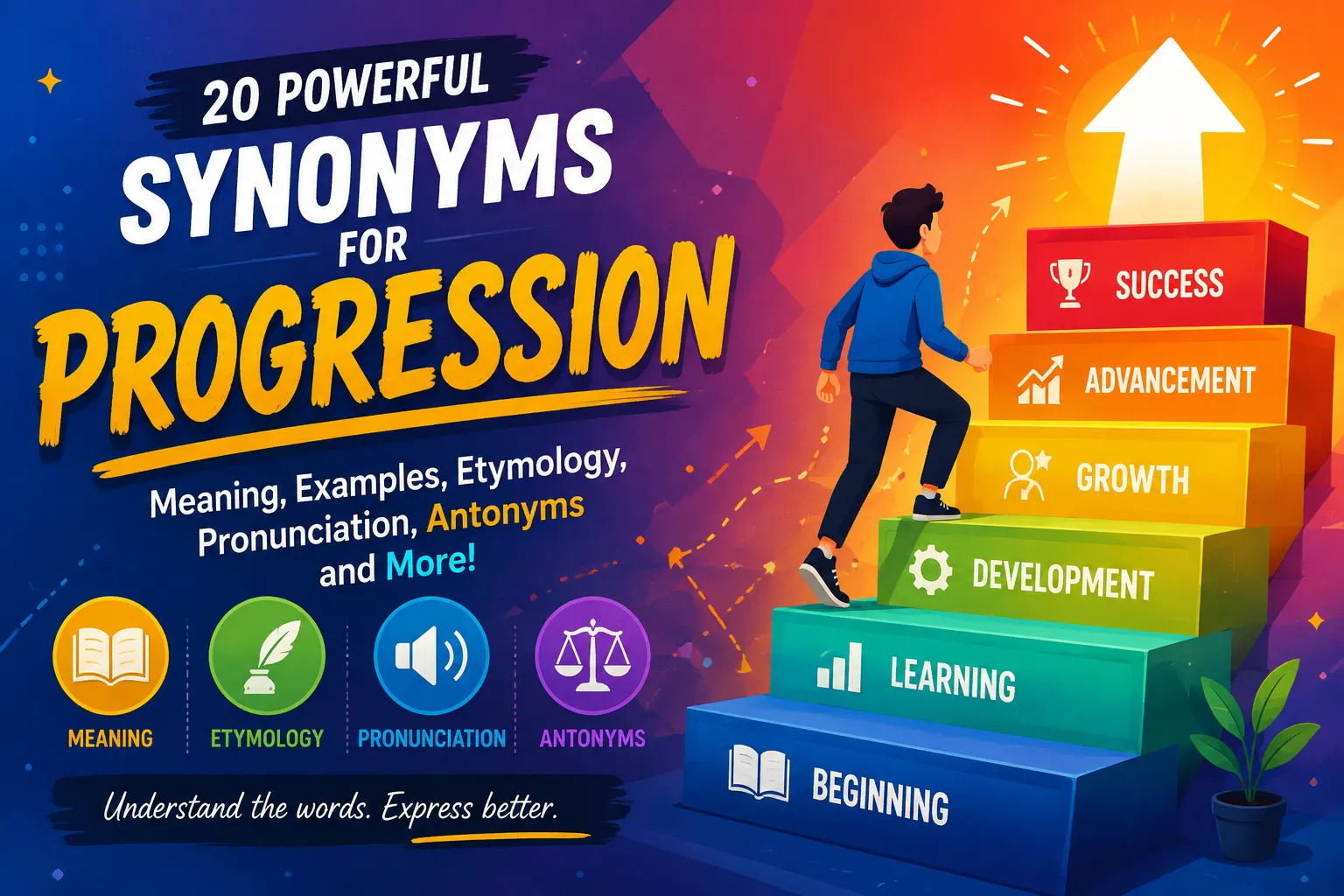
Progression means the gradual process of moving toward a more advanced or different stage. Common synonyms include advancement, development, progress, evolution, growth, and momentum. The best choice depends on context, such as career growth versus an ordered series of events.
Think of a student moving from beginner lessons to advanced classes over several years, step by step, each stage building on the last. That steady movement forward is progression, the process of developing or moving toward a more advanced stage. The word appears often in conversations about careers, health, education, and stories, which makes it easy to overuse in writing. Learning synonyms for progression helps English learners and writers describe growth, change, and forward movement with more variety and precision. This article covers the meaning of progression, its history, pronunciation, word family, twenty useful synonyms with examples, its opposite words, and answers to common questions people ask about the term.
Meaning of Progression
Definition
Progression (Noun): The process of developing or moving gradually toward a more advanced or different stage.
Examples
- The patient’s progression toward recovery pleased the doctors.
- Her career showed a steady progression from intern to manager.
Connotative Meaning
The word progression carries different tones depending on context.
- Positive tone: A career progression suggests growth and success.
- Negative tone: The progression of a disease suggests worsening and worry.
- Neutral tone: A progression of numbers in math describes a simple pattern with no emotional weight.
(Connotation: the feeling or association a word carries beyond its literal meaning)
Etymology
The word progression traveled from Latin into English through French influence.
- Old English (450 to 1100): English did not use progression during this period; forward movement was described through simpler Germanic terms.
- Middle English (1100 to 1500): The term entered English through Old French progression, based on Latin progressio, meaning a going forward.
- Modern English (1500 to Present): Progression kept its core meaning of forward movement, expanding into fields such as medicine, music, mathematics, and career development.
Pronunciation (IPA)
- IPA: /prəˈɡrɛʃən/
- Syllables: pro gres sion (three syllables)
Affixation Pattern of Progression
- Root: progress
- Prefix: pro (forward)
- Suffix: ion, ive, ing, ed (added to form related words)
- Word formations:
- progress (noun and verb)
- progressive (adjective)
- progressively (adverb)
- progressing (verb, present participle)
- progressed (verb, past tense)
20 Synonyms of Progression With Meaning and Examples
1. Advancement (Noun)
Meaning: The process of moving forward or developing to a higher level. Examples:
- Her advancement to senior manager took only two years.
- Technological advancement changed how people communicate.
2. Development (Noun)
Meaning: The process of growing or improving over time. Examples:
- The child’s development was tracked closely by the doctor.
- Software development requires careful planning and testing.
3. Progress (Noun)
Meaning: Forward movement toward a goal or better state. Examples:
- The team made great progress on the project this week.
- Her progress in learning English impressed her teacher.
4. Evolution (Noun)
Meaning: Gradual development or change over time. Examples:
- The evolution of the company’s products reflected changing customer needs.
- Historians studied the evolution of the ancient trade routes.
5. Growth (Noun)
Meaning: The process of increasing, developing, or becoming more advanced. Examples:
- The company saw strong growth in its second year.
- Personal growth often comes from facing new challenges.
6. Movement (Noun)
Meaning: A gradual shift or change from one stage or position to another. Examples:
- There was a clear movement toward remote work in recent years.
- The story follows the movement of the character from fear to courage.
7. Continuation (Noun)
Meaning: The act of carrying on or extending something further. Examples:
- The sequel served as a continuation of the original story.
- Their partnership was a continuation of years of teamwork.
8. Succession (Noun)
Meaning: A series of events, people, or things following one after another. Examples:
- The succession of good decisions led to the company’s success.
- A succession of storms hit the coast that season.
9. Sequence (Noun)
Meaning: A particular order in which related events or steps follow each other. Examples:
- The training followed a clear sequence of steps.
- The sequence of scenes built tension throughout the film.
10. Series (Noun)
Meaning: A number of related events or items arranged in order. Examples:
- The lecture was part of a series on world history.
- A series of small changes led to major improvement.
11. Chain (Noun)
Meaning: A connected series of events or actions. Examples:
- A chain of decisions led to the company’s expansion.
- The accident started a chain of unexpected events.
12. Procession (Noun)
Meaning: A steady, orderly forward movement or series of events. Examples:
- A procession of new ideas shaped the industry that decade.
- The procession of seasons marked the passing year.
13. Advance (Noun)
Meaning: Forward movement or progress, often in skill or knowledge. Examples:
- The advance in medical research saved many lives.
- Her advance in fluency came from daily practice.
14. Headway (Noun)
Meaning: Forward movement or progress, especially after difficulty. Examples:
- The team finally made headway on the stalled project.
- They made slow but steady headway through the mountain trail.
15. Improvement (Noun)
Meaning: The act of becoming better or more advanced. Examples:
- His improvement in math grades pleased his parents.
- The city saw steady improvement in public transport.
16. Momentum (Noun)
Meaning: The force or speed gained from continued movement or progress. Examples:
- The project gained momentum after the first success.
- Her career built strong momentum after the award.
17. Flow (Noun)
Meaning: A smooth, continuous movement or progression. Examples:
- The flow of the story kept readers engaged.
- The steady flow of new customers helped the business grow.
18. March (Noun)
Meaning: Steady, continuous forward movement, often used figuratively. Examples:
- The march of technology changed daily life.
- The relentless march of time affects everyone equally.
19. Course (Noun)
Meaning: The path or direction something follows as it develops. Examples:
- The course of her career changed after the promotion.
- The disease followed a predictable course.
20. Unfolding (Noun)
Meaning: The gradual development or revealing of events over time. Examples:
- The unfolding of the plot kept the audience curious.
- The slow unfolding of events surprised everyone involved.
Prototype Meaning
When people think of progression, they usually picture a steady, forward moving process, one stage leading naturally into the next, whether in a career, a story, an illness, or a skill. The core image is one of gradual movement toward something further along, rather than a single sudden leap. This idea of steady, connected forward motion ties together nearly every synonym in this list.
Prototype Categorization
Grouping the synonyms helps a writer choose the exact shade of meaning needed for a sentence.
- Words describing personal or professional growth: advancement, development, growth, improvement, headway, momentum. These suit descriptions of careers, skills, or personal change.
- Words describing ordered steps or events: sequence, series, succession, chain, procession, course. These fit situations involving a clear order of events or stages.
- Words describing gradual movement or change: progress, evolution, movement, flow, march, unfolding, continuation, advance. These work well for describing change over time in stories, technology, or society.
Choosing from the right category keeps writing accurate, whether describing a career path, a story, or a scientific process.
Antonyms of Progression
- Regression (Noun): A return to a previous, less advanced state.
- Decline (Noun): A gradual decrease or worsening.
- Stagnation (Noun): A lack of movement, growth, or change.
- Setback (Noun): An event that stops or reverses progress.
- Reversal (Noun): A change to an opposite state or direction.
- Standstill (Noun): A complete stop in movement or activity.
Short Questions and Answers
- What does progression mean? Progression means the process of developing or moving gradually toward a more advanced or different stage.
- When should progression be used? Use progression when describing gradual change over time, such as in a career, a story, an illness, or a skill.
- Is progression positive or negative? It depends on context. Career progression sounds positive, while the progression of a disease sounds negative and concerning.
- How is it different from similar words? Words like sequence and series describe an order of events, while words like growth and improvement focus more on positive development over time.
Conclusion
Learning the word progression and its many synonyms gives writers and speakers a wider range of tools for describing change, growth, and forward movement. Rather than repeating progression throughout an essay or conversation, choosing words like advancement, momentum, or unfolding adds variety and precision to writing. This kind of vocabulary growth strengthens both spoken and written English, helps avoid repetition, and builds confidence when describing careers, stories, and processes of change. Practicing a few new synonyms each day, and applying them in real sentences, is a simple and effective way to build a stronger vocabulary over time.
Read More: Synonyms for Devious: 20 Useful Alternatives

Hi, I am Abid, a writer and editor at InstantSynonyms.com, where he creates clear and reader-friendly content about synonyms, vocabulary, and English word usage. His goal is to help readers choose the right words, expand their vocabulary, and write with greater confidence.