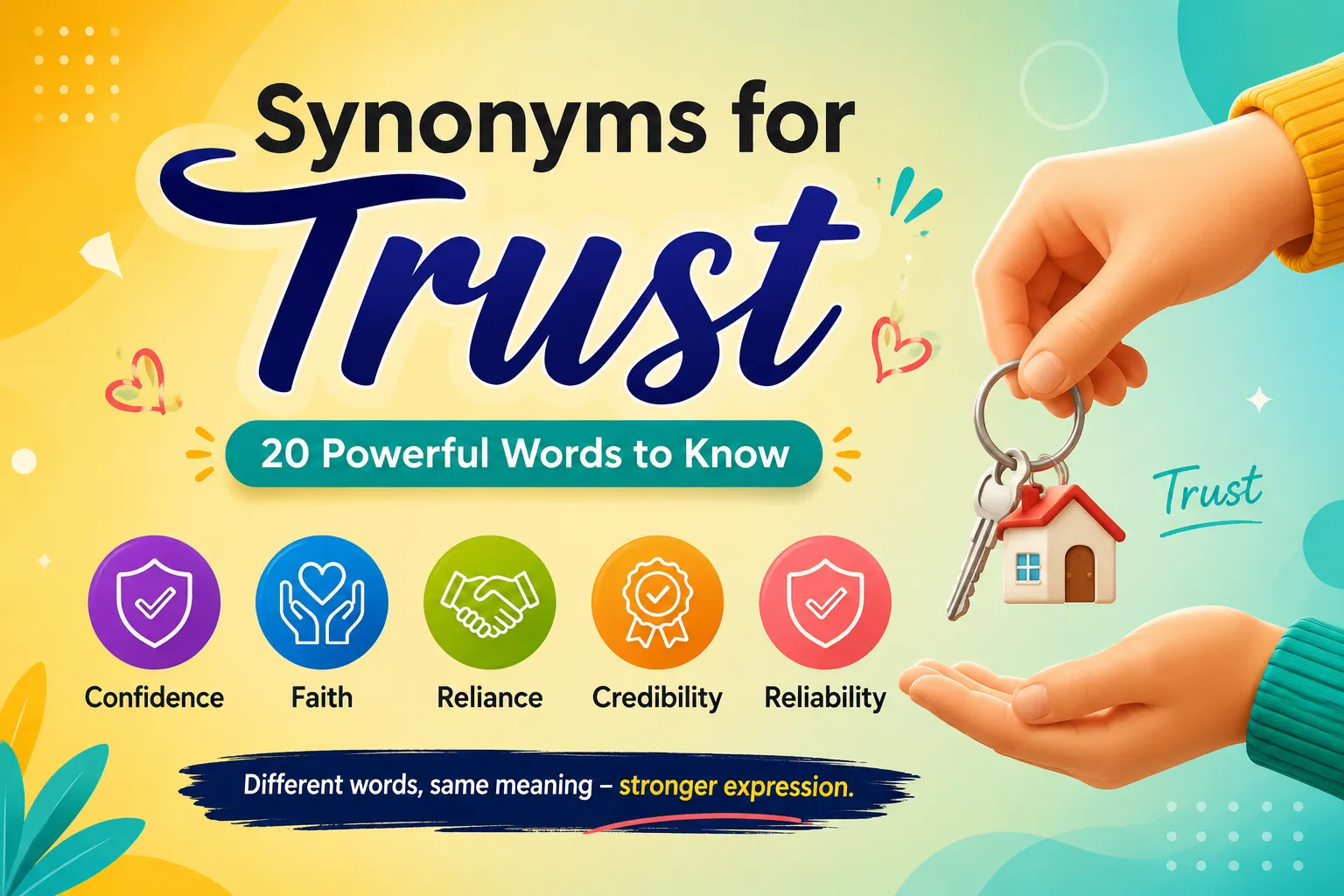
Trust means a firm belief in the reliability, honesty, or ability of someone or something. Common synonyms include confidence, faith, belief, reliance, credibility, and reliability. The best choice depends on context, such as personal belief versus an earned reputation.
Picture a close friend handing you their house keys while they travel, without a single worry crossing their mind. That quiet confidence is trust, the belief that someone or something is reliable, honest, and will not let you down. Trust shapes friendships, business deals, and everyday choices, which is why the word appears constantly in conversation and writing. Relying on the same word again and again can make speech and writing feel repetitive, so learning synonyms for trust helps English learners and writers express shades of confidence, faith, and reliance with more precision. This article explains the meaning of trust, its history, pronunciation, word family, twenty helpful synonyms with examples, its opposite words, and answers to common questions people ask about the term.
Meaning of Trust
Definition
Trust (Noun): A firm belief in the reliability, honesty, or ability of someone or something.
Examples
- She placed her trust in her doctor’s advice.
- Trust between business partners builds long lasting success.
Connotative Meaning
The word trust carries emotional weight depending on how it is used.
- Positive tone: Trust in a loyal friend feels warm and reassuring.
- Negative tone: Losing trust after betrayal feels painful and heavy.
- Neutral tone: Trust in a machine’s accuracy is simply practical and factual.
(Connotation: the feeling or association a word carries beyond its literal meaning)
Etymology
The history of trust reveals a journey from Old Norse into the English we use today.
- Old English (450 to 1100): English did not use the word trust directly during this period; related ideas were expressed through words tied to faith and belief.
- Middle English (1100 to 1500): Trust entered English from Old Norse traust, meaning confidence or firmness, brought through Norse influence in Britain.
- Modern English (1500 to Present): Trust developed into both a noun and a verb, expanding to describe confidence in people, institutions, information, and even machines.
Pronunciation (IPA)
- IPA: /trʌst/
- Syllables: trust (one syllable)
Affixation Pattern of Trust
- Root: trust
- Prefix: dis, mis, en (added to form related words)
- Suffix: ed, ing, worthy, ful, ing (added to form related words)
- Word formations:
- distrust (noun and verb)
- mistrust (noun and verb)
- entrust (verb)
- trusted (adjective)
- trusting (adjective)
- trustworthy (adjective)
- trustful (adjective)
- trustworthiness (noun)
20 Synonyms of Trust With Meaning and Examples
1. Confidence (Noun)
Meaning: A firm belief in the reliability or ability of someone or something. Examples:
- The team had full confidence in their captain.
- She spoke with confidence during the interview.
2. Faith (Noun)
Meaning: Complete trust or belief in someone or something, often without needing proof. Examples:
- He kept faith in his brother even during hard times.
- The investors showed strong faith in the new company.
3. Belief (Noun)
Meaning: An acceptance that something is true or trustworthy. Examples:
- Her belief in her team never wavered.
- The community’s belief in the leader grew over time.
4. Reliance (Noun)
Meaning: Dependence on someone or something for support or help. Examples:
- The company’s reliance on one supplier was risky.
- Children show a natural reliance on their parents.
5. Credence (Noun)
Meaning: Acceptance that something is true or trustworthy, often used formally. Examples:
- The judge gave little credence to the witness’s story.
- Scientists gave credence to the new theory after testing it.
6. Conviction (Noun)
Meaning: A firm belief or certainty about something. Examples:
- She spoke about the plan with total conviction.
- His conviction in the mission inspired the entire team.
7. Assurance (Noun)
Meaning: A positive declaration meant to give confidence, or the confidence itself. Examples:
- The manager gave assurance that the project would finish on time.
- Her calm assurance put everyone at ease.
8. Certainty (Noun)
Meaning: Complete confidence that something is true or will happen. Examples:
- He answered the question with total certainty.
- There was no certainty about the results yet.
9. Dependence (Noun)
Meaning: The state of relying on someone or something. Examples:
- The village’s dependence on rainfall made farming risky.
- Their dependence on each other grew stronger over the years.
10. Credibility (Noun)
Meaning: The quality of being trusted and believed. Examples:
- The report lost credibility after the errors were found.
- Her honesty gave her great credibility among coworkers.
11. Loyalty (Noun)
Meaning: Firm support and trust toward a person, cause, or organization. Examples:
- His loyalty to the company never changed.
- The fans showed great loyalty to their team.
12. Reliability (Noun)
Meaning: The quality of being consistently good, dependable, and trustworthy. Examples:
- The car’s reliability made it a popular choice.
- Her reliability at work earned her a promotion.
13. Sureness (Noun)
Meaning: Confidence or certainty in a belief or decision. Examples:
- He walked with a sureness that impressed the panel.
- Her sureness about the plan convinced the investors.
14. Security (Noun)
Meaning: A feeling of safety and confidence, often based on trust. Examples:
- Having savings gave her a sense of security.
- Trust between partners creates emotional security.
15. Hope (Noun)
Meaning: A feeling of trust and expectation that something good will happen. Examples:
- She held onto hope that the treatment would work.
- Their hope in the new leader grew each month.
16. Expectation (Noun)
Meaning: A strong belief that something will happen, often based on trust. Examples:
- The coach set high expectations for the team.
- There was an expectation that the deal would succeed.
17. Credit (Noun)
Meaning: Trust given based on someone’s honesty or ability. Examples:
- Give him credit for keeping his promise.
- The company earned credit for its honest reporting.
18. Faithfulness (Noun)
Meaning: Loyalty and consistent trustworthiness over time. Examples:
- Her faithfulness to her values never wavered.
- The employee’s faithfulness to the company was rewarded.
19. Trustworthiness (Noun)
Meaning: The quality of deserving trust or confidence. Examples:
- His trustworthiness made him the obvious choice for the role.
- The bank valued trustworthiness above all else in its staff.
20. Dependability (Noun)
Meaning: The quality of being able to be relied upon. Examples:
- Her dependability made her a favorite among clients.
- The old machine was known for its dependability.
Prototype Meaning
When people think of trust, they usually picture a steady, quiet confidence, the feeling of handing something valuable to another person without fear of loss. It often brings to mind relationships built over time, such as friendships, family bonds, or business partnerships, where honesty and consistency earned that confidence. This central idea of firm, earned belief connects nearly every synonym in this list.
Prototype Categorization
Sorting the synonyms into groups makes it easier to pick the right word for a given sentence.
- Words describing belief or confidence: confidence, faith, belief, conviction, certainty, sureness. These fit situations involving personal or emotional trust.
- Words describing reliance or dependence: reliance, dependence, security, credit, dependability. These suit situations describing support or need.
- Words describing earned reputation: credibility, trustworthiness, reliability, loyalty, faithfulness. These work well when describing a person’s proven character over time.
Choosing the right group keeps writing precise, whether describing a feeling, a relationship, or a reputation.
Antonyms of Trust
- Distrust (Noun): A lack of trust or suspicion toward someone.
- Doubt (Noun): Uncertainty about the truth or reliability of something.
- Suspicion (Noun): A feeling that someone may be dishonest or untrustworthy.
- Disbelief (Noun): Refusal or inability to believe something.
- Skepticism (Noun): An attitude of doubt toward claims or people.
- Uncertainty (Noun): A lack of confidence or sureness about something.
Short Questions and Answers
- What does trust mean? Trust means a firm belief in the honesty, reliability, or ability of someone or something.
- When should trust be used? Use trust when describing confidence in a person, a relationship, an institution, or the reliability of information.
- Is trust positive or negative? Trust is usually positive, describing confidence and security, though losing trust carries a painful, negative feeling.
- How is it different from similar words? Words like faith and belief often involve emotion or personal conviction, while words like credibility and reliability describe a reputation earned through consistent, proven behavior.
Conclusion
Understanding the word trust and its many synonyms gives speakers and writers a richer way to describe confidence, reliance, and belief in everyday language. Instead of repeating trust in every sentence, choosing words like credibility, reliance, or faithfulness allows for more precise and engaging communication. This kind of vocabulary growth strengthens writing, improves speaking skills, and helps avoid repetition in essays, conversations, and professional communication. Practicing new synonyms regularly, and using them naturally in sentences, builds lasting confidence in the English language.
Read More: Synonyms for Labor: 20 Useful Alternatives

Hi, I’m Ayesha, the creator of InstantSynonyms.com. I believe the right word can transform a sentence, strengthen an idea, and make communication more impactful. That’s why I created this site, to help writers, students, professionals, and English learners find accurate synonyms, antonyms, and better word choices quickly and effortlessly.
Every article is easy to understand, and designed to save you time while improving your vocabulary and writing. Whether you’re searching for a stronger alternative, a more precise expression, or simply expanding your word knowledge, my goal is to make finding the perfect word simple, fast, and reliable.