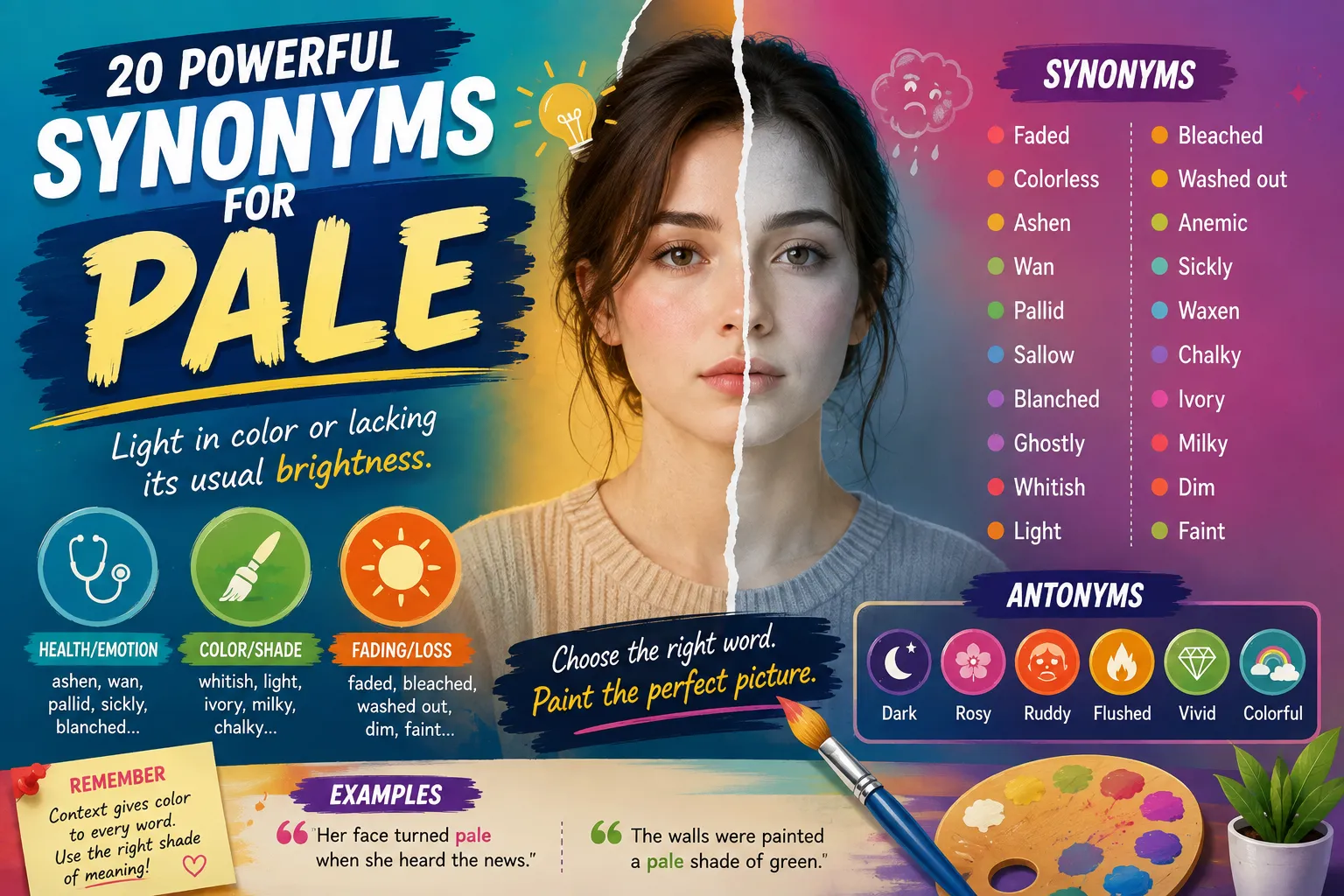
Pale means light in color or lacking its usual brightness. Common synonyms include faded, colorless, ashen, wan, pallid, whitish, and washed out. The best choice depends on context, such as describing a person’s complexion versus describing a shade of paint.
Imagine walking into a room and noticing a friend looks pale, as if the color has drained from their face. The word pale describes something light in color or lacking its usual brightness, and it shows up everywhere, from describing skin tone after a scare to describing a soft shade of blue on a wall. Writers and English learners often lean on the same word again and again, and that repetition can make writing feel flat. Learning synonyms for common words like pale sharpens vocabulary, adds precision to description, and helps a writer choose exactly the right shade of meaning for a scene or sentence. This article walks through the meaning of pale, its history, pronunciation, word family, twenty useful synonyms with examples, its opposite words, and answers to common questions people ask about the term.
Meaning of Pale
Definition
Pale (Adjective): Light in color, or having less color than usual, often used to describe skin, light, or a shade that is close to white.
Examples
- Her face turned pale when she heard the news.
- The walls were painted a pale shade of green.
Connotative Meaning
The word pale carries different emotional weight depending on context.
- Positive tone: A pale sunrise can sound gentle and soft.
- Negative tone: A pale face after shocking news suggests fear or illness.
- Neutral tone: A pale blue shirt simply describes color with no strong feeling attached.
(Connotation: the feeling or association a word carries beyond its literal meaning)
Etymology
Tracing the roots of pale shows how it moved through several languages before settling into modern English.
- Old English (450 to 1100): English at this time did not use pale directly; related color ideas came from Germanic roots describing lightness and weakness.
- Middle English (1100 to 1500): The word entered English through Old French pale, itself from Latin pallidus, meaning pale or wan.
- Modern English (1500 to Present): Pale settled into its current spelling and meaning, used for both color and complexion, and later extended to describe weak or faint qualities of anything, such as a pale excuse.
Pronunciation (IPA)
- IPA: /peɪl/
- Syllables: pale (one syllable)
Affixation Pattern of Pale
- Root: pale
- Prefix: none
- Suffix: ness, er, est, ly (added to form related words)
- Word formations:
- paleness (noun)
- paler (adjective, comparative)
- palest (adjective, superlative)
- palely (adverb)
- paling (verb, present participle)
- paled (verb, past tense)
20 Synonyms of Pale With Meaning and Examples
1. Faded (Adjective)
Meaning: Having lost brightness or strength of color. Examples:
- The old photograph looked faded after years in the sun.
- Her faded jeans were her favorite pair.
2. Colorless (Adjective)
Meaning: Completely without color. Examples:
- The liquid in the beaker was colorless and clear.
- His colorless face worried the nurse.
3. Ashen (Adjective)
Meaning: Extremely pale, often from shock or fear, resembling the color of ash. Examples:
- His ashen face showed how frightened he was.
- She went ashen when she saw the accident.
4. Ghostly (Adjective)
Meaning: Pale and eerie in a way that resembles a ghost. Examples:
- A ghostly light filled the abandoned hallway.
- His ghostly complexion made everyone stare.
5. Wan (Adjective)
Meaning: Pale and looking tired or unwell. Examples:
- She gave a wan smile despite the pain.
- His wan appearance suggested he had not slept in days.
6. Pallid (Adjective)
Meaning: Pale in a way that suggests poor health. Examples:
- The patient had a pallid complexion after surgery.
- His pallid skin worried his family.
7. Sallow (Adjective)
Meaning: Pale yellowish skin tone, often linked with poor health. Examples:
- Years of little sunlight left him with sallow skin.
- Her sallow cheeks made the doctor concerned.
8. Blanched (Adjective)
Meaning: Made pale suddenly, often from fear or shock. Examples:
- Her cheeks blanched when she heard the loud crash.
- He blanched at the sight of blood.
9. Whitish (Adjective)
Meaning: Somewhat white in color. Examples:
- The sky had a whitish haze that morning.
- His hair had turned whitish with age.
10. Light (Adjective)
Meaning: Pale in shade, not deep or dark in color. Examples:
- She chose a light shade of pink for the nursery.
- The light fabric suited the summer dress.
11. Bleached (Adjective)
Meaning: Made pale or white through exposure or chemical treatment. Examples:
- The sun had bleached the wooden fence over time.
- Her bleached hair looked almost silver.
12. Washed Out (Adjective)
Meaning: Appearing faded, tired, or drained of color. Examples:
- The old curtains looked washed out after years of sun.
- He looked washed out after the long flight.
13. Anemic (Adjective)
Meaning: Pale due to a lack of red blood cells, often used medically or figuratively. Examples:
- The doctor said her anemic condition explained her pale skin.
- His anemic complexion concerned his teacher.
14. Sickly (Adjective)
Meaning: Looking unhealthy and pale. Examples:
- The plant had a sickly, pale green color.
- He looked sickly after the long illness.
15. Waxen (Adjective)
Meaning: Pale and smooth like wax, often describing skin. Examples:
- Her waxen face frightened the visitors.
- The corpse in the story had a waxen appearance.
16. Chalky (Adjective)
Meaning: Pale white, resembling chalk. Examples:
- The chalky cliffs stretched along the coast.
- His chalky complexion suggested he was unwell.
17. Ivory (Adjective)
Meaning: A soft, pale, creamy white shade. Examples:
- The bride wore an ivory gown.
- The walls were painted an ivory tone.
18. Milky (Adjective)
Meaning: Pale white, similar to the color of milk. Examples:
- The milky sky hinted at rain.
- Her milky skin never tanned in the sun.
19. Dim (Adjective)
Meaning: Lacking brightness, often used for pale or faint light. Examples:
- The dim glow of the candle barely lit the room.
- His dim complexion matched his tired eyes.
20. Faint (Adjective)
Meaning: Barely noticeable, often describing weak color or light. Examples:
- A faint blush appeared on her cheeks.
- The faint outline of the mountain appeared through the fog.
Prototype Meaning
When most people hear the word pale, they picture a face or a color drained of its usual richness, something close to white but not quite white. The typical image is a person’s skin losing color from fear, illness, or cold, or a soft, light shade seen in paint, fabric, or light. This central image of lightness and reduced intensity is what ties together nearly every synonym on this list.
Prototype Categorization
Grouping the synonyms into categories helps a writer pick the exact shade of meaning needed for a sentence.
- Words describing health or emotion: ashen, wan, pallid, sallow, blanched, sickly, anemic, waxen. These fit best when describing a person’s face or condition.
- Words describing color or shade: whitish, light, chalky, ivory, milky, colorless. These work well when describing objects, fabric, or paint.
- Words describing fading or loss of intensity: faded, bleached, washed out, dim, faint, ghostly. These suit descriptions of light, memory, or something that has lost its original strength.
Choosing from the right category keeps writing accurate and avoids awkward word choices, such as calling a wall sallow or a sick person chalky.
Antonyms of Pale
- Dark (Adjective): Deep in color or shade.
- Rosy (Adjective): Having a healthy pink or red color.
- Ruddy (Adjective): Having a healthy red or reddish skin tone.
- Flushed (Adjective): Red in the face, often from heat or emotion.
- Vivid (Adjective): Strong and bright in color.
- Colorful (Adjective): Full of rich, bright color.
Short Questions and Answers
- What does pale mean? Pale means light in color or having less color than normal, often describing skin, light, or shade.
- When should pale be used? Use pale when describing a person’s complexion, a light shade of color, or something weak in intensity, such as pale light or a pale excuse.
- Is pale positive or negative? It depends on context. A pale sunrise sounds gentle, while a pale face after bad news suggests fear or illness.
- How is it different from similar words? Words like ashen and wan suggest illness or shock, while words like ivory and milky simply describe a soft, light shade with no emotional weight.
Conclusion
Learning the word pale and its many synonyms opens up a wider range of expression for both speaking and writing. Instead of repeating the same word for every shade of light color or every description of a tired face, a writer can choose from words like ashen, wan, faded, or ivory, each carrying a slightly different sha
de of meaning. This kind of vocabulary growth strengthens both spoken and written English, helps avoid repetition, and builds confidence when describing people, colors, and light. Practicing a few new synonyms each day, and using them in real sentences, is one of the simplest ways to grow a stronger, more flexible vocabulary over time.
Read More: Synonyms for Labor: 20 Useful Alternatives

Hi, I am Abid, a writer and editor at InstantSynonyms.com, where he creates clear and reader-friendly content about synonyms, vocabulary, and English word usage. His goal is to help readers choose the right words, expand their vocabulary, and write with greater confidence.