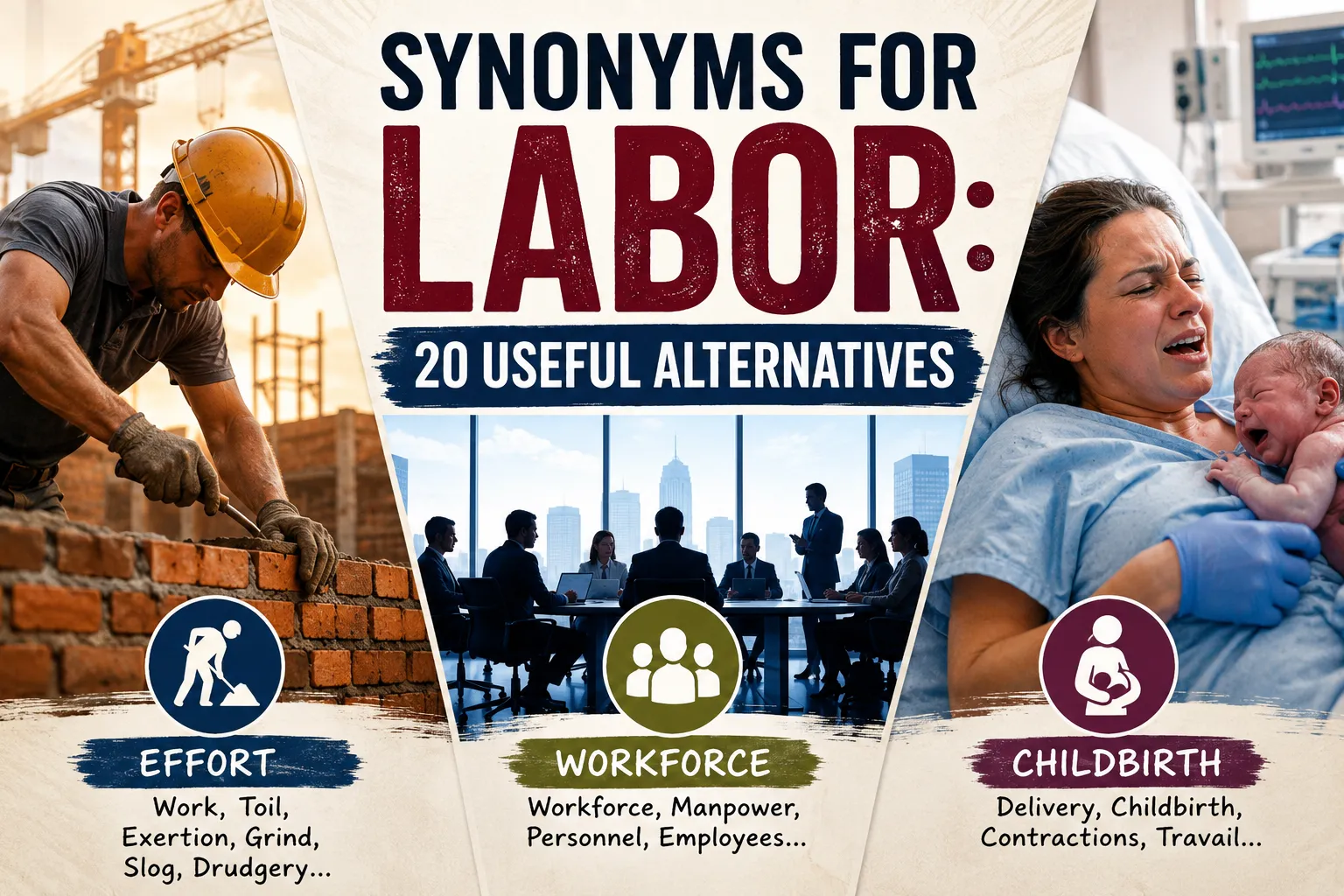
Labor most often means physical or mental effort put into work, though it can also refer to workers as a group or to childbirth. Strong general alternatives include work, toil, and exertion. For physical effort, try grind or drudgery. For the workforce sense, use workforce or manpower. For childbirth, use delivery.
Meaning of Labor
Labor is most commonly a noun. It means physical or mental effort directed toward accomplishing something, as in “the labor of building the fence.” It also functions as a verb, meaning to work hard, as in “she labored over the essay for hours.” In this core sense, the word always carries a hint of exertion, something beyond casual or effortless activity.
Labor has two additional common meanings. First, it can refer to workers collectively, especially in an economic or political sense. You’ll see this in phrases like “labor and management reached an agreement.” Second, it can refer to the process of childbirth, as in “she went into labor at midnight.” Context makes the intended meaning clear almost every time, so readers rarely confuse the three senses in practice.
Understanding all three meanings matters, though, when you’re choosing a synonym. A word that works perfectly for physical effort might sound completely wrong applied to childbirth or the workforce. That’s why this word rewards careful attention rather than a quick, automatic substitution.
Best Synonyms for Labor
Work is the safest, most neutral replacement in almost any sentence. It carries no extra connotation of struggle. You can use it in casual conversation, formal writing, or technical contexts, and it will almost never sound out of place.
Toil signals sustained, exhausting effort, often over a long period. It suits descriptions of farming, manual jobs, or difficult tasks. It leans slightly literary, so it fits reflective or descriptive writing better than casual conversation.
Exertion emphasizes the physical or mental energy spent. It’s useful in fitness, medical, or scientific writing, where the focus falls on effort as a measurable thing. You’ll often see it paired with words like “physical” or “mental,” as in “physical exertion” or “mental exertion.”
Workforce replaces labor only in its collective sense. It refers to the group of people who work, particularly in business or economic contexts. Unlike “labor,” it never implies effort itself, only the people doing the work.
Delivery replaces labor only in the childbirth sense. It’s the term most commonly used in medical settings once the birth itself begins. Doctors and nurses use it constantly, and it has become the default clinical term for this specific stage.
Beyond these five core alternatives, plenty of other useful synonyms exist for each distinct sense of the word.
20 Synonyms for Labor
- Work
- Toil
- Exertion
- Effort
- Drudgery
- Grind
- Slog
- Industry (formal, meaning diligent work)
- Sweat (informal)
- Struggle
- Task
- Duty
- Manpower (workforce sense)
- Workforce (workforce sense)
- Personnel (workforce sense)
- Employees (workforce sense)
- Childbirth (birth sense)
- Delivery (birth sense)
- Contractions (early birth sense, medical)
- Travail (literary, effort or childbirth sense)
Each word here brings its own shade of meaning. “Drudgery” and “slog” both suggest tedious, repetitive effort, the kind that wears you down slowly rather than all at once. “Grind” carries a similar tone, often used to describe daily work routines that feel relentless, as in “the daily grind.” “Sweat,” used informally, evokes visible physical effort, often with a casual or even humorous tone, as in “no sweat” or “put in some sweat equity.”
“Industry,” interestingly, doesn’t mean a business sector here. It means diligent, steady effort, an older usage that survives mostly in formal or literary writing, as in “a man of great industry.” “Struggle” adds a layer of difficulty or resistance, suggesting the effort meets some obstacle along the way, not just physical exhaustion.
On the workforce side, “manpower” and “personnel” both describe groups of workers, but they carry different tones. “Manpower” feels more industrial or military in flavor, often used in logistics or staffing contexts. “Personnel,” by contrast, sounds more corporate and formal, common in HR departments and official business documents. “Employees” is the most direct and neutral term, simply naming the people who work for an organization.
In the childbirth sense, “contractions” refers specifically to the early physical signs before full labor begins. “Travail,” meanwhile, is a rare, literary word that can describe either intense effort or the process of childbirth, depending on context. It rarely appears in modern conversation, but shows up occasionally in older literature or formal, poetic writing.
Types of Synonyms for Labor
Because labor covers three distinct meanings, the right word depends entirely on which sense you intend.
Effort sense: work, toil, exertion, grind, slog, drudgery.
Workforce sense: manpower, workforce, personnel, employees.
Childbirth sense: delivery, childbirth, contractions, travail.
Using a synonym from the wrong category will confuse readers immediately. So this is one keyword where sense matters more than tone. Swapping “workforce” into a sentence about physical exhaustion, or “delivery” into a sentence about hard manual work, creates real confusion rather than a simple stylistic shift.
Intensity Scale
Within the effort sense, intensity rises from mild to heavy.
Work, effort, and task sit at the mild to neutral end. Toil, exertion, and struggle sit in the moderate range. Drudgery, grind, and slog sit at the heavy end, often implying tedium or unpleasantness.
Drudgery in particular implies monotony as much as difficulty. So it fits repetitive chores better than a single demanding project. Calling a one time, intense task “drudgery” doesn’t quite fit, since the word carries a sense of ongoing, grinding repetition rather than a single burst of hard effort.
This scale matters because tone shifts significantly across these words. Describing a job as “work” sounds neutral and matter of fact. Describing the same job as “drudgery” signals real dissatisfaction or exhaustion. Choosing the right point on this scale keeps your writing accurate and appropriately toned.
Common Collocations and Natural Usage
“Manual labor” and “hard labor” are fixed phrases. “Manual work” is acceptable, but “manual toil” sounds unnatural. These fixed pairings have settled into standard English usage over time, and swapping in a synonym, even a close one, can create an odd, unfamiliar phrase.
“Go into labor” is the standard phrase for childbirth. “Go into delivery” is not idiomatic English, even though “delivery” works fine on its own in medical contexts. This shows how collocations don’t always transfer cleanly, even between closely related synonyms.
“Skilled labor” and “skilled workforce” are both natural, but “skilled personnel” leans more formal and corporate. Choosing between these depends heavily on the tone and setting of your writing, whether that’s a casual news article or a formal business report.
“Labor of love” is an idiom meaning work done for enjoyment rather than pay. No other synonym fits this exact phrase. You can’t say “work of love” or “toil of love” and expect the same meaning, since the idiom has become fixed exactly as it is.
Labor vs Similar Words
Labor vs Work: work is the general term for any activity done to accomplish something. Labor specifically implies physical or strenuous effort. So “mental work” sounds natural, while “mental labor” sounds slightly odd, since labor leans more toward physical exertion in common usage.
Labor vs Job: a job is a specific position or task you are paid to do. Labor refers to the effort itself, not the position. You can have a job that requires very little labor, or intense labor without any formal job attached to it at all.
Labor vs Employment: employment refers to the state of having paid work. Labor, in its collective sense, refers to workers as a group in relation to management or the economy. You might discuss “labor relations” between workers and management, a phrase that wouldn’t work the same way with “employment relations.”
How to Choose the Right Synonym
If you mean physical effort, use toil, exertion, or grind.
If you mean the general concept of working, use work or effort.
If you mean workers as a group, use workforce or manpower.
If you are writing about childbirth, use delivery in medical contexts and childbirth in general writing.
If the tone should be literary or old fashioned, travail is a reasonable but rare option.
Consider your audience too. A medical document should stick closely to delivery and contractions, since these terms carry precise clinical meaning. A business report should favor workforce or personnel, since these sound appropriately formal and specific. A personal essay about hard farm work might reach for toil or drudgery, since these words carry emotional weight that plain “work” simply doesn’t capture.
Common Mistakes with Labor
Do not use labor as a countable noun meaning “a job,” as in “I have three labors today.” Use task or job instead. Labor typically functions as an uncountable noun in the effort sense, describing a quantity or quality of effort rather than discrete, countable units.
Do not confuse “labor union” with “workforce union.” The fixed term is labor union in American English and trade union in British English. Swapping in “workforce” here creates a phrase that simply isn’t standard in either variety of English.
Avoid using delivery to mean effort in general. It only works for the childbirth sense. Saying “the delivery of building that fence took all day” would sound confusing or simply incorrect to most readers.
Another common mistake involves treating drudgery as a simple synonym for hard work in every context. Since drudgery specifically implies monotony, using it to describe a single intense, one time physical task, rather than repetitive daily grind, doesn’t quite fit the word’s real meaning.
Antonyms of Labor
Rest, leisure, idleness, and relaxation are the clearest opposites of labor in its effort sense. These words all describe a state free from work or exertion, the natural counterpart to sustained physical or mental effort.
There is no true antonym for the workforce or childbirth senses, since those are not scalar concepts. A workforce doesn’t have a natural opposite the way effort has rest, and childbirth simply doesn’t occur on a spectrum with a clear opposing endpoint.
FAQ
What does labor mean?
It usually means physical or mental effort spent on work. It can also mean the workforce or the process of childbirth.
What is another way to say labor?
Work, toil, or exertion are the most natural general replacements.
What is the strongest synonym for labor?
Drudgery and grind carry the strongest sense of hard, tiring effort.
What is the difference between labor and work?
Work is the neutral, general term. Labor implies more physical or sustained effort.
What is the opposite of labor?
Rest or leisure, when referring to physical or mental effort.
Is labour spelled differently in British English?
Yes. British English uses “labour,” while American English uses “labor.”
Can labor refer to something other than physical work?
Yes. It can describe mental effort too, and it also covers two entirely separate meanings: the workforce and childbirth.
Conclusion
Labor is a flexible word that shifts meaning depending on context. It covers physical effort, the workforce, and childbirth. Choosing the right synonym means first identifying which sense applies. Then match the tone, whether that calls for the plain neutrality of work, the weight of toil, or the technical precision of delivery. Paying attention to these distinctions will make your writing clearer and more accurate than reaching for the first word a thesaurus offers.
Read More: Synonyms for Silhouette: 14 Alternatives Worth Knowing

Hi, I am Abid, a writer and editor at InstantSynonyms.com, where he creates clear and reader-friendly content about synonyms, vocabulary, and English word usage. His goal is to help readers choose the right words, expand their vocabulary, and write with greater confidence.