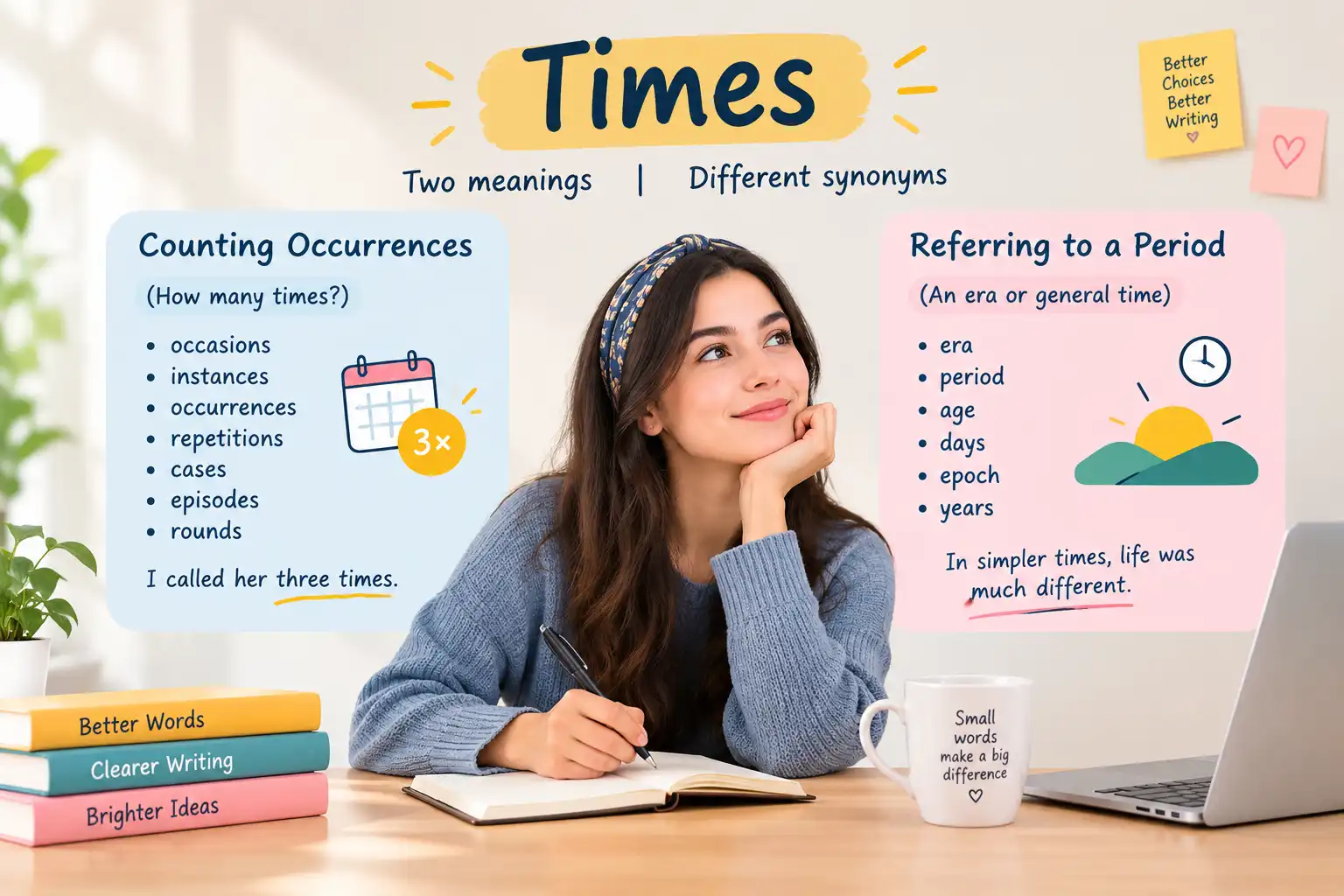
The best synonyms for times depend on which meaning you need. For counting occurrences (three times, many times), use occasions, instances, or occurrences. For referring to a historical period (modern times, hard times), use era, period, or age. These two meanings are not interchangeable.
Meaning of Times
Times is the plural of time, and it works in two very different ways depending on context.
As a counter of occurrences: Times tells you how many instances something happened. “I called her three times” simply counts repeated events.
As a reference to a historical period: Times can describe an era or general period, as in “back in simpler times” or “these are difficult times.” Here the word points to a stretch of history or a general condition of the world, not a count.
A third, much narrower use appears in math and casual speech, where times means multiplied by, as in “five times three equals fifteen.” This sense rarely needs a synonym, since “multiplied by” is already the standard alternative, so this article focuses on the two meanings writers most often search for.
Connotation and Nuance
The counting sense of times is neutral. It carries no emotional weight of its own, though the surrounding words often add tone, as in “countless times” versus “only a few times.”
The historical sense of times often does carry emotional weight, especially in phrases like “hard times” or “the good old times,” where the word absorbs whatever feeling the sentence builds around it.
Best Synonyms for Times
These are the strongest alternatives, split by meaning, since a word that fits one sense often sounds wrong in the other.
Occasions (counting sense)
The most natural formal substitute for times when counting events. Works smoothly in writing and speech alike. “On three occasions” sounds slightly more polished than “three times.”
Instances (counting sense)
Common in academic, professional, and analytical writing. Carries a slightly more clinical or evidence based tone than times.
Occurrences (counting sense)
Useful when describing repeated events in a more technical or observational way, often seen in reports and data driven writing.
Era (historical sense)
A strong, natural substitute for times when referring to a broad historical period. “A different era” reads clearly and confidently.
Period (historical sense)
A flexible, neutral alternative that works in both casual and formal writing when describing a stretch of time rather than a count.
Synonyms for Times: Counting Occurrences
These words replace times when it functions as a counter of repeated events.
- Occasions
- Instances
- Occurrences
- Repetitions
- Cases
- Episodes (best for distinct, notable repeated events)
- Rounds (informal, often used in games, sports, or casual repeated actions)
Not every word here fits every sentence. “Three cases” works in medical or legal writing, but sounds odd in casual conversation compared to “three times.”
Synonyms for Times: Referring to a Period or Era
These words replace times when it refers to a general historical period or condition.
- Era
- Period
- Age
- Days (informal, as in “back in those days”)
- Epoch (formal, often used for long, defined historical stretches)
- Years (general, as in “in earlier years”)
“Epoch” sounds far more formal and academic than “days,” so choosing between them depends heavily on tone, not just meaning.
Times vs Similar Words
Times vs occasions: Occasions can also mean special events, such as a birthday or celebration, while times in the counting sense simply refers to repetition without any sense of significance.
Times vs era: Era typically implies a defined, often notable stretch of history, while times can refer more loosely and informally to any general period, including someone’s personal life stage.
Times vs instances: Instances leans analytical and often appears in writing that examines patterns or evidence, while times stays neutral and works equally well in casual speech.
How to Choose the Right Synonym
If you are counting repeated actions in formal writing, use occasions or instances.
If you are writing a report or analyzing data, occurrences or instances will sound more precise than times.
If you are describing a historical period, use era or period rather than forcing times into that context.
If you want a casual, conversational tone when referring to the past, days works better than era or epoch.
If the sentence involves multiplication, keep times as is, or use multiplied by, since none of the words above apply to that meaning.
Common Mistakes with Times Synonyms
Mistake: Using era or epoch to describe a simple repeated action.
Why it happens: Writers sometimes reach for a bigger, more formal sounding word without noticing that era only fits the historical meaning, not the counting one.
Mistake: Using occasions when referring to an unpleasant or purely mechanical repetition.
Why it happens: Occasions can sound slightly celebratory or notable, so it feels out of place in a sentence like “the machine failed on three occasions,” even though it is technically correct.
Mistake: Treating times, era, and period as fully interchangeable.
Why it happens: All three relate loosely to time, but only era and period share the historical meaning, while times can mean either historical period or simple repetition depending on context.
Antonyms of Times
A true antonym does not exist for the counting sense of times, since it functions more like a number than a descriptive word. For the historical sense, contextual opposites include modernity (opposite of old times) or present day (opposite of past times).
Related Words
Frequency relates closely to the counting sense of times, since it describes how often something happens, though frequency describes the rate rather than a specific count.
Duration relates to the historical sense of times, describing how long a period lasts, though duration measures length rather than naming the period itself.
Frequently Asked Questions
What does times mean?
Times usually means either a count of repeated events, as in “three times,” or a general historical period, as in “modern times.” Context determines which meaning applies.
What is another way to say times when counting?
Occasions, instances, and occurrences all work well as substitutes when times is used to count repeated events.
What is another way to say times when referring to history?
Era, period, and age work naturally when times refers to a historical stretch or general condition of the world.
Are these synonyms interchangeable?
No. Words for the counting sense, like instances, do not work for the historical sense, and words like era do not work when simply counting repeated actions.
What is the most formal synonym for times?
Instances and occurrences tend to sound the most formal in the counting sense, while epoch sounds the most formal in the historical sense.
Can times mean multiplication?
Yes, in math and casual speech, times can mean multiplied by, as in “four times five.” This sense rarely needs a synonym beyond multiplied by.
Conclusion
Times is a small word carrying two very different jobs, counting repeated events or naming a historical period, and the right synonym depends entirely on which job it is doing in your sentence. Occasions and instances work well for counting, while era and period suit historical references far better than forcing times to stretch across both meanings. Before swapping in a synonym, check which sense of times you actually mean, since picking the wrong category will make the sentence sound slightly off even if the word seems close enough on the surface.
Read More: Synonyms for Wilderness: 25 Natural Alternatives

Hi, I’m Ayesha, the creator of InstantSynonyms.com. I believe the right word can transform a sentence, strengthen an idea, and make communication more impactful. That’s why I created this site, to help writers, students, professionals, and English learners find accurate synonyms, antonyms, and better word choices quickly and effortlessly.