Little bit means a small quantity, a short time, or a slight degree. The best alternatives depend on which of those you mean. For quantity, use a bit, a small amount, or a touch. For degree, use slightly or somewhat. For casual speech, a smidge and a tad work well, while formal writing usually prefers a small amount or to some extent.
Meaning of Little Bit
Little bit is a noun phrase, usually appearing as a little bit, meaning a small quantity or a small degree of something. It is one of the most flexible quantity expressions in English, partly because it attaches to so many different kinds of words.
The phrase covers three distinct uses. With uncountable nouns, it measures quantity, as in a little bit of sugar. With adjectives and verbs, it measures degree, as in a little bit tired or it hurts a little bit. With time, it measures duration, as in wait a little bit.
Grammatically, a little bit of comes before uncountable nouns, not countable ones. You can have a little bit of water or a little bit of patience, but not a little bit of chairs. For countable nouns, English uses a few instead. This is one of the most common errors English learners make with the phrase, and it is worth committing to memory.
Connotation and Nuance
Little bit is neutral in meaning but soft in effect. It reduces the weight of whatever follows it, which is why speakers use it so often to be polite, cautious, or modest.
Saying I am a little bit worried signals concern without alarm. Asking for a little bit of help makes the request feel smaller and easier to grant. English speakers also use it for understatement, where a little bit clearly means a great deal, as in that was a little bit awkward said after a disaster.
This softening function matters when choosing a synonym. Slightly and somewhat preserve the softening. A smidge preserves it and adds warmth. A small amount is neutral and loses most of the social softening entirely.
Best Synonyms for Little Bit
1. A Bit
Part of Speech: Noun phrase
Meaning: A small quantity or small degree of something.
Best Use: Almost anywhere little bit works. It is shorter and very slightly more casual.
Difference: Nearly identical in meaning, so this is the closest thing to an exact synonym.
Examples: Add a bit of salt to the sauce. Traffic was a bit heavier than usual this morning.
2. Slightly
Part of Speech: Adverb
Meaning: To a small degree.
Best Use: Modifying adjectives and verbs in neutral or professional writing.
Difference: Slightly is an adverb, so it cannot replace little bit before a noun. You can be slightly tired, but you cannot add slightly of sugar.
Examples: Revenue rose slightly in the second quarter. Her tone shifted slightly when the topic changed.
3. A Small Amount
Part of Speech: Noun phrase
Meaning: A limited quantity of something.
Best Use: Formal writing, instructions, and technical or scientific contexts.
Tone or Register: Neutral to formal.
Difference: It measures quantity only and sounds more precise, so it does not work for degree or time.
Examples: Apply a small amount of adhesive to each corner. Only a small amount of funding remains.
4. A Touch
Part of Speech: Noun phrase
Meaning: A very small quantity or degree.
Best Use: Cooking, description, and polished conversational writing.
Difference: A touch suggests something smaller and more deliberate than a little bit, with a slightly refined tone.
Examples: Finish the dish with a touch of lemon. The room felt a touch too warm.
5. Somewhat
Part of Speech: Adverb
Meaning: To a moderate or limited extent.
Best Use: Formal and academic writing where hedging is needed.
Difference: Somewhat is noticeably more formal than little bit and slightly stronger in degree.
Examples: The findings were somewhat inconsistent with earlier research. Attendance has been somewhat lower this term.
25 Synonyms for Little Bit
- A bit
- A small amount
- A touch
- A tad
- A smidge
- A dash
- A pinch
- A drop
- A trace
- A sprinkle
- A hint
- A shade
- A fraction
- A handful
- A few
- Slightly
- Somewhat
- Marginally
- Mildly
- A little
- To some extent
- A modest amount
- Barely any
- A speck
- A splash
These fall into several different grammatical shapes, which matters more than it might seem. Slightly, somewhat, marginally, and mildly are adverbs and modify adjectives or verbs. Everything else is a noun phrase and needs of before an uncountable noun.
A pinch, a dash, a sprinkle, and a splash are cooking specific. A pinch suits dry ingredients like salt or spice. A dash and a splash suit liquids. Using them outside the kitchen sounds figurative rather than literal, which can be an effective stylistic choice, as in a dash of humor.
A trace, a hint, and a speck all suggest an amount so small it is barely detectable, smaller than a little bit usually implies. A few is the countable counterpart, the word you need when a little bit of would be ungrammatical.
Types of Synonyms for Little Bit
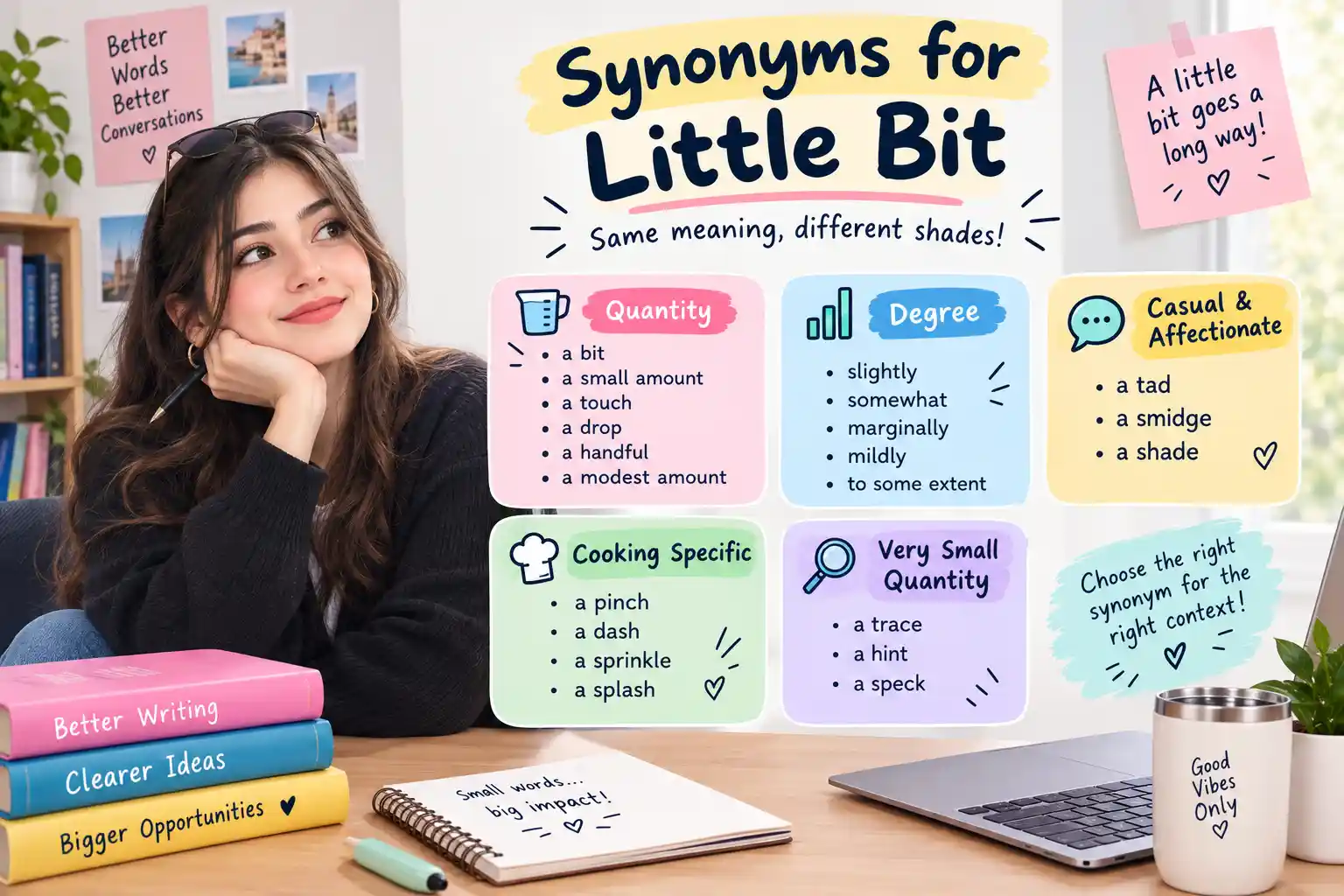
Quantity alternatives: a bit, a small amount, a touch, a drop, a handful, a modest amount.
Degree alternatives: slightly, somewhat, marginally, mildly, to some extent.
Casual and affectionate: a tad, a smidge, a shade.
Cooking specific: a pinch, a dash, a sprinkle, a splash.
Very small quantity: a trace, a hint, a speck.
Sorting them this way prevents the most common substitution error. Quantity words and degree words are not interchangeable, because they occupy different grammatical slots in a sentence.
Intensity Scale
Within the quantity sense, the amount implied rises roughly like this. A trace, a speck, and a hint sit at the smallest end, suggesting something barely present. A pinch, a smidge, and a touch come next, small but deliberate. A bit and a little bit sit in the comfortable middle. A handful and a modest amount suggest noticeably more, though still limited.
Context can override the scale. A little bit of salt and a little bit of money describe wildly different quantities, and only the surrounding sentence tells the reader which scale applies.
Formality Scale
From most casual to most formal: a smidge and a tad sit firmly in relaxed conversation. A bit and a little bit are comfortably neutral. Slightly and a small amount work in professional writing. Somewhat, marginally, and to some extent belong to formal and academic registers.
A smidge in a research paper would be jarring. Marginally in a text message to a friend would sound stiff. Matching the register to the setting matters as much as matching the meaning.
Common Collocations and Natural Usage
“A little bit of time” and “a little bit of help” are both extremely natural. “A small amount of time” is grammatical but sounds oddly clinical in conversation.
“A pinch of salt” is fixed and idiomatic. “A little bit of salt” also works, but a pinch sounds far more natural in a recipe. Meanwhile “a pinch of water” is wrong, since pinch applies to dry ingredients.
“A bit tired” and “a little bit tired” are both standard. “A small amount tired” is ungrammatical, because a small amount cannot modify an adjective.
“Take it with a pinch of salt” is a fixed idiom meaning to treat something skeptically, and no synonym substitutes into it. British English uses pinch here while American English usually says grain.
“Wait a little bit” and “wait a bit” are both natural for short periods of time. “Wait a small amount” is not idiomatic English.
Little Bit vs Similar Words
Little bit vs A few: little bit works with uncountable nouns and a few works with countable ones. A little bit of rice is correct because rice is uncountable. A few grains of rice is correct because grains can be counted.
Little bit vs A little: these are very close, and a little is simply shorter. A little bit tends to sound slightly more conversational and emphatic, while a little can feel marginally more neutral. Both are correct in almost all the same places.
Little bit vs Slightly: the difference is grammatical rather than semantic. Little bit is a noun phrase and slightly is an adverb, so they cannot be swapped freely. It hurts a little bit and it hurts slightly both work, but a slightly of sugar does not.
Little bit vs Somewhat: somewhat is more formal and usually indicates a slightly larger degree. Somewhat disappointed sounds more measured and more serious than a little bit disappointed.
How to Choose the Right Synonym
If you are measuring an uncountable noun, use a bit, a small amount, or a touch.
If you are counting separate items, use a few instead, since a little bit of is ungrammatical there.
If you are modifying an adjective or verb, use slightly, somewhat, or mildly.
If you are writing formally or academically, use somewhat, marginally, or to some extent.
If you are writing a recipe, use a pinch, a dash, or a splash depending on whether the ingredient is dry or liquid.
If you want warmth and informality, use a tad or a smidge.
If the amount is genuinely tiny, use a trace, a hint, or a speck rather than overstating with a little bit.
Common Mistakes with Little Bit
Do not use a little bit of before countable nouns. Say a few chairs, not a little bit of chairs. This is the single most frequent error with this phrase.
Avoid using a small amount to modify adjectives. A small amount is a noun phrase, so a small amount nervous is ungrammatical. Use slightly nervous instead.
Be careful with a pinch outside cooking contexts. Used literally, it applies to dry, grippable ingredients only, so a pinch of milk sounds wrong.
Do not overuse little bit as a hedge in professional writing. Repeated softening can make writing sound uncertain, and a single precise statement often reads as more credible than three hedged ones.
Avoid stacking hedges. A little bit somewhat unclear is redundant, since both phrases do the same softening work.
Antonyms of Little Bit
A lot, a great deal, plenty, and a large amount are the clearest opposites in the quantity sense. For degree, very, extremely, and considerably reverse the softening effect. None, nothing, and not at all serve as absolute opposites, describing the complete absence of the thing rather than merely more of it.
FAQ
What does little bit mean? It means a small quantity, a small degree, or a short period of time, depending on what follows it in the sentence.
What is another way to say little bit? A bit is the closest everyday alternative. Slightly works for degree, and a small amount works for quantity in formal writing.
Is little bit formal or informal? It is neutral and works in most everyday and professional contexts, though academic writing usually prefers somewhat or slightly.
Can I say a little bit of people? No. People is countable, so the correct phrase is a few people. A little bit of only works with uncountable nouns.
What is the difference between a little bit and a little? They mean essentially the same thing. A little bit sounds slightly more conversational, while a little is shorter and marginally more neutral.
What is the most formal alternative? To some extent and somewhat are the most formal, and both appear frequently in academic and professional writing.
What is the opposite of a little bit? A lot or a great deal for quantity, and very or considerably when you are describing degree.
Conclusion
Little bit does three separate jobs, measuring quantity, degree, and time, and the right alternative depends entirely on which job you need done. Check the grammar first, since adverbs like slightly and noun phrases like a small amount are not interchangeable. Then match the register, keeping a smidge for conversation and somewhat for formal writing. Finally, ask whether the softening effect is helping your sentence or just weakening it. Sometimes the strongest revision is removing the hedge altogether.
Read More: Synonyms for Daughter: 20 Useful Alternatives

Hi, I’m Ayesha, the creator of InstantSynonyms.com. I believe the right word can transform a sentence, strengthen an idea, and make communication more impactful. That’s why I created this site, to help writers, students, professionals, and English learners find accurate synonyms, antonyms, and better word choices quickly and effortlessly.