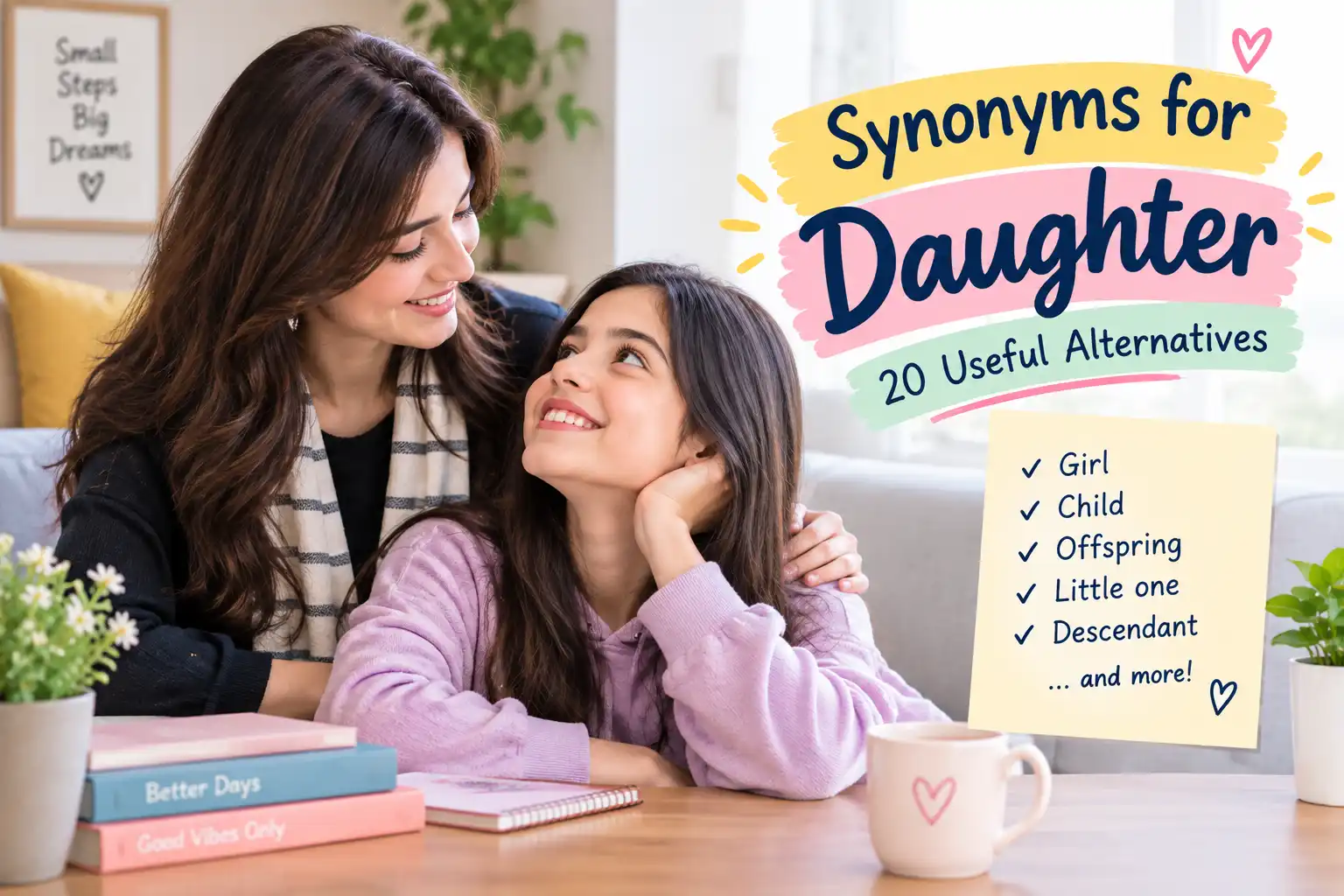
Daughter refers to a female child in relation to her parents. Because it describes a relationship rather than a quality, true synonyms are limited. The closest alternatives include girl, child, and offspring, though each shifts the meaning slightly. Affectionate options like little one work in casual speech, while formal documents often use female child or descendant instead.
Meaning of Daughter
Daughter is a noun describing a female person in relation to her parents. It is a relational term, meaning it only makes sense when a parent is implied or stated. You can be someone’s daughter, but you cannot simply be a daughter in isolation, the way you can simply be a woman or a student.
Age plays no role in the meaning. A newborn is a daughter, and so is a seventy year old woman whose parents have passed away. This surprises some English learners, who assume the word implies youth the way words like girl or child often do.
Daughter also appears in a few extended, figurative uses. Someone might describe a city as a daughter of an older civilization, or call a woman a daughter of a particular region or tradition, as in “a daughter of the South.” These uses are literary rather than everyday, and they borrow the sense of origin and lineage rather than family in the strict sense.
Why True Synonyms Are Limited
Most words have synonyms because they describe qualities, actions, or objects that can be described in more than one way. Daughter is different. It names a precise relationship between two people, and English has only one word for that exact relationship.
Everything on the list below is therefore a near synonym, a contextual alternative, or an affectionate substitute rather than an exact match. Girl loses the relational element entirely. Child loses the gender. Offspring keeps both but sounds clinical. Understanding this gap matters, because swapping in a near synonym often changes what the sentence actually communicates.
Best Synonyms for Daughter
1. Girl
Part of Speech: Noun
Meaning: A young female person.
Best Use: Casual conversation where the family relationship is already obvious from context.
Difference: Girl carries no relational meaning on its own and implies youth, so it fails for adult daughters.
Examples: Their girl just started middle school this year. My oldest girl plays on the soccer team.
2. Child
Part of Speech: Noun
Meaning: A son or daughter of any age, or a young person generally.
Best Use: Writing where gender is irrelevant or deliberately unstated, including legal and formal contexts.
Difference: Child does not specify gender, so it broadens the meaning rather than replacing it exactly.
Examples: Both of their children attended the ceremony. Each child receives an equal share under the will.
3. Offspring
Part of Speech: Noun
Meaning: A person’s child or children, considered biologically.
Best Use: Scientific, legal, or humorous writing. Rarely natural in warm family conversation.
Tone or Register: Formal, clinical, occasionally jokey when used about humans.
Difference: Offspring emphasizes biological descent and sounds detached, while daughter carries emotional warmth.
Examples: The study tracked health outcomes in the offspring of participants. He jokes about his offspring eating everything in the fridge.
4. Little One
Part of Speech: Noun phrase
Meaning: An affectionate term for a young child.
Best Use: Warm, casual speech between family members or close friends.
Difference: Little one works only for young children and carries strong affection that daughter does not automatically imply.
Examples: How is your little one settling into nursery? Bring the little one along, there is plenty of space.
5. Descendant
Part of Speech: Noun
Meaning: A person related to an earlier ancestor, across any number of generations.
Best Use: Historical, genealogical, or legal writing about family lines.
Difference: Descendant covers grandchildren and beyond, so it is much broader than daughter and loses the direct parent link.
Examples: Her descendants still farm the same land. The estate passes to his direct descendants only.
20 Synonyms for Daughter
- Girl
- Child
- Offspring
- Little one
- Descendant
- Baby girl
- Kid
- Young lady
- Female child
- Heir
- Heiress
- Firstborn
- Eldest
- Youngest
- Stepdaughter
- Goddaughter
- Granddaughter
- Adopted daughter
- Princess
- Sweetheart
Several of these need careful handling. Heir and heiress relate to inheritance rather than family relationship, so they only substitute for daughter in legal or dynastic contexts. Firstborn, eldest, and youngest describe birth order and need the family context supplied around them.
Stepdaughter, goddaughter, granddaughter, and adopted daughter are not substitutes at all. They are specific relationship types that include the word daughter, and using one in place of daughter changes who the person actually is. They belong on this list because searchers often want them, not because they are interchangeable.
Princess and sweetheart are pure endearments. They express affection toward a daughter without describing the relationship, so they only work when the relationship is already understood.
Types of Synonyms for Daughter
Neutral and general: child, girl, kid, young lady, female child.
Formal and technical: offspring, descendant, heir, heiress.
Affectionate: little one, baby girl, princess, sweetheart.
Specific relationship types, not substitutes: stepdaughter, goddaughter, granddaughter, adopted daughter.
These categories matter because the groups behave very differently in a sentence. A word from the affectionate group sounds odd in a legal document. A word from the formal group sounds cold at a birthday party. And the fourth group changes the factual meaning entirely rather than the tone.
Formality Scale
From most casual to most formal, the usable alternatives roughly line up as follows. Baby girl and princess sit at the casual, affectionate end. Kid and girl come next, still relaxed but less sentimental. Daughter and child sit comfortably in the neutral middle, appropriate almost everywhere. Female child, offspring, and descendant occupy the formal and technical end, common in legal filings, medical records, and academic research.
Context, not just formality, drives the choice. A hospital form and a wedding speech are both serious occasions, yet one calls for female child while the other calls for daughter.
Common Collocations and Natural Usage
“Eldest daughter” and “youngest daughter” are both standard and extremely common. “Firstborn daughter” also works naturally, particularly in historical or narrative writing.
“Only daughter” is a fixed, natural phrase meaning a family’s single female child. “Only girl” can convey something similar in casual speech, but it sounds less precise and can be misread as meaning the only girl present somewhere.
“Grown daughter” and “adult daughter” are both natural when age needs emphasis, which is useful precisely because daughter alone gives no age information. “Grown girl” is not idiomatic and will sound wrong to native speakers.
“Daughter in law” refers to a son’s wife, not a daughter, and no alternative on this list substitutes for it.
Daughter vs Similar Words
Daughter vs Girl: girl describes age and gender without any relationship, so it only stands in for daughter when the family context is already clear. It also fails completely for adult daughters, since calling a forty year old woman a girl reads as dismissive to many people.
Daughter vs Child: child is gender neutral and covers sons too. Choosing child over daughter is useful when gender genuinely does not matter, but it also removes information a reader might need.
Daughter vs Offspring: both keep the parent relationship intact, but offspring treats the person as a biological result rather than a family member. It fits a genetics paper and clashes badly with a Mother’s Day card.
Daughter vs Heiress: heiress describes someone who will inherit wealth or a title. Many daughters are not heiresses, and an heiress could in principle be a more distant relative, so the two words overlap only in specific dynastic or legal settings.
How to Choose the Right Synonym
If the family relationship needs to be explicit, keep daughter. Nothing replaces it cleanly.
If gender does not matter to your sentence, use child.
If you are writing something legal, medical, or scientific, use female child or offspring.
If you are speaking warmly about a young child, use little one or baby girl.
If your subject is inheritance or family lines, use heir, heiress, or descendant depending on the exact legal situation.
If you simply want to avoid repeating daughter in a paragraph, try restructuring the sentence instead of substituting a weaker word. Pronouns and names usually solve repetition better than near synonyms do.
Common Mistakes with Daughter
Do not use girl for an adult daughter. Many adult women find it diminishing, and it also removes the family relationship the sentence probably needed.
Avoid offspring in warm or personal writing. It is accurate but clinical, and it can read as cold or unintentionally comic in a card, speech, or tribute.
Do not treat stepdaughter, goddaughter, or granddaughter as polite variations of daughter. Each names a different relationship, and swapping them creates a factual error rather than a stylistic choice.
Be careful with daughter in law. Despite containing the word daughter, it refers to a son’s spouse and belongs to a separate set of terms entirely.
Antonyms of Daughter
Son is the direct counterpart, describing a male child in the same parental relationship. Mother and father function as relational opposites, since they name the other side of the same relationship rather than an opposite quality. There is no true antonym in the usual sense, because daughter describes a role rather than a quality that can be reversed.
Related Words
Several words sit close to daughter without being alternatives. Sibling, parent, and heir all belong to the vocabulary of family and inheritance, and they often appear in the same sentences, but none of them can replace daughter.
Filial is the related adjective, describing the duties or feelings appropriate to a son or daughter, as in filial loyalty. Maternal and paternal describe the parent side of the same relationship. Knowing these words helps writers discuss family relationships precisely without misusing them as substitutes.
FAQ
What does daughter mean? It means a female child in relation to her parents, at any age, from infancy through adulthood.
What is another way to say daughter? Child works when gender does not matter, girl works in casual speech about a young daughter, and offspring works in formal or scientific writing.
Are there exact synonyms for daughter? No. Because daughter names a specific relationship, every alternative changes something, whether that is gender, age, tone, or the relationship itself.
What is the most formal alternative to daughter? Female child and offspring are the most formal, and both appear regularly in legal and medical documents.
Does daughter imply a young person? No. A woman remains her parents’ daughter throughout her life, which is why phrases like adult daughter and grown daughter are so common.
What is the opposite of daughter? Son, in the sense of the male counterpart within the same parent and child relationship.
Is daughter in law a type of daughter? No. The phrase refers to a son’s wife, and it describes a relationship created by marriage rather than by birth or adoption.
Conclusion
Daughter is one of those words with almost no genuine substitutes, because it names a relationship rather than a quality. Child broadens it, girl narrows it to youth, offspring cools it down, and little one warms it up. None of them says exactly what daughter says. Before you reach for an alternative, decide whether you are trying to change the tone, the level of formality, or the information itself, then pick accordingly. Often the clearest choice is simply keeping daughter and rewriting the sentence around it.
Read More: Synonyms for poised: 30 Useful Alternatives

Hi, I am Abid, a writer and editor at InstantSynonyms.com, where he creates clear and reader-friendly content about synonyms, vocabulary, and English word usage. His goal is to help readers choose the right words, expand their vocabulary, and write with greater confidence.