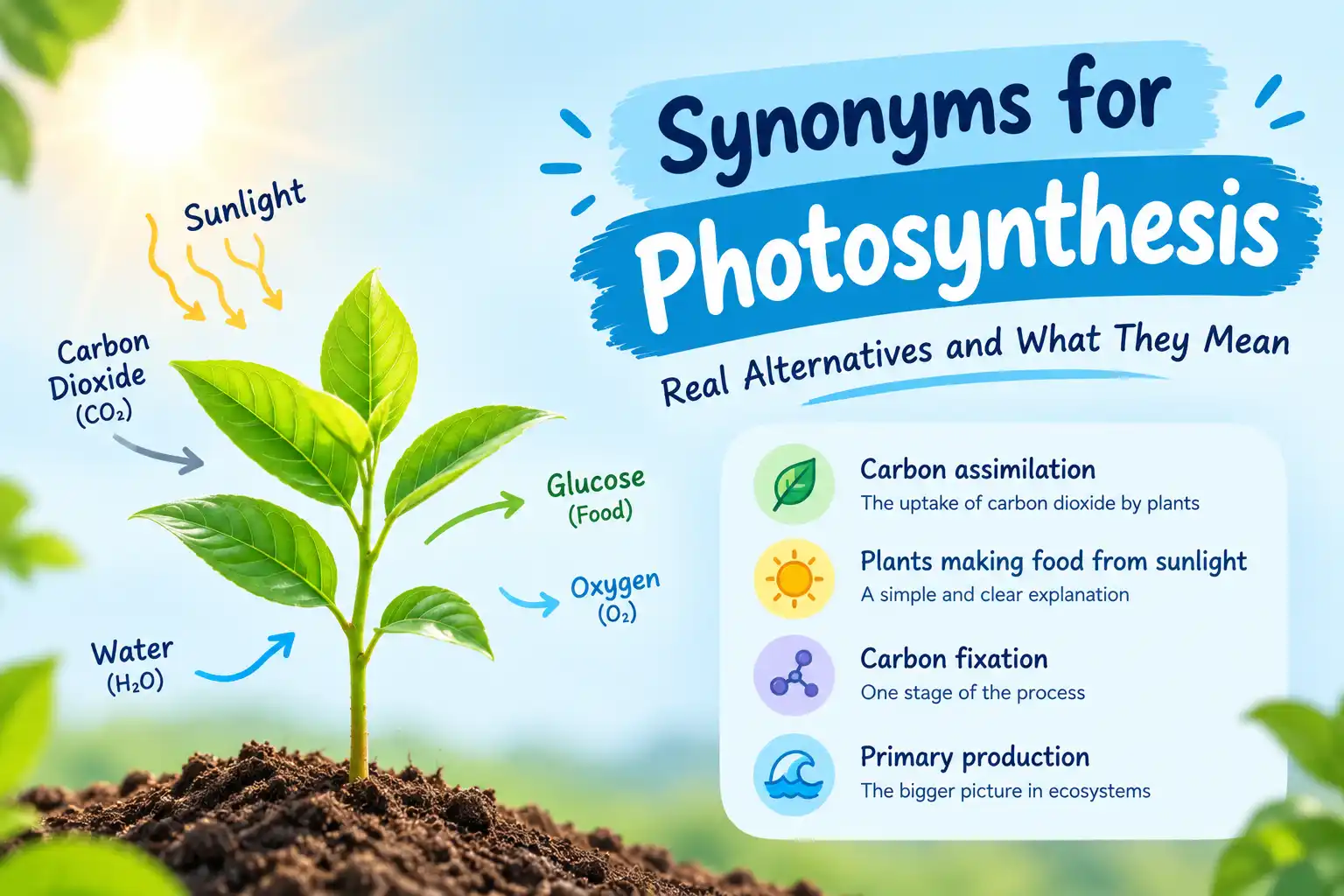
Photosynthesis has no true one word synonym, because it names one specific biological process. The closest alternatives are explanatory phrases such as “plants making food from sunlight,” plus technical terms like carbon assimilation and carbon fixation, which describe the whole process or one stage of it. Use simple phrases for children and precise terms for science writing.
Most synonym articles hand you a long list and wish you luck. That approach fails here. If you swap photosynthesis for a random “similar” term, you can change the science without noticing. So this guide takes a different route. It shows which alternatives are close, which only cover part of the process, and which are merely related, so you can pick the right expression for your reader.
Meaning of Photosynthesis
Photosynthesis is a noun. It is uncountable, so you normally say “photosynthesis” and not “a photosynthesis.” It names the process by which plants, algae, and some bacteria use light energy to turn carbon dioxide and water into sugar, usually glucose, and release oxygen in most cases.
In simple chemical terms, the overall change looks like this: 6CO2 + 6H2O + light energy gives C6H12O6 + 6O2. In words, carbon dioxide and water, powered by light, become glucose and oxygen.
The process has two main stages. In the first, called the light reactions, pigments such as chlorophyll capture light energy. And, In the second, called the Calvin cycle, the plant uses that captured energy to build sugar from carbon dioxide. In plants, this happens inside chloroplasts, mostly in leaves.
The verb form is photosynthesize. The adjective is photosynthetic.
Here are two natural examples:
- Kelp forests photosynthesize even beneath cold coastal water, as long as enough light reaches them.
- Our biology teacher asked us to measure how fast a leaf carries out photosynthesis under a lamp.
Connotation and Nuance
Photosynthesis is a neutral, scientific word. It carries no positive or negative feeling. It does carry a school flavor, because most people first meet it in a classroom. That is why many writers add a short explanation the first time the word appears in a general article.
One nuance matters a lot: photosynthesis does not create energy. It converts light energy into chemical energy stored in sugar. Any alternative that suggests energy is “made from nothing” is scientifically sloppy.
How to Pronounce Photosynthesis
The standard American pronunciation is /ˌfoʊtoʊˈsɪnθəsɪs/. The usual British pronunciation is /ˌfəʊtəʊˈsɪnθəsɪs/. The main stress falls on the third syllable, “syn.”
Break it into syllables like this: pho, to, syn, the, sis. Say it slowly at first, then speed up. The “th” sound in the middle trips up many learners, so give it a clear breath of air.
Etymology and Word Formation
The word is built from two Greek based parts. Photo comes from a Greek word meaning light. Synthesis comes from a Greek word meaning a putting together. So the word literally suggests “putting together with light.” That is a very good short description of what the process does.
From this base, English forms several related words:
- photosynthesize (verb)
- photosynthesizing and photosynthesized (verb forms)
- photosynthetic (adjective)
- photosynthetically (adverb)
- photosynthesizer (a noun used for an organism that does it, less common)
Do not confuse these with words that only look similar, such as “photography,” which shares the “photo” element but has nothing to do with plants.
Best Alternatives for Photosynthesis
Since no perfect synonym exists, these are the four alternatives worth learning first, ranked by usefulness.
1. Carbon assimilation. This is the strongest formal alternative in plant science. It focuses on the plant taking in carbon and turning it into organic matter. It is more technical than photosynthesis, and it puts the spotlight on carbon rather than on light.
2. Plants making food from sunlight. This is the best alternative for beginners. It is friendly and clear. Its weakness is that it simplifies the science, so it suits children and general readers better than researchers.
3. Carbon fixation. This is widely used in biology, but it names only one part of the process. Treat it as a partial alternative.
4. Primary production. This is the ecologist’s phrase. It describes how much organic matter producers create in an ecosystem, so it works at a larger scale than a single leaf.
Accuracy Check: What Counts as a Synonym Here
Before the full list, a quick note on how the terms below are labeled.
An exact synonym can replace the keyword in nearly every context. Photosynthesis has none.
A close contextual alternative can replace it in some contexts without changing the meaning much. Carbon assimilation belongs here.
A partial term names only one stage. Light reactions and the Calvin cycle are partial terms.
A related expression belongs to the same topic but is not a replacement. Phototrophy and primary production are related expressions.
Keeping these labels straight protects you from the most common error in science writing: using a stage name as if it meant the whole process.
Synonyms for Photosynthesis: The Honest List
1. Carbon assimilation
Part of Speech: Noun phrase (uncountable)
Meaning: The uptake of carbon dioxide by a plant and its conversion into organic compounds.
Best Use: Plant physiology, ecology, and research papers, especially when discussing measured rates.
Tone or Register: Formal and academic.
Difference: It highlights carbon gain, while photosynthesis also includes capturing light energy. Close contextual alternative.
Examples:
- The team measured net carbon assimilation in wheat grown under drought conditions.
- By midday, higher leaf temperatures had reduced carbon assimilation across the field.
2. Carbon fixation
Part of Speech: Noun phrase (uncountable)
Meaning: The step in which carbon dioxide is attached to an organic molecule so it can be used to build sugar.
Best Use: Biochemistry and microbiology. In plants, an enzyme called Rubisco carries it out.
Tone or Register: Technical.
Difference: It covers only one part of photosynthesis. Some organisms perform carbon fixation without using light at all, so the two are not interchangeable. Partial term.
Examples:
- Rubisco drives carbon fixation in most land plants.
- Some deep sea bacteria perform carbon fixation without any sunlight.
3. Plants making food from sunlight
Part of Speech: Explanatory phrase
Meaning: A plain language description of what photosynthesis does.
Best Use: Children’s books, classroom introductions, and general audience writing.
Tone or Register: Informal and friendly.
Difference: The word “food” here means sugar, and “sunlight” leaves out artificial light, which plants can also use. It is a simplified, accurate enough description, but not a technical equivalent.
Examples:
- The club taught first graders how plants make food from sunlight.
- Think of a leaf as a tiny kitchen where plants make food from sunlight.
4. Light reactions
Part of Speech: Plural noun
Meaning: The first stage of photosynthesis, in which light energy is captured and water is split, releasing oxygen.
Best Use: Biology lessons and exams that separate the two stages. You may also see “light dependent reactions.”
Tone or Register: Technical and educational.
Difference: This is one stage only, not the entire process. Partial term.
Examples:
- Oxygen is released during the light reactions, not during sugar building.
- Exam question three asks you to name the location of the light reactions.
5. Calvin cycle
Part of Speech: Noun
Meaning: The second stage of photosynthesis, in which energy carriers made earlier are used to build sugar from carbon dioxide.
Best Use: Biochemistry and biology teaching. Also called the light independent reactions.
Tone or Register: Technical.
Difference: Again, only part of the process. Note that the old label “dark reactions” can mislead, because these reactions usually run while light is available. Partial term.
Examples:
- The Calvin cycle takes place in the stroma of the chloroplast.
- Without the products of the light reactions, the Calvin cycle would stall.
6. Primary production
Part of Speech: Noun phrase (uncountable)
Meaning: The creation of organic matter by producers such as plants and algae, forming the base of food webs.
Best Use: Ecology, climate science, and oceanography.
Tone or Register: Formal and scientific.
Difference: It describes an ecosystem scale outcome, and in some settings it includes chemosynthesis. Related expression.
Examples:
- Ocean primary production supports nearly every marine food web.
- Satellite data helps scientists estimate primary production across forests.
7. Phototrophy
Part of Speech: Noun (uncountable)
Meaning: Obtaining energy from light.
Best Use: Microbiology and evolutionary biology.
Tone or Register: Technical.
Difference: It is broader. It covers photosynthetic organisms and can include some light using microbes that do not fix carbon in the usual way. Related expression.
Examples:
- Phototrophy allowed early microbes to thrive in sunlit water.
- The lecture compared phototrophy with feeding on organic matter.
8. Oxygenic and anoxygenic photosynthesis
Part of Speech: Noun phrases
Meaning: Two types of photosynthesis. Oxygenic photosynthesis, found in plants, algae, and cyanobacteria, releases oxygen. Anoxygenic photosynthesis, found in certain bacteria, does not.
Best Use: Advanced biology, when you need to name a specific type.
Tone or Register: Technical.
Difference: These are subtypes, so they narrow the meaning instead of replacing the word.
Examples:
- Cyanobacteria carry out oxygenic photosynthesis, which changed Earth’s atmosphere over time.
- Some purple bacteria use anoxygenic photosynthesis and do not release oxygen.
9. C3, C4, and CAM photosynthesis
Part of Speech: Noun phrases
Meaning: Three major pathways plants use to fix carbon. Each suits different climates.
Best Use: Agriculture, botany, and climate adaptation topics.
Tone or Register: Technical.
Difference: These are types of photosynthesis, not alternative names for it.
Examples:
- Maize uses C4 photosynthesis, which helps it handle heat.
- Many desert succulents rely on CAM photosynthesis to save water.
Types of Synonyms for Photosynthesis
Because the keyword names a process, the useful categories are not mild or strong. They are these:
- Whole process alternatives: carbon assimilation, plants making food from sunlight
- Stage terms: light reactions, Calvin cycle, carbon fixation
- Ecological terms: primary production
- Type labels: oxygenic, anoxygenic, C3, C4, CAM
- Broader concepts: phototrophy
These categories matter because each one answers a different reader need. A student wants the stage names. A farmer may want pathway types. A journalist wants a clear phrase for the public.
Formality Scale
Photosynthesis sits in the middle of the register range. Here is how the alternatives line up:
casual: plants making food from sunlight, then neutral: photosynthesis, then technical: carbon fixation, then academic: carbon assimilation and primary production.
Stage terms do not fit this scale neatly. They differ by scope, not by formality.
Common Collocations and Natural Usage
Photosynthesis pairs naturally with these words:
- Verbs: photosynthesis occurs, takes place, slows down, stops, drives (food webs), is limited by (light, water, carbon dioxide)
- Nouns: rate of photosynthesis, process of photosynthesis, photosynthesis in leaves, oxygen from photosynthesis
- Adjectives: photosynthetic organisms, photosynthetic pigments, photosynthetic efficiency
Carbon assimilation works with measurement language: “rate of carbon assimilation” and “net carbon assimilation.” Carbon fixation pairs with enzymes and pathways: “fix carbon dioxide” and “carbon fixation by Rubisco.” Primary production pairs with scale words, such as “global primary production” or “ocean primary production.”
A quick test: “photosynthetic organisms” sounds natural, but “carbon assimilation organisms” does not. If a swap sounds odd, trust that feeling.
Photosynthesis vs Similar Words
1.Photosynthesis vs cellular respiration
Photosynthesis stores energy in sugar using light. Cellular respiration releases the energy in sugar so cells can use it. Plants do both. Many learners think only animals respire, which is wrong.
2.Photosynthesis vs chemosynthesis
Chemosynthesis builds food using energy from chemical reactions, such as oxidizing sulfur compounds, instead of light. It occurs in places like deep sea vents. Both make organic matter, but the energy source differs.
3.Photosynthesis vs carbon fixation
Carbon fixation is one step inside the larger process, and it can occur without light in some organisms. Using the terms as equals is a frequent mistake.
How to Choose the Right Synonym
- If you are writing for children, use “plants making food from sunlight.”
- If you are writing a lab report on measured gas exchange, consider “carbon assimilation.”
- If you need to name a stage, use “light reactions” or “Calvin cycle.”
- If you are writing about ecosystems or climate, choose “primary production.”
- If you are unsure, keep “photosynthesis.” It is the safest term for nearly every audience.
Common Mistakes with Photosynthesis
Calling it “plant food.” In gardening, plant food means fertilizer. Photosynthesis produces sugar inside the plant. Say “food the plant makes.”
Saying photosynthesis creates energy. It converts light energy into chemical energy.
Using “dark reactions.” This older label can suggest the reactions need darkness. Prefer “Calvin cycle” or “light independent reactions.”
Treating carbon fixation as a full synonym. It is only one stage.
Believing photosynthesis happens only in leaves. Leaves do most of it, but other green parts can contribute.
Misspelling the word. Watch the “th” and the double “s” pattern: photo, syn, the, sis.
Antonyms of Photosynthesis
Photosynthesis has no strict antonym. The closest contextual opposite is cellular respiration, because respiration releases the stored energy and gives back carbon dioxide and water. The two are better described as partners than as exact opposites.
Related Words
These words belong to the topic, but they are not synonyms:
- Chlorophyll: the green pigment that captures light
- Chloroplast: the cell part where photosynthesis happens in plants
- Stomata: tiny leaf openings that let gases in and out
- Glucose: the sugar made
- Autotroph: an organism that makes its own food
- Cyanobacteria: bacteria that carry out oxygenic photosynthesis
Frequently Asked Questions
What does photosynthesis mean? It means the process by which plants, algae, and some bacteria use light to turn carbon dioxide and water into sugar, usually releasing oxygen.
What is another way to say photosynthesis? For general readers, say “plants making food from sunlight.” For science writing, you can use “carbon assimilation,” depending on context.
Is there a one word synonym for photosynthesis? No. It is a specific scientific term, and no single everyday word replaces it accurately.
What is the difference between photosynthesis and carbon fixation? Photosynthesis is the full process. Carbon fixation is the step where carbon dioxide becomes part of an organic molecule.
What is the opposite of photosynthesis? There is no exact opposite. Cellular respiration is the closest contrast, since it releases energy from sugar.
Can animals do photosynthesis? Animals do not photosynthesize on their own. A few, such as certain sea slugs, borrow chloroplasts from the algae they eat, but that is a special case.
How do you use photosynthesis in a sentence? For example: “Photosynthesis slows when a leaf runs short of water.”
Conclusion
Photosynthesis is one of those words that resists easy replacement, and that is a good thing. Its precision is the reason scientists trust it. When you need a different expression, think about what you actually mean: the whole process, a single stage, a measurement, or a simple explanation for a beginner. Carbon assimilation, carbon fixation, and primary production each cover a different slice. Synonyms are rarely interchangeable, so weigh meaning, context, tone, strength, formality, and natural usage before you swap anything. When in doubt, keep photosynthesis and explain it in plain words.
Read More: Synonyms for Incognito: 25 Alternatives for Every Context

Hi, I am Abid, a writer and editor at InstantSynonyms.com, where he creates clear and reader-friendly content about synonyms, vocabulary, and English word usage. His goal is to help readers choose the right words, expand their vocabulary, and write with greater confidence.