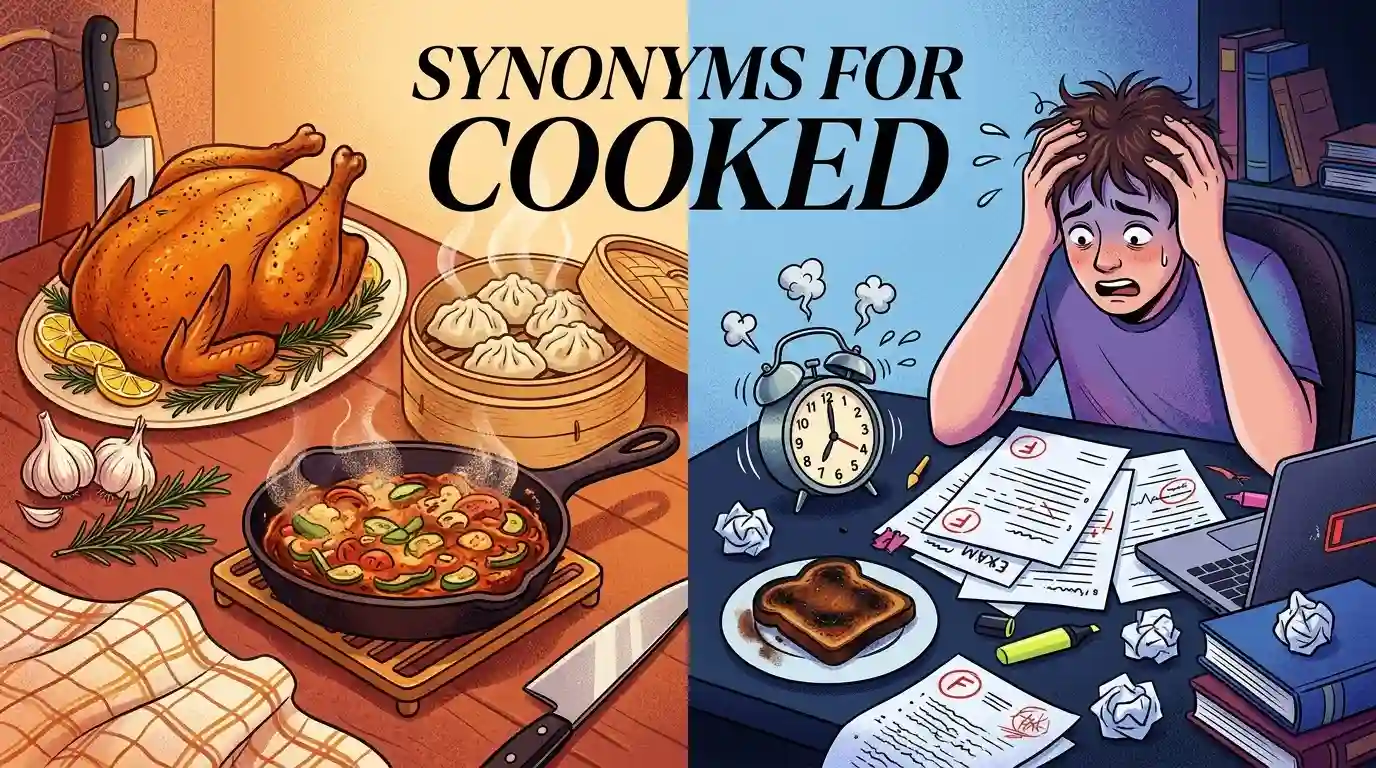
Cooked describes food that has been heated until it is ready to eat. Common alternatives include prepared, baked, boiled, roasted, grilled, fried, steamed, and done. The right choice depends on the method: boiled and steamed use moisture, while baked, roasted, and grilled use dry heat. In modern slang, cooked can also mean doomed or finished.
If you are looking for synonyms for cooked, the first thing to know is that almost none of them are exact swaps. Cooked is a general word. Baked, fried, and steamed are specific ones. Choosing among them means choosing how much detail you want to give the reader. This guide explains what each alternative means, where it fits, and where it quietly changes your sentence.
Meaning of Cooked
Cooked is mainly an adjective formed from the past participle of the verb cook. It describes food that has been heated, usually until it is safe to eat and has changed in texture, color, or flavor.
- Primary meaning: prepared for eating by heating. Example: “Make sure the chicken is fully cooked before you serve it.”
- Past tense and past participle of cook: “She cooked a large meal for the whole family.” “The rice has cooked for twenty minutes.”
- Figurative meaning (informal slang): doomed, finished, or in serious trouble. Example: “If the teacher checks our homework today, we are cooked.”
- Phrasal and idiomatic uses: “cooked up” means invented or devised, and “cooked the books” means falsified financial records.
As an adjective, cooked can go before a noun (cooked rice, a cooked breakfast) or after a linking verb (the rice is cooked). It is neutral in tone and works in everyday speech, recipes, and professional writing.
Connotation and Nuance
In its food meaning, cooked is neutral. It says that heat was applied but not how or how well, which is why it often sounds plain next to words like roasted or braised. It also suggests safety and completion: “cooked” usually contrasts with raw.
The slang meaning is informal and negative. It suggests an unavoidable bad outcome, and it is mostly used in casual speech among younger speakers. It would sound out of place in a formal report.
Pronunciation
Cooked is pronounced /kʊkt/. It has one syllable. The ending sounds like a “t,” not like “ed” as in “wanted,” so it rhymes with “booked” and “looked.”
Etymology
The verb cook comes from the noun cook, a person who prepares food. The noun goes back to Old English and, ultimately, to Latin words for a cook. In other words, the verb developed from the person who did the job. The regular past tense ending ed gives cooked. The slang sense of being doomed is a much more recent development, and its exact origin is not clearly documented, so it is best treated as modern informal usage.
Word Formation
Cooked is the base verb cook plus the ending ed, which forms a past tense and a participle used as an adjective. Related forms built from the same base include cooking, cooks, cooker, cookery, cookware, and cookbook. Common prefixed forms are overcooked, undercooked, and precooked. These describe how well, or how early, something was cooked.
Best Synonyms for Cooked
If you only learn five alternatives, learn these.
1. Prepared
The most flexible alternative. It works when you do not want to specify heat, or when the dish includes both cooked and uncooked parts. It sounds slightly more formal than cooked and is common on menus and labels. Its main difference is that it does not guarantee heat was used: a salad is prepared, not cooked.
2. Done
The everyday word for “cooked enough.” It is informal and natural in kitchens: “Is the pasta done?” Unlike cooked, it usually appears after a verb, not before a noun.
3. Roasted
A strong, appetizing word for food cooked with dry heat, usually until the outside is browned. It adds flavor and texture information that cooked leaves out.
4. Baked
The right choice for anything cooked in an oven without much added fat or direct flame: bread, cakes, potatoes, casseroles, fish. It tells the reader how it was cooked.
5. Boiled
The clearest option for food cooked in bubbling water, such as eggs, potatoes, and pasta. It is plain and specific.
Types of Synonyms for Cooked
It helps to sort the alternatives by what they tell you.
- Dry heat methods: baked, roasted, grilled, broiled, toasted, seared, griddled
- Moist heat methods: boiled, steamed, simmered, stewed, braised, poached, blanched
- Fat based methods: fried, sautéed
- General or neutral alternatives: prepared, made, done, ready
- Informal everyday alternatives: fixed, whipped up, rustled up
- Doneness descriptions: cooked through, well done, browned
- Partial or contextual alternatives: blanched, seared, smoked, browned, microwaved, reheated
This matters because readers choose a word based on what they want to emphasize: the method, the result, or just the fact that food is ready.
Doneness Scale for Cooked Food
Cooked does not have a true intensity scale like angry or very angry, but food has degrees of doneness. A useful scale is:
raw → undercooked → lightly cooked → cooked through → well done → overcooked
For steak, the usual stages are rare, medium rare, medium, medium well, and well done. Note that “overcooked” is not a synonym for cooked; it is a flawed version of it. Context decides what counts as enough: a lightly cooked egg and a lightly cooked chicken breast do not mean the same thing for safety.
Formality Scale
Most words in this list are neutral. The differences appear mainly in tone:
casual (whipped up, rustled up, fixed, done) → neutral (cooked, made, baked, boiled, fried) → professional and menu language (prepared, sautéed, braised, poached, seared)
Some words are not about formality at all. They differ by method, such as steamed and grilled, so a formality label would be misleading.
30 Synonyms for Cooked
None of these is a perfect exact synonym, because cooked is a general term. Prepared and done come closest in everyday use. The rest are close synonyms for particular methods, contextual alternatives, or informal expressions.
1. Prepared
Part of Speech: adjective, past participle
Meaning: Made ready to eat, often by cooking but not always.
Best Use: Menus, labels, hospitality writing, and general descriptions.
Tone or Register: Neutral to formal.
Difference: It does not say that heat was used.
Examples:
Every dish at the banquet was prepared by students from the catering course.
The label says the meal was prepared in a kitchen that handles nuts.
2. Baked
Part of Speech: adjective, past participle
Meaning: Cooked with dry heat in an oven.
Best Use: Bread, cakes, pastries, potatoes, casseroles, and fish.
Difference: It names the method and the oven, unlike cooked.
Examples:
The baked salmon needed nothing more than lemon and salt.
Nothing in the café beats a baked potato on a cold evening.
3. Boiled
Part of Speech: adjective, past participle
Meaning: Cooked in water or another liquid that is bubbling.
Best Use: Eggs, potatoes, pasta, and vegetables.
Difference: It describes a moist, plain method and can suggest less flavor than roasting.
Examples:
A boiled egg is the quickest breakfast I know.
The boiled cabbage had lost most of its color.
4. Roasted
Part of Speech: adjective, past participle
Meaning: Cooked with dry heat, usually at a fairly high temperature, until browned.
Best Use: Meat, vegetables, nuts, and coffee beans. On British menus you will often see roast as well, as in roast chicken.
Difference: It suggests more browning and flavor than baked.
Examples:
Roasted cauliflower is crisp at the edges and sweet in the middle.
We ordered the roasted chicken with garlic potatoes.
5. Grilled
Part of Speech: adjective, past participle
Meaning: Cooked over or under direct heat.
Best Use: Steaks, kebabs, fish, vegetables, and sandwiches.
Difference: It implies visible char marks and a smoky flavor in most contexts.
Examples:
The grilled prawns came with a squeeze of lime.
He ordered a grilled cheese sandwich and tomato soup.
6. Fried
Part of Speech: adjective, past participle
Meaning: Cooked in hot oil or fat.
Best Use: Eggs, chicken, fish, vegetables, rice, and snacks.
Tone or Register: Neutral, though it sometimes suggests richness or an unhealthy choice.
Difference: It names the cooking fat and usually implies a crisp or golden surface.
Examples:
Fried rice is a good way to use up last night’s leftovers.
The fried fish arrived hot, golden, and slightly too salty.
7. Steamed
Part of Speech: adjective, past participle
Meaning: Cooked by steam rising from boiling water.
Best Use: Vegetables, dumplings, fish, and rice cakes.
Difference: It suggests a gentle, light method that keeps food moist.
Examples:
The steamed dumplings were soft and full of ginger.
Our dietitian recommended steamed vegetables instead of fried ones.
8. Sautéed
Part of Speech: adjective, past participle
Meaning: Cooked quickly in a small amount of fat in a shallow pan, usually while tossing.
Best Use: Mushrooms, onions, spinach, and thin cuts of meat.
Tone or Register: Culinary and slightly upscale.
Difference: It is faster and uses less fat than frying.
Examples:
The sautéed mushrooms went perfectly with the steak.
She finished the pasta with sautéed garlic and chili.
9. Simmered
Part of Speech: adjective, past participle
Meaning: Cooked gently in liquid just below boiling point.
Best Use: Soups, sauces, curries, and beans.
Difference: It is gentler than boiled and suggests small, slow bubbles.
Examples:
The simmered tomato sauce tasted richer after an hour.
Grandmother’s simmered lentils were the best part of the meal.
10. Stewed
Part of Speech: adjective, past participle
Meaning: Cooked slowly in liquid, usually in small pieces.
Best Use: Meat, vegetables, and fruit such as apples or plums.
Difference: It suggests soft, tender food in a sauce.
Examples:
The stewed apples were served warm with custard.
The stewed beef fell apart at the touch of a fork.
11. Braised
Part of Speech: adjective, past participle
Meaning: Browned first, then cooked slowly in a covered pot with a little liquid.
Best Use: Tough cuts of meat such as short ribs and lamb shanks, and also cabbage or leeks.
Tone or Register: Culinary.
Difference: It describes a specific two stage method, not just general heating.
Examples:
The braised lamb shank was the most popular dish on the menu.
Braised red cabbage is a classic with roast pork.
12. Poached
Part of Speech: adjective, past participle
Meaning: Cooked gently in liquid that is hot but not bubbling.
Best Use: Eggs, fish, chicken, and fruit such as pears.
Difference: It suggests delicate food and a soft texture.
Examples:
A poached egg sat on top of the toast.
The poached pears were served with vanilla cream.
13. Broiled
Part of Speech: adjective, past participle
Meaning: Cooked by strong heat from above in an oven.
Best Use: Fish, steaks, and thin cuts of meat in American English.
Difference: In British English, the same method is usually called grilled.
Examples:
The broiled trout was ready in ten minutes.
He topped the casserole with cheese and had it broiled until golden.
14. Barbecued
Part of Speech: adjective, past participle
Meaning: Cooked outdoors over a fire or coals, often with a sauce or marinade.
Best Use: Ribs, chicken, sausages, and vegetables.
Difference: The meaning varies by region: in some places it means slow smoked meat, and in others it simply means grilled outdoors.
Examples:
The barbecued ribs were sticky, smoky, and gone in minutes.
We had barbecued corn at the beach party.
15. Seared
Part of Speech: adjective, past participle
Meaning: Cooked briefly at very high heat to brown the surface.
Best Use: Scallops, tuna, steak, and the first step of braising.
Difference: A seared piece of food is not necessarily cooked through. Seared tuna is often rare inside.
Examples:
The seared scallops had a golden crust and a soft center.
Seared tuna is not the same as fully cooked tuna.
16. Griddled
Part of Speech: adjective, past participle
Meaning: Cooked on a flat or ridged hot surface with little or no fat.
Best Use: Pancakes, halloumi, vegetables, and flatbreads.
Difference: It is more specific than cooked, and is often used on British menus.
Examples:
The griddled halloumi came with a mint salad.
We ate griddled courgettes and warm bread for lunch.
17. Toasted
Part of Speech: adjective, past participle
Meaning: Browned and crisped with dry heat.
Best Use: Bread, sandwiches, nuts, and seeds.
Difference: It is narrower than cooked and often describes light browning.
Examples:
The toasted almonds added crunch to the salad.
She ordered a toasted sandwich and a glass of juice.
18. Blanched
Part of Speech: adjective, past participle
Meaning: Boiled briefly, then cooled quickly in cold water.
Best Use: Green beans, tomatoes, and almonds.
Difference: This is a partial cooking step, so it is not equal to fully cooked.
Examples:
The blanched beans stayed bright green in the salad.
Blanched tomatoes are easy to peel.
19. Smoked
Part of Speech: adjective, past participle
Meaning: Cooked or flavored by exposure to smoke.
Best Use: Fish, meat, cheese, and sausages.
Difference: Some smoked foods are fully cooked, and others, such as cold smoked salmon, are not. Do not treat smoked as a guaranteed synonym.
Examples:
The smoked brisket had been cooking since the early morning.
Cold smoked salmon is cured and flavored, not cooked in the usual sense.
20. Done
Part of Speech: adjective
Meaning: Cooked enough and ready to eat.
Best Use: Everyday speech, kitchen talk, and instructions.
Tone or Register: Informal to neutral.
Difference: It describes completion, not method, and usually comes after a verb. Saying “a done steak” sounds unnatural, but “a well done steak” is fine.
Examples:
Check whether the potatoes are done before you drain them.
The cake will be done when a skewer comes out clean.
21. Ready
Part of Speech: adjective
Meaning: Prepared and available to eat.
Best Use: Announcing that food can be served.
Difference: It tells the reader the food is available, not that it was cooked. It is a contextual alternative only.
Examples:
Dinner is ready, so please wash your hands.
The soup will be ready in five minutes.
22. Made
Part of Speech: verb, past tense
Meaning: Prepared or produced a dish or meal.
Best Use: Casual conversation and personal writing.
Difference: It is broader than cooked and works for cold dishes, like sandwiches.
Examples:
My brother made lunch while I finished the report.
I made pancakes for everyone on Sunday.
23. Fixed
Part of Speech: verb, past tense
Meaning: Prepared food, usually quickly and without ceremony.
Best Use: Informal American English, as in “fixed dinner” or “fixed a snack.”
Tone or Register: Informal and regional.
Difference: It can confuse learners because fixed also means repaired, so context must be clear.
Examples:
She fixed us a quick supper after the long drive.
Dad fixed eggs and toast before school.
24. Whipped Up
Part of Speech: phrasal verb, past tense
Meaning: Prepared a meal quickly and with little effort.
Best Use: Casual stories and recipes with fast results.
Tone or Register: Informal.
Difference: It suggests speed and ease, so it does not suit a dish that took all day.
Examples:
After the match, Tariq whipped up a pot of noodles for the team.
She whipped up a pasta sauce from tinned tomatoes and garlic.
25. Rustled Up
Part of Speech: phrasal verb, past tense
Meaning: Put a meal together quickly from whatever was available.
Best Use: Informal British English, but understood elsewhere.
Tone or Register: Informal.
Difference: It adds the idea of improvising with what is on hand.
Examples:
With the shops closed, he rustled up an omelette from the last few eggs.
Could you rustle up something for the kids?
26. Cooked Through
Part of Speech: adjective phrase
Meaning: Heated all the way to the center.
Best Use: Safety instructions, especially for poultry, pork, burgers, and sausages.
Difference: It is more precise than cooked, because it excludes food that is only browned on the outside.
Examples:
Cut into the thickest part to confirm the chicken is cooked through.
Burgers should be cooked through before serving to children.
27. Well Done
Part of Speech: adjective phrase
Meaning: Cooked thoroughly, especially of steak or other red meat.
Best Use: Ordering meat and describing a high level of doneness.
Difference: It is stronger than cooked and means little or no pink inside. Do not confuse it with the exclamation “Well done!”, which means congratulations.
Examples:
He asked for his steak well done, so it came out firm and brown.
Well done meat can taste dry if it is not rested properly.
28. Browned
Part of Speech: adjective, past participle
Meaning: Cooked until the surface turns brown.
Best Use: Meat, onions, butter, bread, and baked dishes.
Difference: It describes appearance and a stage of cooking, not necessarily completion.
Examples:
The browned onions gave the stew a deep flavor.
Serve the pie when the top is evenly browned.
29. Microwaved
Part of Speech: adjective, past participle
Meaning: Cooked or heated in a microwave oven.
Best Use: Quick meals, leftovers, and instructions on packaging.
Difference: It names the appliance, and in practice it is often used for reheating.
Examples:
The microwaved porridge was ready in two minutes.
I had a microwaved curry between lectures.
30. Reheated
Part of Speech: adjective, past participle
Meaning: Heated again after being cooked earlier.
Best Use: Leftovers and ready meals.
Difference: It is a contextual alternative only. Reheated food has already been cooked, so it does not describe first time cooking.
Examples:
Reheated rice should be steaming hot all the way through.
The reheated pizza was still better than cereal.
Common Collocations and Natural Usage
Some pairings sound natural, and others do not.
- Cooked: cooked meal, cooked breakfast (common in British English), cooked food, cooked rice, fully cooked, lightly cooked, freshly cooked, cooked through
- Baked: baked potato, baked beans, baked fish, baked goods
- Boiled: boiled egg, boiled potatoes, boiled water
- Roasted: roasted vegetables, roasted peppers, roasted nuts, roasted coffee
- Grilled: grilled chicken, grilled fish, grilled cheese, grilled vegetables
- Fried: fried egg, fried chicken, fried rice, fried fish
- Steamed: steamed vegetables, steamed rice, steamed dumplings
- Poached: poached egg, poached salmon, poached pears
- Smoked: smoked salmon, smoked cheese, smoked sausage
Notice that you do not usually say “boiled steak” or “poached bread.” The method has to fit the food, or the phrase sounds odd. Use these pairings as a quick test before you swap words in your sentence.
Cooked vs Similar Words
Cooked vs prepared: Cooked means heat was used. Prepared means made ready, which may include chopping, mixing, or assembling. A fruit salad is prepared, but not cooked.
Cooked vs done: Cooked is a general description. Done is a judgment about completeness, usually used after a verb: “The rice is done.”
Baked vs roasted: Both use dry oven heat, and they overlap a great deal. Baked is more typical for bread, cakes, and casseroles. Roasted is more typical for meat and vegetables, usually with stronger browning.
Grilled vs broiled: In American English, grilled usually means heat from below, and broiled means heat from above in an oven. In British English, grilled can mean heat from above.
Boiled vs simmered vs poached: Boiled means active bubbling. Simmered means gentle bubbles. Poached means hot liquid with almost no bubbling, which is the gentlest method of the three.
Stewed vs braised: Stewed food is usually cut into smaller pieces and covered by liquid. Braised food is often a larger piece that is browned first and cooked with only a little liquid.
Sautéed vs fried: Sautéed food is cooked quickly in a small amount of fat, while fried food may be cooked in more fat for longer.
How to Choose the Right Synonym
- If you want a neutral alternative, use prepared or made.
- If you want to describe method clearly, choose baked, boiled, grilled, or steamed.
- If you want a rich, appetizing word for a menu, consider roasted, braised, or seared.
- If you are writing a safety note, use cooked through.
- If you are speaking casually, use done, whipped up, or rustled up.
- If you are talking about steak, use well done, medium, or rare as appropriate.
- If the food is only partly cooked, use blanched, seared, or browned, not cooked.
- If the food was cooked earlier, use reheated.
A simple rule works well: ask what the reader needs to know. If they need to know the method, name it. If they only need to know the food is ready, use cooked, done, or prepared.
When Cooked Means Something Else
The slang and idiomatic meanings need different synonyms.
Cooked meaning doomed or finished (informal): doomed, finished, done for, sunk, in trouble, toast. Example: “If the manager reads this email, we are done for.”
Cooked the books: falsified, doctored, manipulated, fudged (informal). Example: “The auditors found that the accountant had doctored the figures.”
Cooked up: invented, devised, concocted, made up, hatched. Example: “The two friends hatched a plan to surprise their teacher.”
Do not mix these with the food meaning. “We are cooked” is a joke about trouble, not about dinner.
Common Mistakes with Cooked
- Using specific words as if they were identical. Boiled, steamed, and poached all use moisture, but they do not describe the same method.
- Calling seared food cooked. Seared tuna and seared steak may still be rare inside.
- Using done before a noun. Say “a well done steak,” not “a done steak.”
- Mixing up grilled and broiled. The meaning depends on whether you use American or British English.
- Treating prepared as always meaning cooked. A prepared meal can be cold.
- Confusing well done with “Well done!” One describes steak, and the other congratulates someone.
- Using overcooked as a positive word. It means cooked too long.
- Using the slang meaning in formal writing. “We are cooked” is fine with friends but not in a business report.
Antonyms of Cooked
- Raw: not cooked at all.
- Uncooked: not yet cooked, a neutral and direct opposite.
- Undercooked: cooked too little, which is a flaw.
- Rare: lightly cooked, mostly used for steak.
For the slang meaning, opposites include safe, saved, and in the clear. Overcooked, burnt, and charred are not real opposites; they describe cooking that went too far.
Related Words
These words connect to the topic but are not synonyms: overcooked, undercooked, precooked, cooker, cookery, cookware, chef, recipe, kitchen. They are useful vocabulary, but they should not replace cooked in a sentence.
FAQ
What does cooked mean?
Cooked means heated until ready to eat. In informal slang, it can also mean doomed or finished.
What is another way to say cooked?
Common options are prepared, done, baked, boiled, roasted, grilled, fried, and steamed. The best one depends on the method.
What is the best synonym for cooked in a recipe?
Done works for instructions, and the specific method word, such as baked or simmered, works for descriptions.
Is prepared the same as cooked?
Not exactly. Prepared means made ready, which may or may not involve heat.
What is the difference between baked and roasted?
They overlap, but baked usually describes bread, cakes, and casseroles, while roasted usually describes meat and vegetables with stronger browning.
What does “we are cooked” mean?
It is informal slang meaning we are in serious trouble or are likely to fail.
What is the opposite of cooked?
The most common opposites are raw and uncooked.
Conclusion
Cooked is a useful general word, but its alternatives do different jobs. Baked, boiled, grilled, and steamed describe method. Prepared and made describe readiness. Done describes completion, and cooked through describes safety. Slang meanings need separate words altogether. Before replacing cooked, ask what you want the reader to understand: how the food was made, whether it is ready, or how thoroughly it was heated. Check the tone, the food it is paired with, and the regional meaning of words like grilled and broiled. The more precisely a word fits your context, the more natural your writing will sound.
Read More: Synonyms for Bye: 30 Ways to Say Goodbye

Hi, I am Abid, a writer and editor at InstantSynonyms.com, where he creates clear and reader-friendly content about synonyms, vocabulary, and English word usage. His goal is to help readers choose the right words, expand their vocabulary, and write with greater confidence.