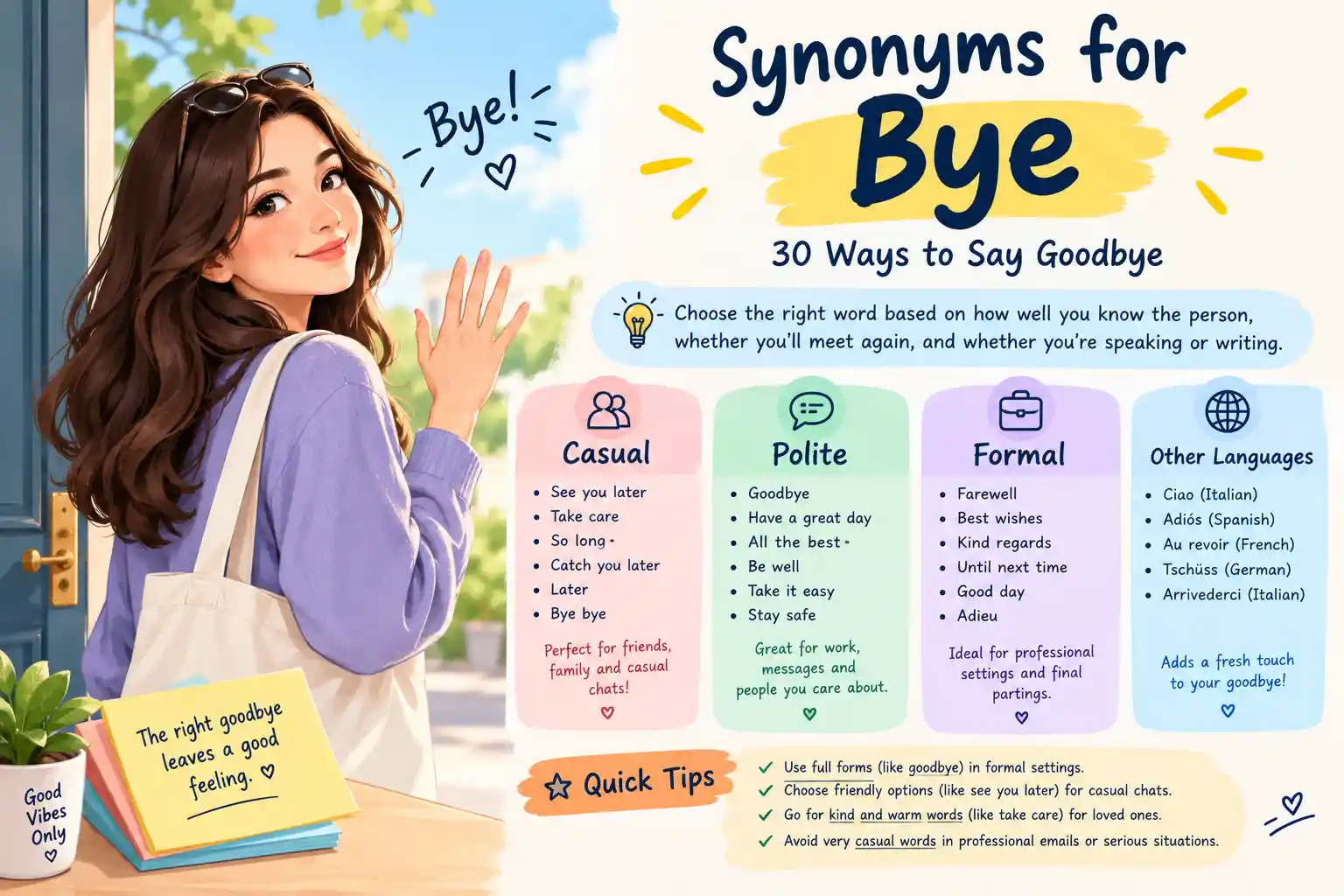
Bye is a short, casual way to say goodbye. Strong alternatives include goodbye, see you later, take care, and so long for everyday use, farewell and best wishes for formal moments, and ciao or later for casual chats. Choose by how well you know the person, whether you will meet again, and whether you are speaking or writing.
Saying goodbye sounds simple until you have to do it in writing. You may be signing off a work email, leaving a group chat, or ending a call with a customer. Bye can feel too short for some of those moments and too plain for others.
This guide sorts the alternatives by situation, not by length. You will see which ones are casual, which are polite, which sound final, and which are borrowed from other languages. You will also learn which ones only fit special cases, such as a trip or the end of a night.
Meaning of Bye
Bye is mainly an interjection, a short word used to say goodbye when you leave or end a conversation. It is informal. You hear it in homes, shops, phone calls, and text messages.
It is often doubled: “Bye bye.” This form is gentle and playful. Parents use it with small children, and friends use it to sound warm.
Bye also has two separate meanings as a noun, though readers who search for synonyms rarely mean these:
- In sports tournaments: a round in which a team or player moves ahead without playing. “The top seed received a bye in the first round.”
- In cricket: a run scored when the ball passes the batter and the wicketkeeper without being touched.
For synonyms, the farewell meaning is the one that matters.
Here are two natural examples:
- “Bye, see you tomorrow!” she called from the doorway.
- The call ended with a quick “Okay, bye.”
Connotation and Nuance
Bye is neutral to casual. It does not feel cold, but it is brief. In a long, warm conversation, a bare “bye” can sound a little abrupt. In a very formal setting, it can sound too relaxed.
The tone often depends on what comes with it. “Bye!” with a cheerful voice feels friendly. “Bye.” with a flat voice can feel distant. In writing, you do not have the voice, so the choice of word matters more.
Words that signal a final goodbye, such as farewell and adieu, carry weight. Words that point to a future meeting, such as see you soon, carry a promise. Using the wrong one can send the wrong message.
How to Pronounce Bye
Bye is pronounced /baɪ/ in both American and British English. It rhymes with “high” and “sky.”
It sounds exactly like by and buy. Words that sound the same but have different meanings and spellings are called homophones. This is why spelling mistakes happen with bye, as you will see below.
Where Bye Comes From
Bye is a shortened form of goodbye. Many dictionaries trace goodbye to an older phrase like “God be with you.” Over time, the words were squeezed together, and “good” probably replaced “God” under the influence of greetings such as “good day” and “good night.” The shorter bye developed later as a casual version.
The history helps explain a point of tone. Goodbye began as a small blessing. That gentle origin is still felt in warmer phrases such as “take care” and “safe travels.”
Best Synonyms for Bye
Learn these five first. They cover most everyday situations.
1. Goodbye
Why it is useful: It is the standard full form, and it works in nearly every setting.
When it works best: Speaking, writing, and anywhere you want to be clear and polite.
Tone: Neutral.
Key difference from bye: More complete and slightly more polite than bye.
2. See you later
Why it is useful: It is friendly and suggests you will meet again.
When it works best: Casual conversations with friends, coworkers, and family.
Tone: Warm and casual.
Key difference from bye: It carries a promise of a future meeting; bye does not.
3. Take care
Why it is useful: It adds kindness, and it works in speech and writing.
When it works best: Phone calls, messages, and goodbyes to people you care about.
Tone: Warm.
Key difference from bye: It wishes the person well, which makes it softer.
4. So long
Why it is useful: It is a classic, relaxed alternative.
When it works best: Casual or friendly goodbyes, especially in American English.
Tone: Casual, a little old fashioned.
Key difference from bye: It sounds a bit more nostalgic.
5. Farewell
Why it is useful: It gives a goodbye weight and dignity.
When it works best: Formal speeches, retirements, and final partings.
Tone: Formal and serious.
Key difference from bye: It often suggests a long or final separation.
30 Synonyms for Bye
Some of these are exact matches. Others fit only certain moments. Each entry says which.
1. Goodbye
Part of Speech: Interjection and noun
Meaning: A word used when parting from someone.
Best Use: Any situation, spoken or written.
Tone or Register: Neutral.
Difference: The full form of bye; slightly more polite.
Examples:
- Goodbye, and thank you for coming.
- They said goodbye at the train station and promised to write.
2. See you later
Part of Speech: Phrase
Meaning: A friendly way to say goodbye that suggests you will meet again.
Best Use: Friends, family, and coworkers.
Tone or Register: Casual and warm.
Difference: Implies a future meeting; use it only when that is likely.
Examples:
- I have a meeting at two, so see you later.
- Okay, see you later at the café.
3. See you
Part of Speech: Phrase
Meaning: A short, friendly goodbye.
Best Use: Quick exits with people you will see again.
Tone or Register: Casual.
Difference: Shorter than see you later, and similar in meaning.
Examples:
- See you on Monday!
- Thanks for lunch, see you.
4. See you soon
Part of Speech: Phrase
Meaning: A goodbye that promises a meeting in the near future.
Best Use: When a meeting is planned or likely.
Tone or Register: Warm.
Difference: Stronger promise than see you later.
Examples:
- Safe drive home, and see you soon.
- We booked the tickets, so see you soon!
5. See you around
Part of Speech: Phrase
Meaning: A relaxed goodbye with no fixed plan to meet.
Best Use: Neighbors, classmates, and people you meet by chance.
Tone or Register: Casual and loose.
Difference: No firm promise, unlike see you soon.
Examples:
- Nice talking to you, see you around.
- Good luck with the move, and see you around.
6. Take care
Part of Speech: Phrase
Meaning: A goodbye that wishes the person safety and good health.
Best Use: Calls, messages, and warm farewells.
Tone or Register: Warm and neutral.
Difference: Adds kindness that bye lacks.
Examples:
- It was lovely to hear from you. Take care.
- Take care, and message me when you land.
7. Take it easy
Part of Speech: Phrase
Meaning: A relaxed goodbye that tells someone not to stress.
Best Use: Friends and casual coworkers.
Tone or Register: Casual.
Difference: Wishes the person a calm time; bye does not.
Examples:
- Heading out now, take it easy.
- Take it easy this weekend, you earned it.
8. So long
Part of Speech: Phrase
Meaning: An informal, slightly old style goodbye.
Best Use: Friendly partings, often in American English.
Tone or Register: Casual and a little nostalgic.
Difference: Can sound dated to some younger speakers.
Examples:
- So long, and thanks for the ride.
- The captain waved and said, “So long, folks.”
9. Farewell
Part of Speech: Interjection and noun
Meaning: A formal goodbye, often for a long or final parting.
Best Use: Speeches, ceremonies, and literary writing.
Tone or Register: Formal and serious.
Difference: Much heavier than bye; it can sound dramatic in daily talk.
Examples:
- The team held a farewell lunch for the retiring principal.
- She bid farewell to the town she grew up in.
10. Later
Part of Speech: Interjection
Meaning: A very casual goodbye, short for see you later.
Best Use: Close friends and peers.
Tone or Register: Very informal.
Difference: Too casual for most work settings.
Examples:
- Gotta run. Later!
- Alright, later, man.
11. Catch you later
Part of Speech: Phrase
Meaning: A casual goodbye that suggests you will talk or meet again.
Best Use: Friends and coworkers.
Tone or Register: Casual.
Difference: Slightly more relaxed than see you later.
Examples:
- I have to jump on a call, catch you later.
- Catch you later at practice.
12. Talk to you later
Part of Speech: Phrase
Meaning: A goodbye used when you will talk again, often by phone or message.
Best Use: Calls and chats.
Tone or Register: Neutral and friendly.
Difference: Focuses on talking, not meeting in person.
Examples:
- Dinner is ready, so talk to you later.
- Talk to you later, I will send the file tonight.
13. Talk soon
Part of Speech: Phrase
Meaning: A short goodbye that suggests another conversation soon.
Best Use: Emails, messages, and client calls.
Tone or Register: Friendly and professional.
Difference: Works well in writing; bye does not suit emails as well.
Examples:
- Thanks for the update. Talk soon.
- Great call today, and talk soon.
14. Until next time
Part of Speech: Phrase
Meaning: A goodbye that looks forward to the next meeting.
Best Use: Hosts, teachers, and presenters ending an event or show.
Tone or Register: Warm and slightly polished.
Difference: Sounds like a pleasant closing, not a quick exit.
Examples:
- Thanks for joining us, and until next time.
- Until next time, keep practicing your scales.
15. Have a good one
Part of Speech: Phrase
Meaning: A casual goodbye wishing the person a good day or evening.
Best Use: Shops, cafés, and quick exits.
Tone or Register: Casual and friendly.
Difference: More polite than bye, and common in everyday service settings.
Examples:
- Here is your coffee. Have a good one!
- Thanks for stopping by, have a good one.
16. Have a good day
Part of Speech: Phrase
Meaning: A polite goodbye wishing someone a pleasant day.
Best Use: Customer service and daytime partings.
Tone or Register: Polite and neutral.
Difference: More formal than have a good one.
Examples:
- Your order is ready, and have a good day.
- Thank you for calling, and have a good day.
17. All the best
Part of Speech: Phrase
Meaning: A warm wish for someone’s future, often used to end messages.
Best Use: Emails, cards, and goodbyes before a big change.
Tone or Register: Warm and polite.
Difference: A written sign off more than a spoken exit.
Examples:
- I wish you well in your new role. All the best.
- All the best with the exams next week.
18. Best wishes
Part of Speech: Phrase
Meaning: A polite, kind way to end a message.
Best Use: Letters, emails, and formal notes.
Tone or Register: Polite and a little formal.
Difference: Suits writing; it would sound stiff in speech.
Examples:
- Thank you for your time. Best wishes, Sana.
- Best wishes to you and your family.
19. Cheers
Part of Speech: Interjection
Meaning: A casual goodbye, especially in British English; it can also mean thanks.
Best Use: Friendly, informal partings in the United Kingdom and some other countries.
Tone or Register: Casual.
Difference: Can confuse readers elsewhere, since it also means thanks or a toast.
Examples:
- Right, I am off. Cheers!
- Cheers, mate, see you Friday.
20. Cheerio
Part of Speech: Interjection
Meaning: A cheerful, old fashioned British goodbye.
Best Use: Playful or humorous use, and period writing.
Tone or Register: Dated and light.
Difference: Many people now use it jokingly.
Examples:
- Cheerio, and thanks for the tea.
- The old gentleman tipped his hat and said, “Cheerio.”
21. Ciao
Part of Speech: Interjection
Meaning: An Italian word used as a casual goodbye; it can also mean hello.
Best Use: Informal chats and playful sign offs.
Tone or Register: Casual and stylish.
Difference: Works as both hello and goodbye, which can confuse learners.
Examples:
- Ciao, see you at the gallery tomorrow.
- She waved and said, “Ciao!”
22. Au revoir
Part of Speech: Phrase (from French)
Meaning: A French goodbye that carries the sense of until we meet again.
Best Use: Playful, polished, or French themed settings.
Tone or Register: Elegant and a bit theatrical in English.
Difference: Sounds more refined than bye.
Examples:
- The host smiled and said, “Au revoir, until next week.”
- Au revoir, and thanks for the lovely evening.
23. Adieu
Part of Speech: Interjection and noun (from French)
Meaning: A formal, often literary goodbye.
Best Use: Poetry, historical writing, and dramatic effect.
Tone or Register: Formal and serious.
Difference: Feels final and old fashioned, much heavier than bye.
Examples:
- She whispered adieu and left the garden.
- The poem ends with a sad adieu to the sea.
24. Hasta luego
Part of Speech: Phrase (from Spanish)
Meaning: A Spanish goodbye that means until later.
Best Use: Casual use among Spanish speakers and in playful English.
Tone or Register: Friendly and casual.
Difference: Similar to see you later in meaning.
Examples:
- Hasta luego, my friend!
- The tour guide called, “Hasta luego, everyone.”
25. Bon voyage
Part of Speech: Phrase (from French)
Meaning: A wish for a good trip, used when someone leaves on a journey.
Best Use: Goodbyes at airports, stations, and before holidays.
Tone or Register: Warm and polite.
Difference: A contextual alternative; use it only when someone is traveling.
Examples:
- Bon voyage, and send us a postcard!
- We hugged at the gate and wished them bon voyage.
26. Safe travels
Part of Speech: Phrase
Meaning: A wish for a safe journey.
Best Use: Goodbyes to travelers, in speech or writing.
Tone or Register: Warm and neutral.
Difference: Another contextual alternative; it only fits trips.
Examples:
- Safe travels, and text me when you land.
- Thanks for visiting, and safe travels home.
27. Good night
Part of Speech: Interjection and noun
Meaning: A goodbye said in the evening or before sleep.
Best Use: Evening partings and bedtime.
Tone or Register: Neutral and warm.
Difference: Fits only evening or night. It is not a general goodbye.
Examples:
- Good night, sleep well.
- We said good night and locked the shop.
28. Godspeed
Part of Speech: Interjection and noun
Meaning: A formal wish for success and safety on a journey or task.
Best Use: Ceremonies, speeches, and dramatic writing.
Tone or Register: Formal, solemn, and a little old fashioned.
Difference: Carries a religious tone, so it may not suit every reader.
Examples:
- The commander wished the crew Godspeed.
- We watched the ship leave and whispered Godspeed.
29. Peace out
Part of Speech: Phrase (slang)
Meaning: A very casual, playful goodbye.
Best Use: Close friends and joking exchanges.
Tone or Register: Slang and informal.
Difference: Not suited for work or formal messages.
Examples:
- I am heading home. Peace out!
- Peace out, team, great game.
30. Toodle oo
Part of Speech: Interjection
Meaning: A playful, dated British goodbye.
Best Use: Humor, imitation, and light period writing.
Tone or Register: Old fashioned and cheeky.
Difference: Rare in modern daily speech, and often used jokingly.
Examples:
- Toodle oo, darling, I am off to the shops.
- The actor waved and trilled, “Toodle oo!”
Types of Synonyms for Bye
Grouping these helps you pick quickly.
- Everyday and neutral: goodbye, see you, take care, so long
- Promises another meeting: see you later, see you soon, until next time, talk soon
- Very casual or slang: later, catch you later, peace out, cheers
- Polite and written: best wishes, all the best, have a good day
- Formal or final: farewell, adieu, godspeed
- Borrowed from other languages: ciao, au revoir, adieu, hasta luego, bon voyage
- Fits one situation only: bon voyage, safe travels, good night
The last group matters most. A word like good night is a perfect goodbye in the evening and an odd one at noon.
Formality Scale
Here is a rough scale using words from this article:
casual: later, peace out, catch you later; then friendly: bye, see you, take care; then neutral: goodbye, have a good day; then polite and professional: all the best, best wishes, talk soon; then formal: farewell, adieu, godspeed.
Some words do not sit on this scale. Bon voyage and safe travels depend on the situation, not on formality.
Common Collocations and Natural Usage
Some words pair naturally with certain verbs and nouns.
- Say goodbye / say bye: the normal way to describe the act
- Wave goodbye: the common phrase for the gesture
- Bid farewell: a formal, slightly literary phrase; “bid someone farewell” is also common
- Farewell party / farewell speech / farewell tour: common noun uses
- A fond farewell: a warm, set phrase
- A tearful goodbye: a common description of an emotional parting
- Safe travels / safe journey: used for trips
Notice that bye mostly works as an exclamation. You say “bye!”, but you do not usually say “a bye” to mean a parting. For that, use goodbye or farewell.
Bye vs Similar Words
Bye vs goodbye
They mean the same thing. Goodbye is the full form and is slightly more polite. Bye is casual and short. In a formal email, goodbye or a sign off such as “best wishes” is a safer choice.
Bye vs farewell
Farewell is heavier and more formal. It often suggests a long or final parting. If you tell a friend “farewell” at the end of a coffee, it will sound dramatic.
Bye vs by vs buy
All three sound alike. Bye is the goodbye. By is a preposition, as in “stand by the door.” Buy is a verb meaning to purchase. When you write, pause for a second on this one.
Bye vs see you later
Bye only ends the conversation. See you later also suggests you will meet again. If you have no plans to meet, bye or goodbye is more accurate.
How to Choose the Right Synonym
- For a neutral, safe option, use goodbye.
- For a friendly option with someone you will see again, use see you later or see you soon.
- For a warm option, use take care.
- For a casual chat with a close friend, use later or catch you later.
- For a work email, use talk soon, all the best, or best wishes.
- For a formal speech or a final parting, use farewell.
- For someone leaving on a trip, use safe travels or bon voyage.
- For the end of the evening, use good night.
- For a playful or stylish exit, use ciao or au revoir.
Common Mistakes with Bye
Writing by or buy instead of bye
- Wrong: She waved by and left.
- Right: She waved bye and left.
The three words sound the same, so the ear cannot help. Check the meaning: a goodbye needs bye.
Using farewell in casual talk
A friendly goodbye after lunch does not need farewell. It makes an ordinary moment sound like the end of a story.
Using bye in a very formal message
A resignation letter or a message to a senior official usually calls for a polite sign off, not a bare bye.
Promising a meeting you will not keep
“See you soon” and “see you later” suggest a future meeting. If none is planned, goodbye or take care is more honest.
Using good night as a general goodbye
Good night fits evening. Use it in the morning and it sounds like a mistake.
Spelling goodbye as two words
The standard spelling is the single word goodbye. Older texts sometimes use a hyphenated form, but modern writing uses one word. Pick one style and keep it.
Antonyms of Bye
The opposite of bye is a greeting.
- Hello
- Hi
- Welcome
- Greetings
- Good morning (a time based greeting)
Some words, such as ciao, work in both directions. Context tells you which meaning is intended.
Related Words
These words belong to the same topic but are not synonyms.
- Greeting: a word or gesture used when meeting someone
- Sign off: the closing line of an email or message
- Valediction: a formal word for a farewell or closing remark
- Parting: the act of leaving someone
- Send off: a gathering to say goodbye to someone
Frequently Asked Questions
What does bye mean? Bye is an informal word used to say goodbye. It is short for goodbye and is used when leaving or ending a conversation.
What is another way to say bye? You can say goodbye, see you later, take care, so long, or farewell. The best choice depends on the setting and your relationship with the person.
What is the most formal alternative to bye? Farewell is one of the most formal, along with adieu and godspeed. In written messages, best wishes is a polite formal sign off.
What is the difference between bye and goodbye? They mean the same thing. Goodbye is the full form and slightly more polite. Bye is shorter and more casual.
Is bye acceptable in formal writing? It is usually too casual. Use goodbye in speech, and a closing such as best wishes or kind regards in formal emails.
Are these synonyms interchangeable? No. Some suggest a future meeting, some sound final, and some fit only trips or evenings. Choose by meaning and context.
What is the opposite of bye? The opposite is a greeting such as hello or hi.
Conclusion
Bye is simple, friendly, and almost always understood, which is why it is so common. But the alternatives let you say more. See you soon promises a meeting, take care adds kindness, farewell adds weight, and best wishes suits a polished email. These words are not interchangeable, so weigh meaning, context, tone, strength, formality, and natural usage before you pick one. When in doubt, goodbye is safe. When you want to sound warm, add a short wish. A well chosen goodbye leaves the last impression just right.
Read More: Resume Synonyms for Led: 30 Strong Alternatives

Hi, I’m Ayesha, the creator of InstantSynonyms.com. I believe the right word can transform a sentence, strengthen an idea, and make communication more impactful. That’s why I created this site, to help writers, students, professionals, and English learners find accurate synonyms, antonyms, and better word choices quickly and effortlessly.