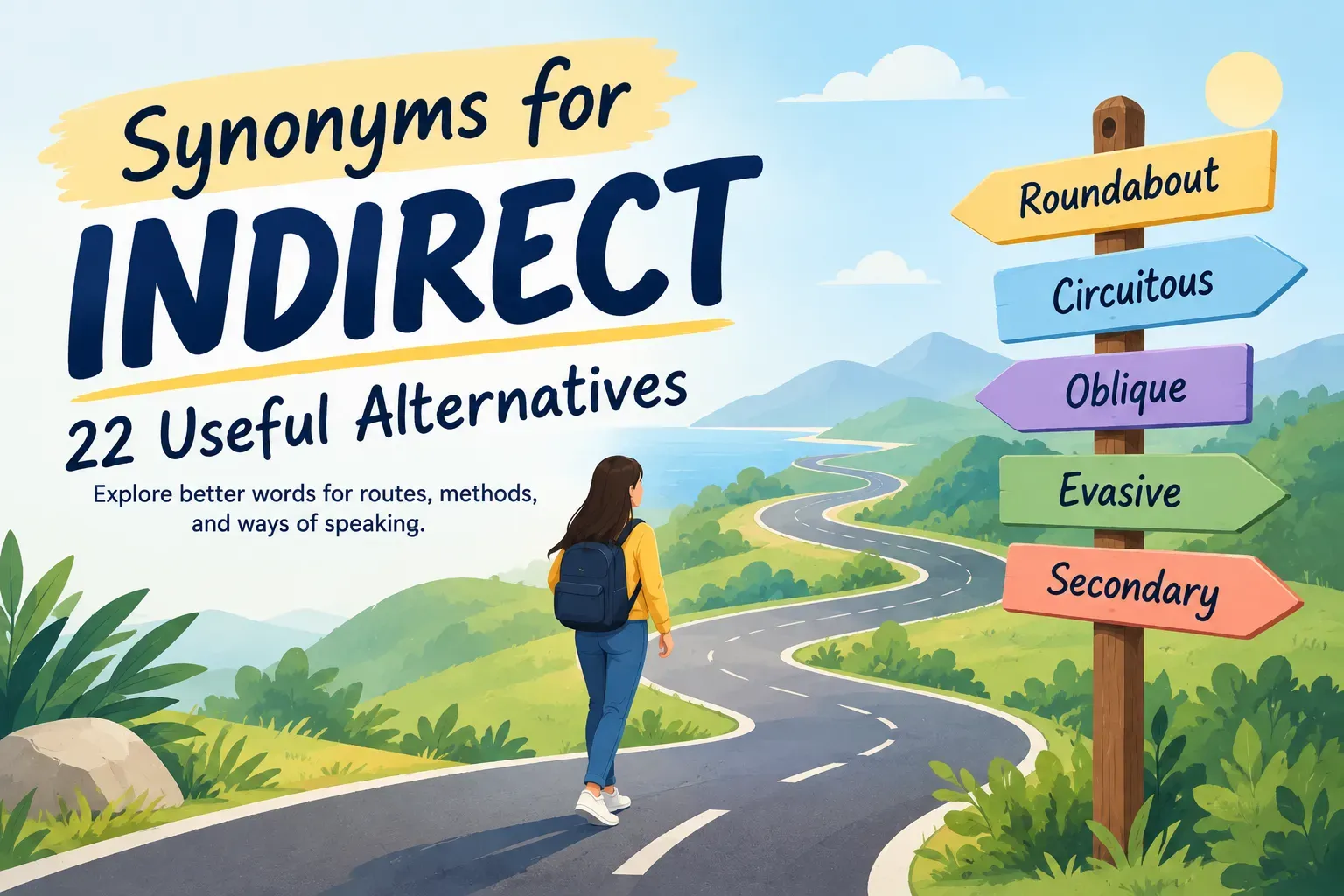
Indirect describes something that does not go straight to its point, goal, or destination, whether a route, a method, or a way of speaking. Strong alternatives include roundabout and circuitous for physical routes, oblique and evasive for communication, and secondary or incidental for causes and effects.
Meaning of Indirect
Indirect is an adjective built from direct plus the negative prefix in, and it means not going straight from one point to another, whether that path is physical, logical, or verbal.
The word covers several related situations. A route can be indirect, meaning it takes a longer or less obvious path to a destination. A method or approach can be indirect, meaning it achieves a goal through a less obvious or roundabout process rather than a direct action. Speech or communication can be indirect, meaning a person hints at something rather than stating it plainly, often to soften bad news or avoid confrontation. A cause or effect can be indirect, meaning it is not the immediate or primary reason something happened, but a secondary or contributing factor.
Because indirect covers physical paths, communication style, and cause and effect, the best synonym depends heavily on which of these situations is being described.
Connotation and Nuance
Indirect is mostly neutral, but its emotional tone shifts with context. Describing a route as indirect is simply factual, with no judgment attached. Describing a person’s communication as indirect can carry a slightly negative undertone, suggesting evasiveness or a reluctance to be honest and clear, though in some cultures and workplace settings, being indirect is instead seen as polite and considerate. Describing a cause as indirect is neutral and often used in careful, analytical writing, such as legal, scientific, or journalistic contexts.
Pronunciation
Indirect is pronounced /ˌɪndɪˈrɛkt/ in most varieties of English, with the main stress on the final syllable. It has three syllables: in di rect.
Etymology
Indirect developed from the Latin word indirectus, formed from the negative prefix in and directus, meaning straight or direct. The word entered English through this Latin root, carrying its original sense of not straight, and gradually extended from describing physical paths to describing speech, methods, and cause and effect in the way it is used today.
Word Formation
Indirect belongs to a small, useful family built around the root direct. The adverb indirectly describes how something is done in an indirect way, as in, she indirectly criticized the plan. The noun indirection describes the quality or act of being indirect, though it appears mostly in formal or literary writing. Removing the prefix produces the antonym direct, along with its own family, including directly and directness.
Best Synonyms for Indirect
These five alternatives cover the situations where indirect appears most often.
Roundabout is the natural everyday choice for describing a longer, less direct physical route or a way of explaining something that avoids getting straight to the point, such as a roundabout way of saying no.
Oblique works well in more formal or literary writing, describing a reference or comment that hints at something without stating it directly, such as an oblique remark about someone’s failure.
Circuitous is a more formal, almost literary word for a long, winding route or process, often implying unnecessary length or complexity, such as a circuitous explanation.
Evasive fits situations involving communication where someone is deliberately avoiding a direct or honest answer, carrying a more negative, suspicious tone than indirect.
Secondary suits situations describing cause and effect, where something is not the immediate or main reason for an outcome, but a contributing factor, such as a secondary cause of the delay.
Synonyms for Indirect: Routes, Methods, and Approaches
1. Roundabout
Part of Speech: Adjective Meaning: Longer or less direct than necessary, whether describing a route or a method. Best Use: Everyday speech about routes, plans, or explanations. Difference: More casual and common than indirect. Examples:
- We took a roundabout route to avoid the traffic on the highway.
- He gave a roundabout answer instead of a simple yes or no.
2. Circuitous
Part of Speech: Adjective Meaning: Long, winding, and much longer than a direct path would be. Best Use: Formal or descriptive writing about routes or lengthy processes. Difference: Stronger and more formal than roundabout, often implying unnecessary complexity. Examples:
- The negotiations followed a circuitous path before reaching an agreement.
- The old road took a circuitous route through the mountains.
3. Winding
Part of Speech: Adjective Meaning: Curving repeatedly, not moving in a straight line. Best Use: Physical descriptions of roads, rivers, or paths. Difference: Focuses purely on physical shape rather than method or communication. Examples:
- The winding road offered stunning views of the valley.
- A winding trail led through the forest to the lake.
4. Tortuous
Part of Speech: Adjective Meaning: Extremely twisting or complicated, often implying difficulty. Best Use: Formal writing describing complex, frustrating processes or paths. Difference: Stronger and more negative than circuitous, suggesting strain or difficulty. Examples:
- The tortuous legal process took nearly three years to resolve.
- The path down the cliff was steep and tortuous.
5. Meandering
Part of Speech: Adjective Meaning: Wandering slowly with many turns, without a fixed direct course. Best Use: Descriptions of rivers, conversations, or unfocused writing. Difference: Suggests a relaxed, wandering quality rather than deliberate avoidance. Examples:
- The river meandered slowly through the countryside.
- His meandering speech eventually reached the main point.
6. Backhanded
Part of Speech: Adjective Meaning: Indirect in a way that conceals an insult, often within a compliment. Best Use: Describing insincere or double edged remarks. Difference: Narrower in meaning, tied specifically to insults disguised as praise. Examples:
- That was a backhanded compliment about her cooking.
- His backhanded remark left everyone unsure whether to laugh.
Synonyms for Indirect: Communication and Speech
7. Oblique
Part of Speech: Adjective Meaning: Not stated plainly, hinting at something rather than saying it outright. Best Use: Formal, literary, or careful analytical writing. Difference: More subtle and precise than indirect, often used for veiled references. Examples:
- She made an oblique reference to the company’s recent troubles.
- His oblique answer left the reporters guessing.
8. Vague
Part of Speech: Adjective Meaning: Not clear or precise, lacking specific detail. Best Use: Describing unclear statements, whether intentional or not. Difference: Focuses on lack of clarity rather than avoiding a direct path. Examples:
- His vague reply told us nothing useful.
- The instructions were too vague to follow properly.
9. Evasive
Part of Speech: Adjective Meaning: Deliberately avoiding giving a direct or honest answer. Best Use: Situations involving suspicion, interviews, or uncomfortable questions. Difference: More negative and suspicious in tone than indirect. Examples:
- The politician gave an evasive response to the question.
- His evasive behavior made the detective suspicious.
10. Ambiguous
Part of Speech: Adjective Meaning: Open to more than one interpretation, unclear in meaning. Best Use: Formal writing, legal language, and careful analysis. Difference: Focuses on multiple possible meanings rather than avoidance. Examples:
- The contract contained an ambiguous clause about payment terms.
- Her ambiguous smile could have meant anything.
11. Subtle
Part of Speech: Adjective Meaning: Delicate or precise in a way that is not immediately obvious. Best Use: Describing skillful, understated communication or hints. Difference: Often carries a positive tone, unlike the sometimes suspicious tone of evasive. Examples:
- She gave a subtle hint that dinner was almost ready.
- His humor was subtle, easy to miss if you were not paying attention.
12. Diplomatic
Part of Speech: Adjective Meaning: Careful and tactful in communication, often to avoid causing offense. Best Use: Professional or sensitive situations requiring careful wording. Difference: Positive in tone, unlike evasive, and focused on politeness rather than avoidance. Examples:
- She gave a diplomatic answer that avoided taking sides.
- His diplomatic response smoothed over the tension in the room.
13. Veiled
Part of Speech: Adjective Meaning: Partly hidden or disguised, especially a warning, threat, or criticism. Best Use: Describing comments that carry a hidden meaning. Difference: Implies deliberate concealment, often of something negative. Examples:
- His comment carried a veiled threat.
- The article included a veiled criticism of the company’s leadership.
14. Implied
Part of Speech: Adjective Meaning: Suggested without being directly stated. Best Use: Formal or analytical writing about unstated meaning. Difference: Focuses on meaning conveyed through suggestion rather than route or method. Examples:
- There was an implied warning in her tone.
- The agreement included an implied obligation to renew.
Synonyms for Indirect: Cause, Effect, and Relationships
15. Secondary
Part of Speech: Adjective Meaning: Less important than the primary cause, but still a contributing factor. Best Use: Analytical, scientific, or business writing about causes and effects. Difference: Focuses on ranking of importance rather than communication style. Examples:
- Poor weather was a secondary cause of the delay.
- The report listed several secondary factors affecting sales.
16. Incidental
Part of Speech: Adjective Meaning: Happening as a minor or side effect of something else, not the main focus. Best Use: Formal writing describing minor, unplanned results. Difference: Suggests something unintentional rather than a chosen indirect path. Examples:
- The policy had several incidental benefits for small businesses.
- Any incidental costs will be listed separately on the invoice.
17. Derived
Part of Speech: Adjective Meaning: Coming from or based on something else rather than being original or immediate. Best Use: Academic and technical writing about relationships between ideas. Difference: Focuses on origin rather than avoidance of directness. Examples:
- Her conclusion was derived from indirect evidence rather than direct testimony.
- The theory is derived from earlier research on the topic.
18. Underlying
Part of Speech: Adjective Meaning: Forming the basis of something, often not immediately visible. Best Use: Analytical writing describing hidden or root causes. Difference: Focuses on being hidden beneath the surface rather than a roundabout process. Examples:
- The underlying cause of the argument was financial stress.
- There is an underlying tension between the two departments.
Additional Alternatives
19. Peripheral
Part of Speech: Adjective Meaning: Related to a topic but not central or directly connected to it. Best Use: Academic or professional writing about relevance. Examples:
- The report only briefly mentioned peripheral issues.
- Her comment was peripheral to the main argument.
20. Tangential
Part of Speech: Adjective Meaning: Only loosely or indirectly related to the main topic. Best Use: Formal writing and discussions about relevance and focus. Examples:
- His tangential remarks distracted from the main proposal.
- The connection between the two events is tangential at best.
21. Discreet
Part of Speech: Adjective Meaning: Careful and quiet in a way that avoids drawing attention, often when handling something indirectly. Best Use: Describing careful, low key handling of sensitive matters. Examples:
- She made a discreet inquiry about the missing funds.
- He handled the complaint in a discreet manner.
22. Sidelong
Part of Speech: Adjective Meaning: Directed obliquely, often describing a glance or reference rather than a straightforward one. Best Use: Literary or descriptive writing. Examples:
- She gave him a sidelong glance across the room.
- The article contained a sidelong reference to the scandal.
Types of Synonyms for Indirect
Grouping these words makes it easier to select the right one.
Words describing physical routes or processes, such as roundabout, circuitous, winding, tortuous, and meandering, apply to paths, roads, and lengthy procedures.
Words describing communication style, such as oblique, vague, evasive, ambiguous, subtle, diplomatic, veiled, and implied, apply to how people speak or write.
Words describing cause and effect, such as secondary, incidental, derived, underlying, peripheral, and tangential, apply to relationships between events, ideas, or factors.
Common Collocations and Natural Usage
Certain word and noun pairings sound far more natural than others. People commonly say an indirect route, an indirect question, an indirect cost, and an indirect approach. Oblique pairs naturally with reference and comment, while circuitous pairs naturally with route and path but sounds unusual paired with answer. Evasive pairs naturally with answer and response but sounds odd applied to a physical road. Checking whether a word fits its intended noun is essential before choosing it as a replacement for indirect.
Indirect vs Similar Words
Indirect and vague overlap but are not identical. Indirect describes something that avoids a straight path or straightforward approach, while vague describes a lack of clarity or detail, regardless of whether the speaker intended to avoid the point.
Indirect and evasive also overlap, but evasive carries a stronger, more negative implication of deliberately dodging a direct answer, often under pressure, while indirect can be neutral or even polite.
Indirect and secondary differ mainly in scope. Indirect often describes a method, route, or way of communicating, while secondary describes rank or importance among causes, without implying a roundabout process.
How to Choose the Right Synonym for Indirect
If describing a physical route, roundabout works for everyday speech, while circuitous and winding suit more formal or descriptive writing. If describing communication that hints without stating plainly, oblique and subtle fit careful, often positive contexts, while evasive fits suspicious or uncomfortable ones. If describing something not fully clear, vague or ambiguous are the more precise choices. If describing a contributing but non primary cause, secondary and incidental work well in analytical or business writing.
Common Mistakes with Indirect
A common mistake is using evasive as a neutral replacement for indirect, when evasive almost always implies dishonesty or reluctance, which can unfairly suggest bad intentions. Another mistake is using vague when the intended meaning is closer to a roundabout method, since vague focuses on unclear detail rather than an indirect path. Learners sometimes also confuse indirect speech, a grammar term describing reported speech such as she said that she was tired, with the general adjective meaning not direct, which can cause confusion in academic writing.
Antonyms of Indirect
Common opposites include direct, straightforward, explicit, and blunt, each describing communication, routes, or causes that go plainly and immediately to the point without detour or hesitation.
Related Words
Indirect speech is a specific grammar term describing reported speech, distinct from the general adjective sense covered in this article. Indirect object is a grammar term describing the receiver of an action in a sentence, also a separate, technical use of the word.
FAQ
What does indirect mean? Indirect describes something that does not go straight to its point, destination, or cause, whether describing a route, a way of speaking, or a contributing factor.
What is another way to say indirect? Roundabout and circuitous work well for routes and methods, while oblique and evasive work well for indirect communication.
What is the most formal alternative to indirect? Circuitous and oblique both sound more formal and literary than everyday words like roundabout.
Is indirect the same as vague? Not exactly. Indirect describes avoiding a straight path or approach, while vague describes a lack of clarity, regardless of intention.
What is the opposite of indirect? Direct, straightforward, and explicit are the most common opposites.
Is being indirect always negative? No. In many workplace and cultural contexts, being indirect is seen as polite and tactful, while in other situations it can suggest evasiveness or dishonesty.
What is the difference between indirect and secondary? Indirect often describes a method, route, or style of communication, while secondary describes rank or importance, usually applied to causes or factors.
Conclusion
Indirect covers a wide range of situations, from a winding physical route to a careful, roundabout way of delivering bad news, to a secondary cause behind a larger event. The right synonym depends on which of these situations applies, since a word like oblique fits careful communication far better than a physical road, and a word like secondary fits a contributing cause far better than a hesitant answer. Paying attention to whether the sentence involves a path, a method of speaking, or a relationship between causes will lead to a far more accurate and natural word choice than relying on a single generic substitute.
Read More: Synonyms for Visual: 14 Alternatives Worth Knowing

Hi, I’m Ayesha, the creator of InstantSynonyms.com. I believe the right word can transform a sentence, strengthen an idea, and make communication more impactful. That’s why I created this site, to help writers, students, professionals, and English learners find accurate synonyms, antonyms, and better word choices quickly and effortlessly.
Every article is easy to understand, and designed to save you time while improving your vocabulary and writing. Whether you’re searching for a stronger alternative, a more precise expression, or simply expanding your word knowledge, my goal is to make finding the perfect word simple, fast, and reliable.